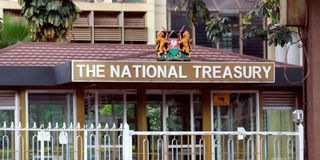
The National Treasury has warned that the country’s budget is operating under mounting fiscal pressures, with projected revenue recording a significant shortfall of Sh162.6 billion as of February 2026, according to documents tabled in the National Assembly.
“The budget pressures are driven by persistent revenue shortfalls and unanticipated expenditure demands,” a document, which the National Treasury presented to the Budget and Appropriations Committee (BAC), reads.
The National Treasury document adds that “this has been attributed to underperformance in ordinary revenue as well as administrative inefficiencies in tax collection.”
This comes as MPs voted to endorse a report of the Budget and Appropriations Committee (BAC) on April 2, 2026, to approve the country’s additional spending for the fiscal year 2025/26, by Sh363.9 billion, less than three months to the end of the fiscal year.
The additional budget effectively escalates the national budget to Sh4.7 trillion, compared to the Sh4.3 trillion approved by the National Assembly in June 2025.
The BAC report notes that the missed revenue target is projected to push the national government’s fiscal deficit in the budget to Sh1.2 trillion from Sh933.3 billion approved in the 2025/26 estimates.
BAC, chaired by Alego Usonga MP Samuel Atandi, notes that “although recent improvements in customs revenue signal a potential recovery, the revenue gap remains a key concern for fiscal sustainability.”
“The committee noted with concern the revenue shortfalls recorded as of February 2026 and emphasized the need to enhance revenue mobilization efforts,” the committee says, and challenged the Kenya Revenue Authority (KRA) to up its game.
“KRA has been adequately resourced to undertake institutional and policy reforms aimed at improving tax administration, sealing revenue leakages, and broadening the tax base” it said.
The BAC report indicates that the deficit financing will be largely driven by net domestic borrowing, which is expected to increase by Sh323.1 billion to hit Sh947.8 billion, with net foreign financing projected to decline by Sh60 billion to Sh227.7 billion.
The committee revealed that by the end of February 2026, total revenue collection, including Appropriation-in-Aid (Ai), was Sh1.98 trillion, compared to the targeted Sh2.14 trillion.
The shortfall was primarily driven by weaker performance in key revenue streams, with income tax underperforming by Sh103.5 billion, Value Added Tax (VAT) by Sh40.5 billion, and excise duty by Sh18.6 billion.
“This revenue gap raises concerns about the sustainability of the proposed expenditure increases,” warns the Atandi-led committee.
Poor revenue mobilization means that the full-year fiscal deficit is likely to exceed 6 percent of GDP, reflecting a deviation from the original fiscal consolidation path.
The widening fiscal deficit is largely attributable to a combination of below-target revenue performance and sustained expenditure pressures by government Ministries, Departments, and Agencies (MDAs).
However, it is not gloom and doom for the country’s fiscal space as the National Treasury projects ordinary revenue to increase by Sh29.7 billion from the Sh2.8 trillion in the approved 2025/26 estimates in the supplementary estimates I.
This modest growth, BAC says, reflects mixed performance across tax heads.
As per the National Treasury projections, import duty is expected to increase by Sh4.1 billion and other tax revenue by Sh56 billion.
The National Treasury Building in Nairobi.
Photo credit: Pool
Conversely, income tax is expected to fall by Sh18 billion due to unpopular policies like the housing levy and other enhanced statutory deductions the government has imposed on payslips, leading to massive job cuts in the private sector.
The excise duty revenue also fell by Sh12.4 billion, even as VAT tax remained unchanged at Sh771.7 billion.
The National Treasury is, however, banking on the fact that “despite these challenges, Kenya's macroeconomic outlook remains relatively resilient.”
The resilience is supported by stable inflation within the target, declining interest rates, improved credit to the private sector, and a strengthened external position, “characterized by stable exchange rates and increased foreign reserves.”
However, significant risks persist, including global geopolitical uncertainties like the US and Israel vs Iran war, climate-related shocks, public debt vulnerabilities, and contingent liabilities from state corporations and Public Private Partnerships (PPPs).
“Sustained fiscal discipline, improved efficiency in public spending, and stronger domestic revenue mobilization will be critical to restoring fiscal stability and safeguarding long-term economic growth,” says the National Treasury.