Parliament holds the key to Kenya’s quest to start commercial production of crude oil after the Ministry of Energy approved Gulf Energy’s commercialisation plan of the Turkana oil project.
Opiyo Wandayi, the Cabinet Secretary for Energy and Petroleum, said that he has cleared the Field Development Plan (FDP) and will forward it to Parliament for ratification, in line with the law.
“I approved the Field Development Plan for the South Lokichar project submitted by Gulf Energy in line with Section 10(j) of the Petroleum Act, 2019,” Mr Wandayi told this publication on Wednesday.
Energy and Petroleum Cabinet Secretary Opiyo Wandayi.
Photo credit: Evans Habil | Nation Media Group
“I will be forwarding the approved FDP to Parliament for ratification. Upon ratification, the contractor will commence project implementation. First oil is expected by December 2026.”
The Petroleum Act requires the CS to submit the plan within 30 days after approval. Lawmakers have 60 days to debate and ratify plan, meaning that an approval of Gulf Energy’s FDP is expected not later than the end of January 2026.
Approval of the plan is critical in allowing Gulf Energy to proceed with the project, boosting Kenya’s dream of exporting the first batch of crude oil for commercial refining by December 2026.
The Petroleum Act 2019 says that the FDP will be deemed to have been ratified if Parliament does not decide within 90 days.
Commercial production of the oil is estimated at 120,000 barrels of oil per day.
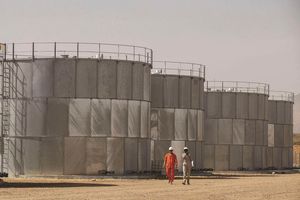
An estimated $3.4 billion (Sh439.5 billion) is needed to build infrastructure such as storage tanks for the crude oil and a pipeline to transport it to the port of Mombasa for export and refining abroad.
British firm Tullow discovered commercially viable oil reserves in blocks 10BA, 10BB and 13T in South Lokichar, Turkana County in 2012.
But rejection of its FDP and failure to get strategic investors for the project delayed Kenya’s oil dream for over a decade. Commercial production was earlier targeted to start in 2020.
The struggles in progressing the project prompted the multinational's local subsidiary Tullow Kenya BV to sell the project to Gulf Energy and end its tumultuous oil venture.
Gulf Energy bought the project in a $120 million (Sh15.5 billion at current exchange rates) deal in September this year.
Mr Wandayi added that the ministry is satisfied by the financial and technical aspects of the FDP that was submitted by Gulf Energy.
It is not clear whether Gulf Energy has inked a deal with a strategic investor or whether the firm will self-fund the project.
Approval of the FDP sets Kenya on course to become the third East African economy after Uganda and South Sudan to commercially export crude oil.
Uganda has set an ambitious target to start commercial production of oil in the Albertine Graben by mid-2026. South Sudan has been exporting crude oil since 2011.