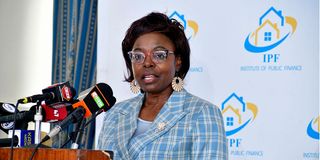
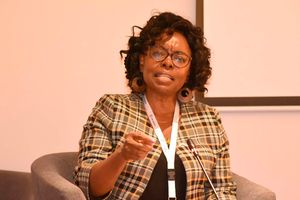
The government risks defaulting on repayment of Sh3.32 trillion external debt due in a year unless sound fiscal consolidation measures are implemented, Controller of Budget Margaret Nyakang’o has warned
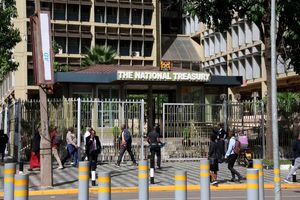
She said proposals to reduce the widening budget deficit and growing public debt through spending cuts and increasing revenue have been ignored by National Treasury mandarins.
Dr Nyakang’o said that high debt servicing obligations will “significantly” constrain fiscal space, limiting the government’s ability to finance development and social programmes — health, education, social protection, and other critical investments.
The Controller of Budget said that the possibility of the government defaulting on its debt obligations has been exacerbated by fiscal deficits. This, she said, has elevated the country’s public debt to a staggering Sh12.3 trillion as of December 31, 2025.
Dr Nyakang’o noted that fiscal deficits have become a moving target due to over-projected revenue collection that has not been met, forcing the government to increase expensive borrowing — largely from the local market — to support budgetary operations.
“The high debt servicing heightens fiscal vulnerability, indicating substantial near-term repayment pressure,” Dr Nyakang’o told the National Assembly Public Debt and Privatization Committee.
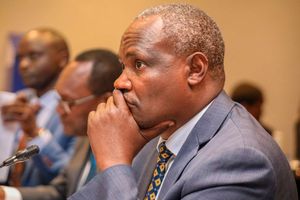
“The skew towards short-term maturities exposes the government to refinancing and rollover risks,” she further told the committee, chaired by Balambala Member of Parliament Abdi Shurie.
She noted that the government has previously defaulted on the repayment of Sh53.6 billion Treasury Bonds by one to two months, raising concerns about its ability to honour debt obligations.
“Bonds with due dates are paid much later,” Dr Nyakang’o said. Continued reliance on borrowing to meet both recurrent and debt obligations puts the country in a debt trap as it raises the risk of a debt spiral, in which new borrowing is required to service existing debt.”
The depreciation of the Kenyan shilling, especially against major foreign currencies like the Sterling Pound and the Euro, as the dollar remains relatively constant, “has further increased the cost of servicing external debt in local currency terms.”
“The rising share of debt service relative to revenue presents a debt sustainability risk, as increasing resources are required to service existing obligations,” the Controller of Budget said.
She also said that the concentration of domestic debt in short-term instruments “creates liquidity and refinancing risks, while reliance on market-based borrowing exposes the government to interest rate risk, particularly in a high-interest environment.”
The short-to medium-term maturity profile of domestic debt and sovereign bonds has also necessitated frequent refinancing, exposing the government to rollover pressures.”
The Sh3.32 trillion debt repayment is part of the Sh5.5 trillion external debt stock due in at least 10 years.
The others include: Sh197.72 billion due in the next two years, Sh7.74 billion due in the next three years, Sh134.03 billion due in the next five years, and Sh393.51 billion due in the next 10 years.
There is also the Sh1.41 trillion, about 26 per cent of the external debt due, that matures in slightly over 10 years.
Dr Nyakang’o said that poor budget planning by the National Treasury, which has seen government Ministries, Departments and Agencies exploit Article 233 of the Constitution, as well as the payment of commitment fees on undrawn loans, puts the country in a difficult position.
Already, the government has requested MPs to approve Sh245.9 billion in additional budget under Article 223 of the Constitution, on top of the Sh4.2 trillion budget approved by the National Assembly in June 2025.
Of the approved additional expenditure, Sh185.8 billion has already been disbursed and is now awaiting the post-facto approval by the National Assembly.
Treasury Cabinet Secretary John Mbadi.
Photo credit: Bonface Bogita | Nation Media Group
The mini estimates approval request presented by National Treasury Cabinet Secretary John Mbadi exceeds the threshold of 10 per cent by 1.1 per cent as provided in the Constitution, raising public finance questions.
Article 223 (5) of the Constitution stipulates that in any particular financial year, the national government may not spend under “this Article” more than 10 per cent of the sum appropriated by Parliament for the financial year unless, in special circumstances, Parliament has approved a higher percentage.
The fiscal indiscipline within government is contrary to section 12 (2) of the Public Finance Management (PFM) Act.
It provides that the National Treasury shall promote transparency, effective management and accountability of public finances in the national government.
“The National Treasury shall ensure proper management and control of, and accounting for the finances of the national government and its entities to promote the efficient and effective use of budgetary resources at the national level,” the PFM Act states.
However, a recent document presented to parliament by Auditor-General Nancy Gathungu shows that the government paid Sh6.6 billion as commitment fees on undrawn loans procured from foreign lenders to finance capital projects, exposing the country’s fiscal discipline.
Auditor-General Nancy Gathungu.
Photo credit: Alex Odhiambo | Nation Media Group
This, as the country continues to experience shortfalls in resource mobilization to finance critical expenditures like releasing capitation amounts in time to public primary, Junior school, secondary school and university education, as well as health facilities for public-funded insurance card holders.
The resource shortfalls have also crowded out other development priorities like infrastructure, as it locks out cheap credit to the local investors.
Of the Sh515.1 billion that was borrowed to finance the 14 capital-intensive projects, Sh304.4 billion had not been spent, raising questions about why the loans were procured.
According to Ms Gathungu, some of the projects were lapsing, posing risks that the projects would end without implementing all the planned activities and “therefore not likely to meet the project objectives.”
“Some of the projects have clauses where they attract commitment fees for any undrawn amounts, leading to wastage of funds and lack of value for money,” said Ms Gathungu.
According to Dr Nyakang’o, the high cost of borrowing, “characterized by peak interest rates on government securities, has significantly raised interest payments.”
The CoB notes that in the first six months of the fiscal year 2025/26, the National Treasury undertook a liability management operation targeting the USD1 billion issued in 2018, due 2028.
Further, the government spent USD657.9 million, about Sh86.2 billion, to buy back USD628.4 million, about Sh82.3 billion, a premium of USD23.57 million or Sh3.1 billion and accrued interest of USD5.89 million, about Sh0.77 billion.
“Overall, the transaction resulted in an additional cost of about ShSh3.86 billion above the principal amount,” says Dr Nyakang’o.