Thousands of intern teachers will have to wait until January 2027 for permanent and pensionable jobs after the government deferred their absorption under the 2026/27 budget, which proposes a record Sh784.5 billion allocation to the education sector.
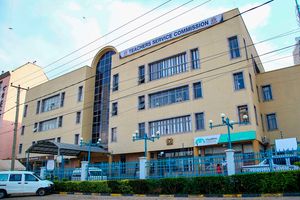
Treasury Cabinet Secretary John Mbadi yesterday unveiled a spending plan that will see the Teachers Service Commission (TSC) receive Sh424 billion, up from Sh290 billion in 2022, making it the single largest allocation within the education sector, while 20,000 intern teachers will be converted to permanent and pensionable terms from January next year.
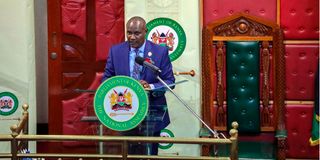
Treasury CS John Mbadi delivers the FY 2026/2027 Budget Highlights at Parliament Buildings, outlining the government's fiscal policy direction and priority spending areas for the coming financial year.
Photo credit: Dennis Onsongo | Nation Media Group
The proposed allocation marks an increase from the Sh702.7 billion set aside for the education sector in the 2025/26 financial year, when the Teachers Service Commission received Sh387.2 billion, including funds for the recruitment of intern teachers.
The budget also provides Sh4.9 billion to convert 20,000 intern teachers to permanent and pensionable terms from January 2027 and Sh8.2 billion for the recruitment of intern teachers to address staffing shortages in schools.
In addition, the 24,000 intern teachers recruited this year will be absorbed into permanent and pensionable employment from July 2027.
“By next year, this government will have employed 116,000 teachers. On average, that is more than 20,000 teachers per year. No previous government has ever employed more than 10,000 teachers per year,” Mr Mbadi said.
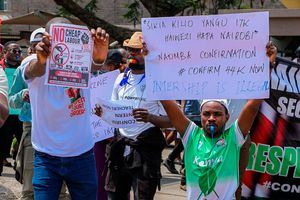
The planned absorption comes amid sustained pressure from teachers' unions and lawmakers, who have been pushing the government to place intern teachers on permanent and pensionable terms.
The commission has in recent years relied on intern teachers to bridge staffing gaps in public schools, particularly following the rollout of Junior Secondary School under the Competency-Based Curriculum (CBC). However, unions have argued that the internship programme leaves teachers on lower pay and without the job security and benefits enjoyed by their permanently employed colleagues.
Mr Mbadi said education remains the single largest recipient of government funding, accounting for 26.4 per cent of total ministerial allocations. The proposed allocation represents a 49 per cent increase from the Sh526 billion allocated to the sector in the 2021/22 financial year.
“In 2021/22, funding for education was Sh526 billion, representing 24.5 per cent of the ministerial budget. In 2026/27, we are proposing Sh784.5 billion, which is 26.4 per cent of the ministerial budget. Therefore, it is not correct that this government is defunding education. In fact, we are funding it more,” Mr Mbadi said.
CS Mbadi reads Sh4.8 trillion election year budget
Basic education will receive Sh136.6 billion, compared with Sh107 billion four years ago, while higher education funding has risen to Sh163.9 billion from Sh105 billion over the same period.
Under the capitation programme, the Treasury has proposed Sh7 billion for Free Primary Education, Sh54.6 billion for Free Day Secondary Education and Sh30.7 billion for Junior Secondary School capitation.
The combined allocation for Free Day Secondary Education and Junior Secondary School capitation stands at Sh92.3 billion. National examinations have been allocated Sh9.9 billion, while the school feeding programme will receive Sh3 billion, up from approximately Sh2.2 billion in 2022.
Technical and Vocational Education and Training (TVET) institutions are set to receive Sh58.5 billion as the government seeks to expand skills training and boost youth employability.
To improve learning facilities, the Treasury has proposed Sh4.1 billion for primary and secondary school infrastructure and Sh2.1 billion for the construction and equipping of TVET centres.
The government has also allocated Sh1.3 billion for science, innovation and research, Sh7.1 billion for the Kenya Primary Education Equity and Learning Programme and Sh4.7 billion for the Kenya Secondary Education Quality Improvement Programme.
University students are among the biggest beneficiaries of the proposed spending plans, with higher education loans receiving Sh56.3 billion, nearly four times the Sh15.39 billion allocated in 2022.
An additional Sh30.9 billion has been allocated for university scholarships, Sh9.2 billion for TVET scholarships and Sh6.7 billion to settle university arrears under the 2021–2025 collective bargaining agreement.
National Treasury and Economic Planning CS John Mbadi pose for a photo with a briefcase containing the 2026/2027 budget statement at Parliament Buildings, Nairobi, on June 11, 2026.
Photo credit: Lucy Wanjiru | Nation Media Group
The allocations come at a time when stakeholders in the education sector have raised concerns over delayed capitation disbursements, funding shortfalls and growing enrolment pressures, particularly in junior secondary schools and public universities.