Hello

Your subscription is almost coming to an end. Don’t miss out on the great content on Nation.Africa

Ready to continue your informative journey with us?

Hello

Your premium access has ended, but the best of Nation.Africa is still within reach. Renew now to unlock exclusive stories and in-depth features.

Reclaim your full access. Click below to renew.

Rik Haanen,
Caption for the landscape image:

Accidental innovation: Fear of theft turned a stationary solar panel into a 'backpack' pump

Scroll down to read the article

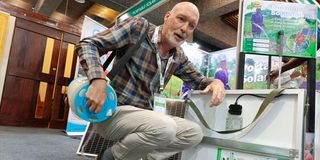
Rik Haanen, CEO of Jacana Foundation and innovator of the portable solar pump, at the Africa Agri Expo in Nairobi, on February 12, 2026.

Photo credit: Sammy Waweru | Nation Media Group

Mr Rik Haanen, the CEO of the Jacana Foundation, has spent years working closely with small-scale entrepreneurs in rural African communities.

He has travelled extensively throughout Zambia, Mozambique, Malawi, Tanzania and Ghana, and most of the entrepreneurs he works with are farmers.
For many of them, one challenge consistently stands in the way of higher yields and better incomes: water.

"Water shortage and the lack of this crucial commodity have proven to be a major challenge," says Mr Haanen.

Africa is a continent plagued by the uncertainties of climate change, with millions going hungry.

Although agriculture is the main source of livelihood on the continent, the dry season often means months of inactivity for farmers who rely on rain-fed agriculture.

From his experience, Mr Haanen has learned that if farmers could irrigate their land during the dry season, they could more than double their production and income. Household food security would also improve significantly.

Six years ago, the Jacana Foundation in Zambia began developing a game-changing innovation: a portable solar pump specifically designed for smallholder farmers.

“We started working on an extremely affordable pump. It should provide enough water, but not be so big that it is too expensive. It should be solar-powered because rural areas in Zambia do not have much power,” he explains.

Rik Haanen, CEO of Jacana Foundation and the brain behind portable solar pump, during the Africa Agri Expo at KICC, Nairobi, on February 12, 2026.

Photo credit: Sammy Waweru | Nation Media Group

According to Haanen, he experimented with several pump models.

The journey, however, was not easy. Some broke down after a year and were discarded. A few survived the rigorous field tests.

Two years later, the foundation began installing the durable, reliable model.

Initially, the solar panel was permanently mounted on a stand at a farmer’s house. However, an unexpected issue reshaped the design.

“One of the farmers came back the next day and said that he didn't want the panel outside at night because he didn't trust his neighbours,” Haanen recalls.

It was the fear of theft that prompted him to redesign the system. He made sure that the panel could be detached and stored safely indoors at night.

The following day, the same farmer returned with another insight: the pump was small and light enough to carry to his field, which was about a kilometre away.

This insight transformed the product entirely. “We made sure the pump could be moved. In the morning, he would carry the pump and panels to his field and grow his tomatoes.”

Within days, other farmers had noticed him transporting the pump to his plot.

Soon, there was a queue outside the Jacana Foundation's office. They wanted the same portable solution that reduced the risk of theft while enabling irrigation wherever needed.

The pump is now designed to mitigate theft. Farmers carry it home in the evening and back to the farm in the morning.

Portability, once an afterthought, has become its greatest strength.

Today, Haanen reveals that nearly 800 farmers use the pump, the majority of whom are in Zambia, with additional users in Mozambique, Malawi, Tanzania and Ghana.

He believes the opportunity extends far beyond Zambia. "There are 33 million small-scale farmers in Southern Africa. If you put them in a line half a metre apart, it would stretch all the way to Cape Town and back. The market does not offer products for them because they are either too expensive or too heavy,” he says.

He identifies a clear market gap between costly, large-scale irrigation systems and fragile, low-quality pumps that do not last.

Solar pumps, he insists, are a necessity in an era of climate change and erratic rainfall, not a luxury.

The unit comes with a foldable 160-watt solar panel and a 100-watt submersible pump.

The pump is housed in a blue cylinder, which also contains the hosepipe and electric cable. The cylinder acts as an external filter, and a second internal filter protects the pump from dirty water.

If the water level is shallow and there is sufficient sunlight, the system can pump up to 25,000 litres of water per day.

With one pump, it can lift water up to 12 metres above the water level. According to Mr Haanen, a double-pump configuration can lift water up to 25 metres.

More importantly, the depth of the water level is more important than the total depth of the well.

“In Zambia, there are six months of the year with no rain at all. Farmers are idle during that period, and food insecurity is a problem. With this pump, however, they can farm in the dry season, when prices are higher, and recoup the cost within one harvest,” he says.

In Kenya, where climate variability is increasingly affecting farmers, the technology is now being introduced through Maji Milele, with distribution beginning in Nairobi.

Mr Marcel Schreurs, the company’s managing director, is spearheading the East African rollout.

"Maji Milele has been in the business of water metering and providing drinking water services. We are now adopting a new product which has been very successful in Zambia,” he says.

Established in 2014, the company has focused primarily on drinking water solutions. However, having witnessed the pump’s success in Zambia, where competing products are reportedly declining in popularity, Mr Schreurs is convinced that it could address irrigation challenges in Kenya and the wider region.

“In Kenya and many other African countries, long dry seasons are common. Even during the rainy season, sometimes you need water, but then suddenly there is no rain for 10 or 15 days. If there are several days without rain, your harvest can be ruined,” he explains.

The portable solar pump was a key feature of this year's Africa Agri Expo at the Kenyatta International Convention Centre (KICC) in Nairobi, attracting farmers keen to explore solar and green energy solutions.

The ninth edition of the event, held from 11 to 12 February 2026, was themed “Driving Africa’s Agri-Food and Livestock Transformation through Innovation, Technology, Investment & Sustainability”.

The design of the portable solar pump offers flexibility. A farmer who finishes irrigating early can rent it out to a neighbour, creating an additional income stream.

The submersible system is fitted with dual filtration systems to prevent clogging from brown or dirty water.

According to innovator Haanen, setting it up takes about two minutes. In the evening, it can be dismantled and safely stored at home, which is an intentional feature designed to mitigate theft, a problem which often discourages farmers from investing in irrigation equipment.

A single-pump unit retails at Sh47,900, while a double-pump configuration costs around Sh85,000.

In an interview with Seeds of Gold, Mr Schreurs, the development partner, stated that Maji Milele is exploring flexible payment models, such as partnerships with financial institutions under the Lipa Mdogo Mdogo scheme, to improve affordability.

Follow our WhatsApp channel for breaking news updates and more stories like this.