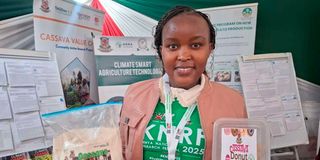
When four postgraduate students at Egerton University came together last year, they did not just want to grow cassava; they wanted to transform it.
What began as a simple demonstration farm project has since blossomed into an ambitious cassava value addition enterprise.
Abigael Chepchumba, a Masters of Science student in Agri-Enterprise Development, says the idea was born out of curiosity and a desire to reimagine cassava beyond its traditional uses.
The group, made up of five classmates—Ms Chepchumba, Joram Kariuki, Sata Barbara, Dennis Odero and Mercy Kanyagia—opted to focus on two high-yielding varieties: KME1 and Tajirika.
Some of the products made from cassava flour by Abigael Chepchumba and her colleagues.
Photo credit: Bonface Bogita | Nation
The varieties are hardy and adaptable, particularly in arid and semi-arid areas. And while Nakuru’s heavy rainfall is not ideal, the team grows cassava in Baringo and at Egerton’s Mpeketoni campus in Kilifi, where the crop thrives.
“We chose cassava because it is often referred to as an orphan crop. Many people do not grow it, yet it has huge potential. For instance, on just one acre, you can harvest up to 50 tonnes of cassava, far more than maize. Cassava is highly adaptable to dry regions,” Ms Chepchumba says.
After harvesting, the cassava roots are peeled, cut into small pieces, and sun-dried for five to ten days depending on the climate. The dried pieces are then ground into flour, which is the base of their innovation.
From the flour, the team creates a variety of products including vanilla and chocolate cakes, mandazi, doughnuts, and crisps.
She says that to enhance the texture of Mandazi and doughnuts, they blend cassava flour with wheat, but she is quick to note that they always use more cassava in the mixture – 80 percent.
“Our cassava cakes are gluten-free, which makes them healthier than wheat-based cakes. We also make crisps that are more nutritious because cassava farming requires fewer chemicals than potatoes,” Ms Chepchumba adds.
Abigael Chepchumba displays products made from cassava flour and donuts at her stand during the Kenya National Research Festival 2025 held at Egerton University.
Photo credit: Bonface Bogita | Nation
Despite their enthusiasm, the journey has not been without challenges with consumer acceptance topping the list.
Unlike maize, cassava takes about seven months to mature, slowing down production cycles, but the group remains optimistic that steady planting schedules will address the gap.
Currently, the products are not yet available in the market as the group is still in the process of securing certification from the Kenya Bureau of Standards.
However, the product is available within the school.
“Many people still associate cassava with cyanide content, so they are hesitant to consume cassava-based foods. We spend a lot of time sensitising people about its nutritional value. Cassava products are safe, nutritious, and versatile. By the end of the year, we are confident that our products will be on the shelves,” she says.
“With value addition, we want to show people that cassava can give you many products, not just boiled roots. It has the potential to boost food security and nutrition in Kenya.”
A few metres from Ms Chepchumba, we meet Ms Jackline Syombua, a student at the institution pursuing Masters in soil science showcasing her potato value chain. She started her project in May, making mandazi out of potato flour.
She kicks off by saying that once the potatoes are harvested, she peels, cleans and dries them, which takes up to three days. She then grinds them to produce flour.
Jackline Syombua displays mandazi made from potato flour at her stand during the Kenya National Research Festival 2025 held at Egerton University 18, 2025.
Photo credit: Bonface Bogita | Nation
“Wheat flour is popular in the market but we are advocating for potato flour to diversify. Because students are curious, they want to taste mandazi made from potatoes; they are finding it unique,” she says.
The two students were among exhibitors at the Kenya National Research Festivals 2025 held at Egerton University whose theme was “Sustainable Agriculture and Food security”. The festival was co-hosted by the National Research Fund, Egerton University, and the county government of Nakuru.
Phyllis Njane, secretary for research, Ministry of Agriculture and Livestock Development, said that advancement of agriculture, food security and rural livelihoods globally depends on sustained investment in science, innovation and institutional collaboration.
Agriculture CS Mutahi Kagwe acknowledged research as a cornerstone of national transformation and the government is expanding regional centres of excellence that reflect Kenya's diverse agricultural zones.
“Research must be recognised and treated as strategic national investment this means securing consistent public funding, leveraging blended finance models and fostering partnership with the private sector,” he said.