At the southern edge of the Mau Forest, where the air remains cold long after sunrise and mist hangs low, lies Mau Narok, one of Kenya’s most productive vegetable regions.
Here, farming is not just a way of life, it is the lifeblood of the community.
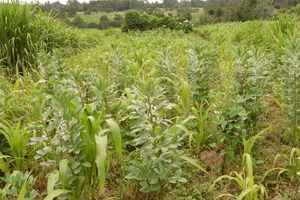
The region’s rich volcanic soils and constant water supply make it ideal for year-round cultivation, attracting thousands of small-scale farmers who rely on the land for their livelihoods.
Among the many crops grown in Mau Narok, carrots stand out. Farmers say the crop offers better returns than most vegetables, matures quickly, and can be planted several times a year.
As water is plentiful, fed by streams and run-off from the Mau Forest, carrots thrive even when other regions are experiencing dry spells.
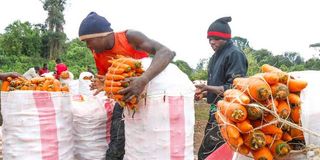
Labourers wash carrots before packing them in sacks in Nessuit, Njoro Sub-County on August 21, 2025. However, brokers and buyers who export the produce to Uganda, continue to exploit farmers by violating the 50 kg packaging regulation.
Photo credit: Boniface Mwangi| Nation Media Group
Consequently, carrot farming has become one of the area’s largest employers, attracting labourers from as far afield as western Kenya and the Nyanza region.
However, behind the neat market bundles and the fresh orange glow seen in wholesale depots lies a demanding process that is often overlooked — one that is carried out almost entirely by women.
In Mau Narok, women form the backbone of the carrot value chain. They harvest, sort, wash and pack the produce before it enters the market system. The washing stage is the most arduous. Carrots arrive from the farms covered in thick layers of mud and clumped together like stones pulled from a riverbed.
“Carrots don’t leave the field looking like something you’d buy,” says one worker.
"We turn them into something customers want." Washing takes place in makeshift open-air stations, usually in shallow pits or on earthen platforms next to water pans that have been dug specifically for this purpose.
The water is icy, reflecting the cold climate that defines Mau Narok almost year-round. To shield themselves from the cold, the women stitch together makeshift outfits from polythene sheets that cover them from neck to toe. Even so, the cold seeps in.
Labourers wash and pack carrots in sacks in Nessuit, Njoro Sub-County on August 21, 2025. Carrots arrive from the farms covered in thick layers of mud.
Photo credit: Boniface Mwangi| Nation Media Group
Before dawn, groups of young men arrive to collect water from the nearby ponds. Armed with buckets and wearing gumboots, they carry the water and splash it over the muddy piles of carrots.
The women follow, scrubbing with their bare hands and bending over piles that never seem to shrink for hours on end. The work is fast-paced, repetitive and hard on the body.
Everyone — men and women alike — is hit by water splashes, leaving them soaked within minutes. In the biting cold of Mau Narok, wet clothes become heavy and hands go numb quickly.
"This work is not for the faint-hearted," remarks another worker. "You need strength and courage. But it’s how we feed our children.”
Constant exposure to cold water puts many workers at risk of pneumonia and other cold-related illnesses. Health workers in the region frequently warn that working in the wet and cold for long hours is hazardous. Yet for many families, this labour is their only source of income.
"There is no choice," says a mother of four who washes carrots daily. "If we stay home, there is no food."
Despite the harsh conditions, it is the resilience of the workers that keeps the wheels of Mau Narok’s farming economy turning. Their labour ensures that, by the time they reach supermarkets, wholesale markets or export destinations, the carrots are spotless, sorted and ready for sale.
Labourers pack carrots in sacks in Nessuit, Njoro Sub-County after washing them in a river on August 21, 2025.
Photo credit: Boniface Mwangi| Nation Media Group
After washing, the carrots are packed into heavy nylon sacks, each weighing 110 kg, before being loaded onto trucks. Some are sold in Kenyan towns such as Nakuru, Nairobi, Eldoret and Kisumu.
Others are exported to neighbouring countries, particularly Uganda and Rwanda, where carrots do not grow as well. Producers, aided by brokers, always ensure that prices remain stable or increase depending on demand.
Currently, the wholesale price for a kilogram of carrots is around Sh30, while a 110 kg sack ranges from Sh3,000 to Sh3,300.
Prices dip slightly during the festive season, but are expected to surge to between Sh4,500 and Sh5,000 per 110 kg sack as demand increases.
Every sack that crosses the border is testament to the hard work of the Mau Narok women — the quiet, relentless workforce behind one of the region's most important agricultural exports.
Although the work is arduous, carrot washing provides a reliable income in an area where alternative employment opportunities are scarce.
The combination of fertile land, consistent rainfall and high demand for vegetables ensures a constant supply of carrots — and with it, constant work.
However, the workers say they want better conditions: sheltered washing stations, protective clothing and fairer wages. Some local cooperatives and farming groups have begun discussing ways to improve working environments, though progress remains slow.
For now, the women of Mau Narok continue to brave cold dawns, muddy heaps, and icy water, shaping the carrots that feed families far beyond their own and underpinning one of Kenya’s quietest yet most vital export economies.