The market for agricultural drones is expected to grow in the coming years. As the world feeds a growing population, there is a growing need for improved productivity, efficient use of resources, and resilience to climate shocks — thus enabling precision farming. ‘Seeds of Gold’ spoke to Velma Wekesa, a Steward Officer under the Product Stewardship Department at AAK GROW, on how drone technology is transforming agriculture.
How are drones transforming modern agricultural practices today?
Drones are increasingly becoming part of modern agricultural practices. This initiative falls under precision agriculture, which incorporates diverse technologies to ensure farmers maximize yields while considering environmental sustainability. Drone technology enables farmers to accurately identify pests and diseases, detect nutritional deficiencies in crops, and apply the right amounts of pest control products and fertilizers effectively and efficiently.
Through the mapping capabilities of drones, farmers do not need to spray entire sections of their farms, unlike traditional scouting methods that often lead to blanket application. Drones are extensively used in farming for tasks such as plant health mapping, seed sowing, livestock monitoring and field topography mapping.
Beyond pesticide spraying, which other agricultural services can be offered by drones?
Drones can be used to monitor crop status in terms of nutritional needs, as well as scout for pests and diseases on farms.
Kenya’s agricultural landscape consists of large-scale, medium-, and smallholder farmers. Currently, drone uptake has been largely embraced by large- and medium-scale farmers and usually used for spraying crops such as maize. Through the support of the Sustainable Pest Management Framework (SPMF) project, supported by CropLife International, we have been conducting extensive awareness programmes highlighting the advantages of drone technology, particularly targeting smallholder farmers.
Gradually, these farmers are embracing the innovation, with projections showing further scale-up in the next three to five years to come. The technology reduces exposure risks because when a farmer hires drone services, they are not directly involved in mixing or applying pest control products; the licensed drone operator handles the entire process. This ensures farmers do not come into direct contact with pesticides.
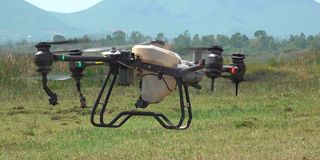
A drone being used in spraying herbicides for demonstration at Kital area in Rachuonyo North in Homa Bay County on December 16, 2025.
Photo credit: George Odiwour | Nation Media Group
Most farmers who feed the nation still rely on conventional farming methods, with some taking longer to transition to modern agriculture.
The global drone market is experiencing rapid adoption, driven by expanding applications across commercial sectors, including agriculture. Two to three years ago, the global adoption rate stood at 38 per cent, and by this year this figure is expected to be much higher, reshaping farming practices worldwide.
In China for instance, drones are used for over 30 per cent of crop protection spraying, especially in rice paddies and orchards, supported by government subsidies and favourable regulations.
Setting cost aside, what is required for a farmer to own and operate a drone?
The Kenya Civil Aviation Authority (KCAA) is the primary regulator overseeing drone operations in the country. It enforces the Civil Aviation (Unmanned Aircraft Systems) Regulations, 2020, which govern drone registration, licensing, flight permissions, and airspace management. A farmer interested in owning a drone must undergo a complex, costly, and lengthy process.
They must first be vetted by KCAA, undergo approved training on drone operation, and purchase the drone from a KCAA-approved and licensed reseller. After training, the farmer is issued with a drone operating licence before acquiring the device.
In my opinion, rather than going through this tedious process, farmers are encouraged to seek services from licensed and certified drone service providers. This approach is easier and more cost-effective unless the farmer intends to venture into drone service provision.
Which channels are you using to reach farmers interested in drone technology, and what milestones have you achieved?
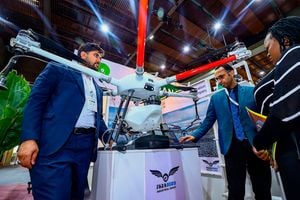
AAK GROW, in partnership with key stakeholders, conducts awareness creation programmes through field days. Partners include Egerton University, the Pest Control Products Board (PCPB), the Ministry of Agriculture and Livestock Development, and Fahari Aviation, a licensed drone service provider.These initiatives embed innovation awareness in farmer and student field days.
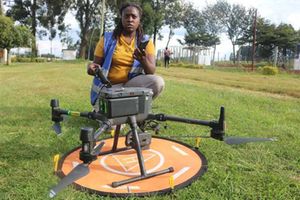
Velma Wekesa a steward officer at AAK-GROW during an interview in Nairobi on January 27, 2026.
Photo credit: Richard Maosi | Nation Media Group
One key milestone achieved with Egerton University is the training of drone pilots. We sponsored two individuals who were previously offering conventional spraying services. They underwent a drone piloting programme conducted in November last year.
One of our departmental agendas is to influence positive farmer behaviour change. This led to the launch of Stewardship Mashinani, a programme aimed at promoting responsible agricultural practices by incorporating young learners.
Last year, we partnered with Egerton University and selected schools through 4K Clubs, whose primary objective is to integrate innovation into agriculture and help learners understand how the sector continues to evolve.
This year, through our Memorandum of Understanding (MOU ) with Fahari Aviation, we plan to introduce drone technology as part of agricultural learning. In the long term, we aim to influence curriculum development to integrate drone technology into agriculture as a subject.
One major challenge is regulatory complexity. Drone operations are regulated by KCAA, while the Pest Control Products Board (PCPB) also plays a role under the PCPB Act CAP 346. This results in multiple licensing requirements, fees, and charges. Currently, stakeholders are working on developing clear guidelines for drone application of pesticides. Which means that a harmonised regulatory framework is necessary to streamline agricultural drone operations.