Salgaa trading centre is one of the most enchanting destinations for travellers. Situated in Rongai sub-county, it lies along the busy Nakuru-Eldoret highway.
The area has a history of incidents, but is now transforming into a commercial hub for trade, agriculture and industrialisation.
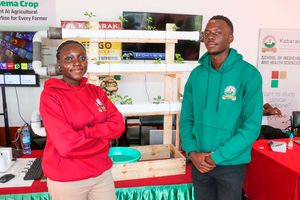
Here, we meet members of the Jua Farm Umoja Youth Group, who are putting the finishing touches to a modern hydroponic facility in preparation for the planting season, which starts in a few weeks.
Sila Ooko, the director, founder and lead innovator of the initiative, says that the project began in October 2025 to empower local young people seeking job opportunities in an already saturated employment market.
“The programme also sought to empower young people in terms of skills and knowledge, so that many of them would see agriculture as a dignified and profitable career,” he says.
He adds that this was in response to the realisation that, although Nakuru is considered to be one of the country's main food-producing counties, its soils have been heavily degraded.
Therefore, food production has decreased due to factors such as the high cost of farm inputs, land, and climate change.
"Initially, they started with a vegetable drying project, and out of curiosity, the members began to discuss how to improve the model by integrating dehydration technologies and storage innovations to increase efficiency, quality and versatility," he says.
Sila Ooko the Director Founder and lead innovator of Jua Farm Umoja Youth Group in Salgaa in Nakuru County on January 13, 2026.
Photo credit: Richard Maosi | Nation Media Group
Additionally, the system is ideal for crops with short growth cycles, such as collard greens, spinach, strawberries, tomatoes, and capsicum.
To set up the project, they needed a layout for the structure, encompassing shelving and a growing medium to support the plant roots.
They also required a balanced hydroponic nutrient solution and a storage tank for water, which is distributed through a drip irrigation system that is highly recommended for this type of setup.
Faster growth and abundant yield
Other necessities included a water source and reservoir, an aeration structure, seeds, and tools for measuring temperatures in the greenhouse to maintain optimal growth conditions.
According to Sila, this modern technology is funded by the European Union (EU) and implemented by the Integrated and Circular Technologies for Sustainable City Region Food Systems in Africa (INCiTiS-FOOD) project.
He adds that this technology has advanced significantly in terms of sustainability, conservation and resilience. Furthermore, hydroponics enables agriculture in nutrient-rich water without the use of soil.
"Instead of soil, porous volcanic rock pellets called pumice are widely used due to their excellent drainage, aeration and moisture retention properties," he adds.
To achieve faster growth and a more abundant yield, coco peat is used as a growing medium. It holds water, ensuring consistent hydration for plant roots while allowing excess water to drain, which prevents root rot and maintains soil pH.
This medium supports healthy root development by maintaining aerobic conditions while gradually releasing water and nutrients.
Currently, the Jua Farm Umoja Youth Group consists of more than 30 young people from the Rongai sub-county in Nakuru.
According to the agripreneur, the struggle to run a viable agricultural enterprise has been caused by extreme weather conditions fuelled by climate change.
Despite the numerous challenges, the group has so far established more than 10 greenhouses, including one at Rongai Teachers College in Nakuru, with the aim of becoming self-sufficient and producing high-quality crops free from harmful pesticides.
"We also produce a modern learning centre for students in order to produce quality vegetables for healthier future generations,' he adds.
Meshack Kemboi, one of the beneficiaries of the group, says that one of the notable advantages of the technology is that crops thrive in microclimate conditions and are therefore not affected by drought.
Production of healthy food
He notes that this impacts crop selection and management at different growth and development stages.
They also maintain the nutrient solution within the ideal temperature range, so production is not reliant on the seasons and can be easily predicted.
Additionally, the plants produced have high yields, thus increasing the food supply.
Prof Arnold Opiyo, from the Faculty of Agriculture at Egerton University, adds that this technology enables the production of healthy food using natural products.
It is also possible to control soil-borne diseases caused by pathogens such as fungi, bacteria, nematodes and viruses found in soils.
"Soilless medium agriculture is going to be a game changer because through it, we are going to minimise waste and undertake good agricultural practices that are market- and labour-oriented," he adds.