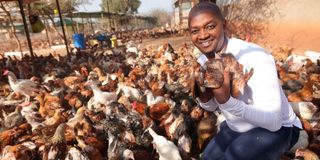
The first thing to greet a visitor to Nick Mwendwa’s farm in Makindu, Makueni County, a few kilometres off the Nairobi–Mombasa Highway, is not silence, but the chorus of thousands of indigenous chickens.
Every corner of the farm pulses with life, from the brooder houses filled with day-old chicks singing beneath carefully regulated warmth to the spacious poultry houses where mature hens scratch the ground before returning to their nesting areas.
Workers move methodically from one section to another, collecting eggs, refilling feeders, and monitoring the birds.
Meanwhile, incubators buzz continuously, nurturing the next generation of chicks.
Spread across 100 acres, the farm, which has utilised only 10 acres, is home to over 150,000 pure indigenous chickens at various stages of growth.
The former Football Kenya Federation (FKF) president says that around 2,500 fertilised eggs are collected and placed in incubators every day.
Former FKF President Nick Mwendwa collects eggs at his Salukya Farms in Ngosini East, Makueni County on July 3, 2026.
Photo credit: Evans Habil | Nation Media Group
“Twenty-one days later, chicks emerge, adding to a breeding programme that I believe will eventually restore genuine kienyeji chickens to Kenyan homes,” he says.
It is hard to believe that this thriving enterprise started with just seven chickens belonging to his mother.
“I simply separated the seven birds and instructed the workers that from that day onwards, we would only breed from them,” Mwendwa recalls.
At the time, even his ambitions sounded unrealistic. His initial goal was to grow the flock to between 7,000 and 15,000 birds.
“My mother laughed. She said that nobody in Kenya had 5,000 pure indigenous chickens. She asked me how I thought I would reach 15,000,”he says with a smile.
Former FKF President Nick Mwendwa at an egg incubator at his Salukya Farms where he rears poultry in Ngosini East, Makueni County on July 3, 2026.
Photo credit: Evans Habil | Nation Media Group
The scepticism did not end there. After realising that the market opportunity was much bigger than he had initially imagined, Mr Mwendwa abandoned the target of producing 15,000 birds altogether. Instead, he told his farm manager that they should aim to produce one million birds.
“My father happened to overhear the conversation. He simply said Nairobi had made me mad,” Mwendwa recalls with a laugh. It came with a lesson.
Although many Kenyans still associate him with football, particularly his time as head of the FKF, Mwendwa insists that football has never defined his career.
“First and foremost, I am an entrepreneur. I build businesses. I did football for leadership and service because I love the game. It was never my business,” he says.
His entrepreneurial journey stretches back nearly two decades. Seventeen years ago, he founded Riverbank Solutions, a financial technology company that specialises in payment systems for banks. Since then, the company has grown to become one of Kenya’s leading fintech firms. KCB acquired a 75 per cent stake, while Mwendwa retained 25 per cent and continues to serve as CEO.
Apart from Riverbank Solutions, he founded the community football project Kariobangi Sharks and has invested in several other ventures.
He says that his expertise lies in fintech, software development, artificial intelligence (AI), payment systems, virtual assets and cryptocurrency.
Agriculture was never part of the original plan. However, a frustrating shopping experience three years ago changed everything.
Former FKF President Nick Mwendwa at Azolla farm at his Salukya Farms where he rears poultry in Ngosini East, Makueni County on July 3, 2026.
Photo credit: Evans Habil | Nation Media Group
“I don't eat broiler chicken. I only eat indigenous chicken. Whenever I visited major supermarkets, I could never find genuine kienyeji chicken or eggs.”
Out of curiosity, he started asking questions. The more he investigated, the more surprising the answers became.
Supermarkets desperately wanted authentic indigenous chicken, but they could not find consistent suppliers. Farmers would deliver for a few weeks before running out of stock, as few of them had enough birds to sustain a regular supply.
Mwendwa also realised that many farmers had abandoned pure indigenous chickens in favour of improved kienyeji breeds that were promoted for their faster growth and higher egg production rates. However, consumers still preferred the taste of traditional indigenous chicken.
“I realised there was a huge gap in the market,” he says. His research took him to markets across Ukambani, where brokers would wait on market days to buy every indigenous bird brought by smallholder farmers, before transporting them to Nairobi.
He confirmed that demand far outstripped supply. Despite identifying the opportunity, he knew almost nothing about poultry farming.
Newly hatched chicks are kept in a brooder house under heat lamps at Salukya Farms in Ngosini East, Makueni County on July 3, 2026
Photo credit: Evans Habil | Nation Media Group
“I didn’t even know what an incubator looked like,” he admits.
Initially, he assumed that hens would naturally hatch every fertilised egg. Reality proved otherwise.
One day, he had nearly 450 eggs, but the hens abandoned them, forcing him to buy his first incubator.
The first hatch was disappointing, with only about 41 per cent of the eggs hatching successfully.
Rather than giving up, Mwendwa approached the challenge in the same way that he builds technology companies.
Chicken at Salukya Farms in Ngosini East, Makueni County on July 3, 2026.
Photo credit: Evans Habil | Nation Media Group
He studied, researched and experimented. “I believe every entrepreneur must become the most knowledgeable person in their chosen business.”
Artificial intelligence became one of his unexpected teachers. After taking photographs of his incubators, he uploaded them for analysis by the AI software. The software identified design flaws, such as poor ventilation and incorrect tray arrangements.
“We made those changes and improved hatch rates from about 61 per cent to 81 per cent,” he says.
Technology has also transformed feeding operations. According to Mwendwa, feed quickly became the farm’s biggest expense, prompting him to use technology to formulate his own feed.
Initially, he knew little about poultry nutrition. “We analysed commercial feeds, hired consultants, researched formulations and even used AI to understand different ingredients.”
Today, the farm manufactures its own feed, operating a modern feed-processing plant and constructing another. Raw materials such as maize and soybeans are purchased in bulk and then mixed on-site using specialised machinery. He says the savings have been substantial, reducing feed costs by more than 60 per cent.
The farm, which is located in Kalii, Makindu, has also discovered the value of Azolla, a protein-rich floating aquatic plant.
A brooder house at Salukya Farms in Ngosini East, Makueni County on July 3, 2026.
Photo credit: Evans Habil | Nation Media Group
“Initially, the birds consumed nearly 40,000 cabbages within two days,” Mwendwa tells Seeds of Gold.
However, Azolla proved to be a far more sustainable source of green feed, significantly lowering protein costs.
Despite careful planning, mistakes have been unavoidable. One such mistake was a wrongly formulated feed additive that killed around 500 chicks.
"At first, we thought it was a nutritional problem, only to discover that it is common behaviour in large flocks."
Power outages also threatened production. An eight-hour blackout nearly disrupted the incubation process, prompting Mwendwa to invest heavily in solar energy, which now meets most of the farm’s electricity needs.
Unlike many poultry farmers who are eager to sell their birds immediately, the former FKF boss has deliberately delayed the start of commercial production.
Apart from disposing of a few aggressive cockerels, almost all of the birds remain on the farm. His reasoning is straightforward: “Take Naivas, for instance. If each of their 110+ outlets requires just 100 indigenous chickens every week, that translates to about 11,000 birds every week. Carrefour would also require thousands of birds.”
Nick Mwendwa at a chicken feeds processing plant at his Salukya Farms on July 3, 2026.
Photo credit: Evans Habil | Nation Media Group
Despite having over 150,000 birds, he says he cannot currently guarantee such volumes without strengthening the breeding programme. His immediate target is to grow the flock to 400,000 birds by December.
At that stage, he expects to have around 200,000 laying hens, which will support sustainable commercial production while allowing for future expansion.
Maintaining genetic purity remains his greatest priority. Since launching the breeding programme, he has refused to introduce birds from outside.
“I don’t want contamination from improved breeds,” he told Seeds of Gold during an interview at his farm.
Although this has slowed expansion, he believes that authenticity will remain his greatest competitive advantage.
His business strategy also relies heavily on vertical integration. Rather than depending on suppliers, the farm is increasingly taking control of every stage of production, from manufacturing feed and managing water systems to assembling its own incubators.
This rapid growth has also created employment opportunities. The farm now employs 54 permanent workers, including 17 who work the night shift because young chicks require round-the-clock care.
Mwendwa says his biggest lesson has been the importance of resilience. “Start-ups are about solving one problem after another.”
He believes that many entrepreneurs fail because they become overwhelmed by long-term goals instead of focusing on making daily progress.
His advice to aspiring poultry farmers is to start small. He says that someone with about Sh500,000 should avoid buying land and instead use any available family property. They should start with around 500 chicks, build simple housing, create affordable feed and grow Azolla, gradually expanding as they go.