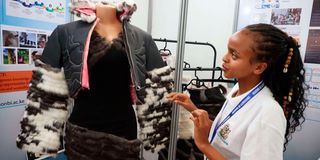
Soft, warm and covered with fine fur, garments displayed by a young innovator at this year’s Nairobi International Trade Fair stand out for an unusual reason: they are partly made from rabbit skins that would otherwise have been discarded.
A jacket, for instance, carries a price tag of Sh50,000, while other pieces in the collection range from Sh18,000 to Sh30,000, depending on the amount of fur, length, labour and materials used.
Behind the unusual fashion pieces is 23-year-old Sharon Mwangi, a fashion designer and recent University of Nairobi graduate who is exploring how rabbit skins can be turned into high-value textiles while reviving traditional Agikuyu hide-processing knowledge.
Sharon, who studied design with a major in fashion design, developed the idea as her final-year practice-based research project. She worked alongside her grandmother, an Agikuyu elder, to assess whether traditional hide and skin processing techniques could be adapted for sustainable rabbit textile production in Kenya.
Her interest in rabbit skins began in 2025 after a family event where a rabbit was slaughtered and prepared using a barbecue (BBQ) method. However, Sharon was struck by the quality of its fur, only to see the skin thrown to a dog. “I thought, ‘Are you serious?’” recalls the Gen Z who holds a Bachelor of Arts (Design).
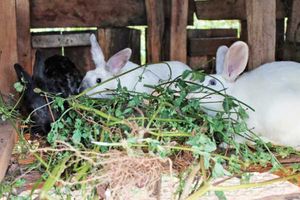
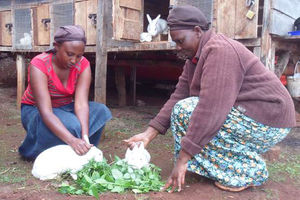
The incident made her question why a material with potential value was being discarded. She also saw an opportunity in the growing rabbit meat industry, where the skin is generally treated as a waste product.
To establish the size of the gap, she contacted 30 rabbit meat suppliers in Nairobi. Only one was doing something with the skins, while the rest were disposing of them. She eventually obtained skins from three suppliers who agreed to support her research.
Her idea also emerged from concerns around conventional leather processing. In an interview during the 2026 Nairobi International Trade Fair, organised by the Agricultural Society of Kenya (ASK) at the Jamhuri Showgrounds in Nairobi, Ms Sharon told ‘Seeds of Gold’ that she wanted to explore an alternative to lead-chromium tanning used in the leather industry, particularly because of its potential environmental impacts.
Her search for an alternative led her back to traditional knowledge. She approached her grandmother, asking how hides and skins were processed in the past and what materials communities used for clothing.
Her grandmother explained how cow and goat hides were processed, along with buffalo and antelope skins obtained through hunting. The two then worked together to adapt some of the traditional techniques to rabbit skins.
Sharon Mwangi displays clothes made from rabbit skins at the University of Nairobi stall at Jamhuri Park Showground in Nairobi on September 30, 2026, during the Nairobi International Trade Fair.
Photo credit: Sila Kiplagat | Nation Media Group
“I experimented with different methods, including a mechanical process involving drying, softening, oiling and removing the membrane from the skin,” she shares. She also tested an acacia-based solution, using branches from trees that grow widely in central Kenya.
She says the plant-based tanning method is an area she wants to investigate further because it could provide an alternative approach to processing skins.
The garments on display at ASK, however, are not made entirely from rabbit skins. Because of the small size of rabbits and the limited time available for her final-year project, Ms Sharon had to combine the skins with other materials.
She used pleather (an artificial, plastic-based fabric made to look and feel like genuine leather) for some sections and 100 per cent cotton, which she dyed herself, for the linings. The pleather was sourced from Kariokor Market, Nairobi, she reveals.
The production process is labour-intensive. Sharon says it took her about one-and-a-half weeks to process the skins for her first batch, followed by several more days to make each garment. “In total, producing one piece can take about two weeks,” she estimates.
The garments are fully handmade, with Sharon doing the stitching and quilting herself. She also dyes the cotton lining used inside the clothes.
The amount of rabbit fur used and the complexity of each garment determine the selling price. A coat with less fur is priced at Sh18,000, while another piece goes for Sh25,000. A longer garment costs Sh30,000, while the jacket, which carries more fur, is priced at Sh50,000.
Sharon says the prices could change depending on the materials requested by customers. For example, using genuine leather instead of pleather would increase production costs.
Her initial collection was designed for women, but she has also received interest from male customers. “One man suggested combining the rabbit fur with denim, an idea that could be explored as I develop the concept,” said the youthful designer.
The target market, she said, is therefore not restricted to one category of customer. Her designs can be adapted into different garments depending on consumer preferences and available production equipment.
For now, she is trying to scale the garments commercially as she continues with research to refine the processing technique. She sees community involvement as central to any future commercialisation. Instead of keeping the skill to herself, she wants to train young people and others without reliable sources of income to process rabbit skins. “I believe this could create an ecosystem in which farmers earn from skins that would otherwise be discarded, while artisans and designers gain access to locally produced material,” Sharon explains.
“This is a handicraft; it is not something that can just be done industrially, at least not with this method. It is something that is done by hand,” she adds.
Acacia-based tanning solutions
However, for the concept to grow, Sharon says more scientific research is needed, particularly to establish the appropriate concentration of acacia-based tanning solutions.
She believes improving the efficiency of the process could reduce the time and cost involved, making it easier to train more people and eventually increase production.
Her research journey was not without setbacks. Obtaining quality skins was one of the biggest challenges. Some skins arrived with cuts and tears, while others had been poorly removed from the rabbits, leaving large portions unusable.
At one point, she received an entire batch that had been damaged by maggots because it had taken too long to reach her. “I remember paying for a kilogramme of skins, and I could only use half of it because the other half was butchered poorly,” she recalls.
The size and condition of the rabbit also affect the quality of the final material. Sharon says how the animal is kept and how it is skinned can determine whether the skin can be used for clothing.
Financial constraints are another challenge as she seeks to undertake more research and improve the processing method.
She says her research began in September 2025 and continued until March this year. She then started designing the collection, completing the garments in June.
Her motivation goes beyond fashion. She wants to revive knowledge held by older generations while giving it a place in modern enterprise. “We should talk to our grandmothers and elders more. They actually have very interesting stories, and there is a wealth of knowledge stored in our culture,” she says.
She also hopes to preserve traditional African cultural practices rooted in sustainable ways of living, long before sustainability became a widely used term. “Sustainability was not a word that existed in traditional African society because everything we did was sustainable,” she says.
Sharon is planning to pursue a master’s degree in fabric production, explaining that her interest extends beyond rabbit skins. In the longer term, she wants to establish an organisation or cooperative where people can learn the skill, earn an income and pass the knowledge to future generations.