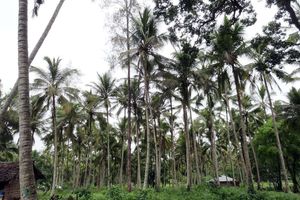
Under the breeze of Hongwe, Francis Njeru Chege, one of the longest-serving councillor in Lamu, walks briskly through rows of coconut trees.
Having served as Hongwe councillor for more than three decades, Chege hung up political boots in 2012, trading council chambers and endless campaign trails for the rustle of palm fronds.
The 74-year-old says public service was more about prestige and community duty, not necessarily for financial reward. His monthly allowance was Sh3,000.
“Councillor Chege”, as he is known in Hongwe, enjoys a stress-free retirement that pays far more than politics did.
“Instead of strenuous morning rallies, my day starts with a cup of tea. I then go to my 30 acres to check on the hybrid palms and supervise harvesting,” Chege says.
He started growing coconuts in 1975 on a small scale, before getting into politics in 1979. Chege was a councillor for seven consecutive terms.
He makes money from every part of the coconut tree; selling madafu to hotels, fruits to traders at municipal markets and dried copra to oil processors in Mombasa, Nairobi and Kampala, Uganda.
Kilifi's green gold: How an accountant-turned-farmer's hybrid coconut venture is boosting profits.
Photo credit: Kalume Kazungu | Nation
He also produces and sells husks for coir fibre. The sturdy central midribs or stems stripped from the leaflets are bound together to make brooms.
Chege considers himself an achiever, being among the few farmers in Lamu with a big number of coconut trees.
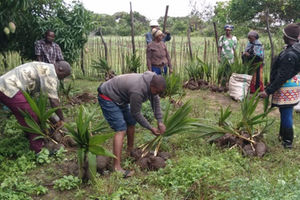
With more than 2,000 mature coconut trees, locals and young farmers regularly stop by the farm to learn modern grafting techniques and organic pest control.
“Income from farming has helped educate my seven children, fund life projects, run business and sustain my family,” he says,
Chege has more than 20 employees, from wine tappers, cultivators, caretakers to casual labourers.
He thanks the devolved government of Lamu for distributing hybrid coconut seedlings, particularly those from India, to farmers.
The trees mature quickly, shortening the periods between harvests and significantly boosting yields and incomes.
Chege encourages locals to embrace the high-yielding hybrid variety, which matures in two and a half to three years. It produces substantially more yields and the fruits have more flesh and water than the traditional tall variety.
News of a processor being put up in Mkunumbi, Lamu West sub-county, has excited Chege and other farmers.
In the past, market was limited to the Coast, making producers struggle to sell their yields. A dehusked coconut goes for Sh40 to as high as Sh150.
“Demand has grown so much that our coconuts are consumed in Nairobi and Uganda. With a factory in Lamu and a regional market, finding buyers no longer worries us,” he says.
He urges locals, especially the young, to get into coconut farming.
“It makes you be your own boss. Once you embrace it at scale, the benefits are unmatched. Coconut farming offers a reliable unending stream of income,” Chege says.
The greatest challenge faced by Chege is pests, with the most destructive one being the coconut rhinoceros beetle (Oryctes rhinoceros).
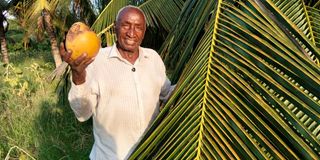
Francis Njeru Chege, 74, holding a coconut at his farm in Hongwe, Lamu West on November 6, 2026.
Photo credit: Kalume Kazungu | Nation
This is a large, shiny, brownish-black nocturnal beetle with a prominent curved horn on its head, found in the Coast – from the northern part in Lamu to Kwale south.
“We ask the government and partners to intervene. Coordinated spraying and other measures can eradicate the pest before it wipes out livelihoods,” he says.
Ali Ahmed, a farmer on Pate island, says coconut production has not translated into substantian economic gains for the region.
According to Ahmed, most farmers still sell raw coconuts to middlemen. He says Lamu is endowed with favourable climatic conditions for coconuts and urges authorities to promote its production.
Lamu Governor Issa Timamy says coconut is a smarter investment compared to oil palm “because it fits the local climate, has an established growing culture, and features a reliable supply chain”.
Lamu has around 15,000 smallholder coconut farmers with key production areas being Hongwe, Mkunumbi, Mpeketoni, Lake Kenyatta, Witu, Faza, Pate, Siyu, Mbwajumwali, Tchundwa, Matondoni, Kipungani and Makafuni.