In the coastal communities of Kilifi, Kwale, Mombasa, Lamu, Tana River and Taita-Taveta counties, coconuts are much more than just a traditional crop. For many households, they are a source of food, income, and cultural identity.
Now, one woman-led enterprise is proving that coconuts can unlock new economic opportunities, particularly for women in Kenya's expanding blue economy.
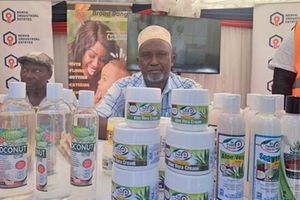
At Nala Foods Africa Limited, founder Subira Zingizi transforms coconuts into value-added products, including virgin coconut oil, body butter and coconut biscuits. In the process, she creates jobs and strengthens women’s participation in agribusiness.
The 37-year-old entrepreneur says her journey into coconut processing began after spending years working in the banking sector. A Kenyatta University Bachelor of Commerce graduate, Subira worked in the financial sector for over 10 years before quitting formal employment to become an entrepreneur.
Today, together with her co-founder and co-director, Ali Salim Mbongi, she is building a company that is slowly reshaping the coconut value chain in Kenya’s coastal region.
“We identified a significant market gap because, despite the widespread cultivation of coconuts in the coastal region, most coconut products available in supermarkets did not originate from Mombasa or Kwale,” explains Subira.
“We asked ourselves why products should come all the way from abroad when we have coconuts and women with experience of producing coconut products locally,” she says.
Subira started the business informally in 2019. Initially, she bought coconut oil from female producers in villages across the coastal region, repackaged it, and sold it to customers.
The women were experienced in traditional coconut oil production, but lacked reliable markets and commercial processing systems.
“We had the market, but we lacked the skills and machinery to produce on a large scale,” she recalls.
In 2022, the business was officially registered as a limited liability company after receiving seed funding of Sh50,000 from the Youth Empowerment Product Initiative. Ms Subira says that the money helped the company to complete registration and formally launch its products.
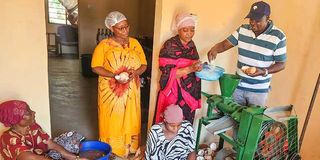
Initially, all operations were manual. Workers grated coconuts by hand, dried them in unpredictable weather conditions, and extracted the oil manually. Production was slow, labour-intensive and expensive.
“We used to produce maybe once a month because the process was very labour-intensive,” says Subira. She reveals that, at the time, the company could only process between 20 and 50 litres of coconut oil per month, despite using thousands of coconuts.
The business also operated with very limited staff. “It was initially a one-woman show,” she says. After formally registering the business, Subira and her co-founder, Salim, ran the company with only a small team, handling production manually. Mobilising female workers for each production cycle was difficult and expensive.
“Our financial resources were very limited,” she says. The turning point came when the enterprise received support through the Investing in Women in the Blue Economy – Kenya (IIW-BEK) programme, which was implemented by the Africa Enterprise Challenge Fund (AECF) with the backing of Global Affairs Canada. Through the programme, the company acquired coconut expellers, a solar dryer, production tables, and working capital to purchase raw materials.
“AECF provided the grant and helped us purchase machinery. They also provided us with a solar dryer and working capital, enabling us to invest in raw materials,” she states. This support enabled the company to transition from entirely manual operations to semi-mechanised production.
Processing cycles that used to take over a week can now be completed in just three days. Production frequency has also increased significantly. “We have moved from producing 20 to 50 litres to producing at least 200 litres per month,” she tells Seeds of Gold.
While the company currently produces around 200 litres per month due to financial limitations, the machinery can process up to one tonne per day. 'If our financial capacity improves further, we can produce even more because the machinery has the capacity,' explains Subira.
She states that the mechanisation has also improved product consistency and efficiency, and reduced the physical burden associated with manual processing. Today, the company employs 12–15 casual female workers during production cycles, providing income opportunities for women in the local community. The women are mainly involved in grating coconuts, drying them, processing them and packaging them.
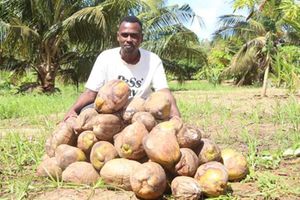
Apart from employing women workers, the company also has an office in Mombasa and sources coconuts from local suppliers and farmer networks within Kwale and neighbouring counties. Currently, the enterprise works with between five and ten suppliers who consolidate coconuts from various farmers and women's groups.
In an exclusive interview with 'Seeds of Gold', Subira said that the company is intentionally encouraging women's groups to participate in the coconut supply chain. "Most coconut farms are owned by men, so we are trying to mobilise women's groups so that they can benefit directly from the income generated through coconuts," she stated.
In addition to virgin coconut oil, Nala Foods Africa Limited has diversified into other value-added products, such as coconut body butter and coconut biscuits. The company is now targeting expansion into food-grade coconut products, such as desiccated coconut, snacks, and sweets. “While many people are focusing on cosmetic coconut products, I want to focus more on the food value chain,” says Subira.
The enterprise has also expanded beyond retail sales into business-to-business markets. Initially, it sold small quantities directly to individual customers, sometimes just one bottle at a time. Today, increased production capacity has created opportunities with bulk buyers in the cosmetics and soap manufacturing industries. “We now have customers using our coconut oil as a base for their own cosmetic and soap products,” she says.
Unlike before, when the company relied on selling small bottles, it is now receiving orders ranging from 20 to 100 litres. 'That gives us hope because these clients can clear large volumes for us,' notes Subira.
The company has also started exploring export markets. Currently, its main export destination is Tanzania, where buyers purchase products in bulk and package them under their own labels through contract manufacturing arrangements. Exports currently account for around 20 per cent of the business, although Subira says that local demand remains high due to the growing preference for healthy, natural products.
“There is still a huge gap in the local market as more consumers embrace healthy living and coconut products,” she observes.
Apart from business growth, Subira says that becoming an entrepreneur has strengthened her confidence and given her a stronger voice in business leadership spaces. “I can now comfortably knock on doors and introduce myself as a manufacturer in the Coastal region. That has given me confidence,” she says, adding: “It has also given me the power to make economic decisions, as I am now involved in areas I previously wasn't.”
She says that combining her banking and financial management experience with entrepreneurship to build a sustainable enterprise that benefits women and coastal communities is one of her biggest achievements.
Subira believes that adding value remains one of the biggest untapped opportunities within Kenya’s agricultural sector. “Value addition is where the real money is, because that is where innovation and creativity come in,” she says.
The agri-processor encourages farmers and local communities to utilise every part of the coconut value chain. She says that even waste products from the processing plant are sold to other businesses producing briquettes, coco peat and coconut shreds.
She emphasises that her vision remains clear: to transform coconuts from a traditionally underutilised crop into a driver of jobs, women's empowerment, and economic growth along Kenya's coast. “My slogan captures the dream perfectly: ‘From Kwale to the world’.”