For years, livestock has been the backbone of many pastoral households in Kenya’s arid and semi-arid lands (ASALs), providing them with food, income and wealth.
However, many pastoralists have struggled to get a fair return from their animals due to high transport costs, middlemen, animal diseases, drought and limited access to reliable markets.
This is a problem that LiveMo Ltd, a women-led livestock enterprise, is seeking to solve by bringing production, animal health services, feed, aggregation and marketing closer to pastoralists.
Lisa Beryl, the organisation’s communications lead, says that the company, which was founded in 2019, deliberately chose a model that goes beyond simply buying livestock from farmers.
“Our aim is not just to buy animals. Our goal is to improve farmers’ economic situations entirely,” she says. LiveMo currently works with around 6,000 farmers in Kajiado, Kilifi and Laikipia counties, 56 per cent of whom are women.
According to Ms Beryl, its model starts with farmer training, followed by animal health services, feed production and guaranteed markets. Through its extension services, the company provides farmers with technical training in areas such as livestock management, breeds, markets and production practices.
The company also provides vaccination and deworming services to protect animals from diseases. This initiative supplements Kenya’s ongoing National Mass Livestock Vaccination Campaign, officially launched in January 2025. The campaign seeks to protect livestock against foot-and-mouth disease (FMD) in cattle and Peste des Petits Ruminants (PPR) in sheep and goats. So far, it has reached more than 18 million animals across targeted counties.
As part of efforts to strengthen disease control, protect farmers from livestock losses and unlock international markets for Kenyan meat and dairy products, the government aims to vaccinate up to 72 million livestock, comprising about 22 million cattle and 50 million sheep and goats.
According to Beryl, feed is another critical component of the LiveMo model. The company commercially produces fodder and silage, and its feed production covers nearly 1,000 acres in Kajiado.
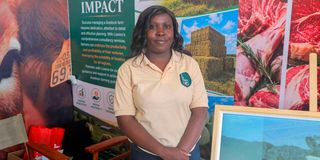
Hay by LIVEMO Limited on display during the 5th Edition of the Kenya Meat Expo 2026 at Kenyatta International Convention Centre on August 27, 2026.
Photo credit: Dennis Onsongo | Nation Media Group
“This means our farmers are not losing animals because of drought,” she says.
The company has also introduced aggregation centres close to pastoral communities, providing farmers with a ready market for their livestock. Farmers can walk into a LiveMo aggregation centre with one or 100 goats, where the animals are weighed and assessed by a veterinarian. They are then paid according to the live weight of the animal.
“This model is designed to eliminate some of the costs and losses that farmers incur when travelling long distances to traditional livestock markets,” she tells Seeds of Gold. Beryl gives the example of a farmer with a 35 kg goat who travels for several hours on a motorbike to a market at a cost of around Sh1,000. By the time the animal reaches the market, it is tired and dehydrated, and a broker may value it at a much lower weight.
Therefore, a goat that could fetch Sh7,000 based on its live weight at a LivMo aggregation centre could earn the farmer only about Sh4,000 at the distant market. After deducting transport costs and other expenses, the farmer may return home with as little as Sh2,500.
At the organisation’s centres, farmers walk their animals to the facility, which is often located less than 10 minutes from their homes, where the animals are weighed immediately. For example, if the animal is valued at Sh7,000, the farmer receives the full amount. You don’t pay for transport. The animal will be treated, fed and watered there for free,” she explains. She says that this model has increased farmers’ incomes by 42 per cent.
The aggregation centres also serve as livestock resource centres. Each facility covers at least 100 acres, enabling animals to be held and free-ranged before moving to the next stage of the value chain.
On arrival, livestock pass through a treatment area before being taken to a collection yard, where a veterinarian separates healthy animals from those requiring treatment. Ms Beryl stated in an exclusive interview that sick animals are quarantined, treated, fed and watered before the farmer is called back.
“Healthy animals are screened and their records checked before they are separated according to age and weight,” she said. Animals remain at the facility for at least seven days to allow veterinarians to identify any diseases that were not apparent upon arrival.
The company also maintains a digital record of every animal. Once tagged, an animal can be traced by its weight, treatment, feeding and eventual market destination. This traceability is important because the company exports meat rather than live animals.
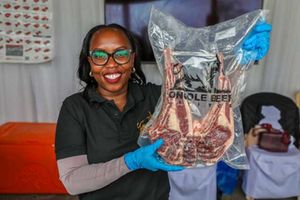
Martin Gachomba of LiveMo Limited during the 5th Edition of the Kenya Meat Expo at the Kenyatta International Convention Centre, Nairobi, on August 26, 2026.
Photo credit: Dennis Onsongo | Nation Media Group
Once livestock leave the aggregation centres, they are taken to export-certified abattoirs for slaughter and processing, after which the meat is packaged and airlifted to markets including Dubai. Since its establishment, the company says it has handled around 300,000 small ruminants and 200,000 cattle..
The women-led company is changing perceptions of the role of women in pastoral economies. Ms Beryl regrets that the livestock sector remains male-dominated and that cultural practices in some pastoral communities traditionally limit women’s ownership of and participation in livestock businesses.
However, 56 per cent of LiveMo’s 6,000 farmers are women.
“Some women have used income from livestock to build permanent homes and pay school fees, including university fees,” she says, sharing some of the success stories.
She says that in some Maasai households, women are increasingly taking responsibility for small ruminants while men retain cattle, enabling households to diversify their livestock enterprises.
The model has also created opportunities for young people. “Some have ventured into veterinary services and animal production, while others have set up agricultural supply businesses,” she reveals.
Some farmers have also started producing silage to sell to other members of their communities. LiveMo itself has grown from three or four employees at its inception to around 74, most of whom work in the field. The company is also encouraging greater participation of women in its field operations and veterinary services.
Ms Beryl says the organisation is committed to supporting the government’s efforts to transform livestock farming, particularly in arid and semi-arid lands (ASAL) counties, from a subsistence activity into a commercially viable enterprise.
At this year’s Kenya Meat Expo, the company presented its hay and other services to farmers and other livestock industry stakeholders. The company also demonstrated meat preparation and cooking, showing visitors the added value that can be created beyond the farm gate.
In his opening speech for the fifth edition of the expo organised by Nation Media Group PLC, Cabinet Secretary for Agriculture and Livestock Development Mutahi Kagwe called for greater investment in livestock genetics, animal nutrition, feedlots, animal health, traceability, and added value.
He also emphasised the importance of climate-smart livestock production, water development, and insurance to safeguard pastoralists against climate-related losses.
“The government is promoting animal identification and traceability to establish the origin and health history of livestock. Improved breeding and feeding are also expected to increase productivity,” said the agriculture ministry boss.
Held from August 26 to 28 at the Kenyatta International Convention Centre (KICC) in Nairobi, the expo brought together farmers, processors, traders, researchers, innovators, financial organisations and consumers. Exhibitors showcased various methods of preparing, processing and adding value to meat.
CS Kagwe urged young people to view the livestock industry as a viable business opportunity, highlighting prospects across production, animal health, processing, marketing and leather.
“The meat industry is lucrative. There is money in the meat sector,” he said.
The event, themed ‘Accelerating Sustainable Growth: Empowering the Next Generation in the Meat Value Chain’, showcased how innovation is transforming the sector beyond livestock production to encompass processing, cooking, preservation, marketing and consumption.