Whenever Derick Mugodo looks at unused urban land, he sees an opportunity: space that could be used to grow food and support the ever-growing population.
The 28-year-old agripreneur believes that Kenya should not continue to rely on imported food, especially given its vast land resources, much of which remains underutilised.
As more young people begin to view farming as a business opportunity, this young innovator is offering a timely solution within the food production chain.
He is the brains behind an automated vertical hydroponic system specifically designed for urban farming.
“Urban areas, including balconies, car parks, and kitchen gardens, can be transformed into productive spaces by leveraging technological solutions,” he says.
Derick Mugodo, the founder of AgriPlant Kenya, a youth-led company in Nairobi that manufactures automated vertical hydroponic systems for urban farming, shows some of the crops grown using the unit.
Photo credit: Sammy Waweru| Nation Media Group
Mugodo is the founder and CEO of AgriPlant Kenya, a youth-led company that manufactures automated vertical hydroponic systems designed primarily for urban environments to support agriculture.
Mugodo, who graduated with a Bachelor of Science in Manufacturing, Engineering, and Technology from Egerton University, says he had numerous ideas around food systems while still in school.
“I was passionate about getting involved in farming, particularly smart agriculture, as I had identified gaps in the value chain. I wanted to reimagine and reengineer the agricultural sector through innovative, sustainable solutions,” he explains.
With a background in manufacturing engineering, Mugodo knew his expertise would be crucial.
Although his entrepreneurial journey was delayed, he is now fully committed to the task.
His experience working in the corporate world — he was employed by flower and vegetable export companies after graduating — prepared him for the urban farming sector.
The urge to pursue his vision eventually led him to resign from his job in early 2023 — a decision that he admits was not an easy one to make.
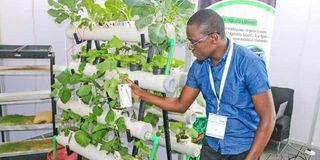
Derick Mugodo, the founder and CEO of AgriPlant Kenya, based in Nairobi, explains how an automated vertical hydroponic system for urban farming operates.
Photo credit: Sammy Waweru| Nation Media Group
Nevertheless, he reassured himself, 'I will not give up,' despite the fear of the unknown.
'With the little savings I had, I started small, right from my balcony in the city,' he recalls.
The first unit, which cost him around 1,000 Kenyan shillings in seed capital, was a simple system comprising troughs.
According to Mugodo, it was a manually operated vertical garden.
To him, it was the simplest system he could imagine, but to neighbours and passers-by, it looked impressive — a big idea.
"That is how I started designing similar units for people who saw it and asked if I could make one for their kitchen gardens," he tells Seeds of Gold.
Since then, Mugodo has refined and developed his innovation through research and mentorship support.
Two years later, the agritech innovator now boasts a modernised solution for the agricultural sector.
The automated vertical hydroponic system he designs is integrated with a mobile phone app for monitoring operations.
The unit is made of PVC pipes supported by steel, and Mugodo notes that these materials are readily and locally available.
"It can be powered either electrically or by solar energy, which is a green option that conserves the ecosystem," explains the agripreneur.
Youthful agripreneur Derick Mugodo, the founder of AgriPlant Kenya, switches on power for water to be pumped into an automated vertical hydroponic system for urban farming.
Photo credit: Sammy Waweru| Nation Media Group
Green energy, also known as renewable or clean energy, is derived from natural resources that are naturally replenished and have minimal environmental impact.
Sources include solar, wind, hydropower, geothermal and biomass energy, all of which are crucial in reducing reliance on fossil fuels and mitigating the effects of climate change.
The system monitors parameters such as temperature, moisture, nutrients (minerals) and pH levels, and sends notifications to the farmer via mobile phone.
The system is programmed based on the type of crop planted and offers two notification options: a mobile app and SMS. These provide an efficient means of achieving optimum production.
“It works in real time. Signals are sent to farmers to prompt action when crops need water, nutrients, or adjustments to temperature or moisture levels,” explains Mugodo.
As climate change continues to wreak havoc through prolonged droughts, floods and destructive insect pests, experts are urging farmers to embrace innovative approaches to enhance food security, not only in Kenya, but across Africa — a continent with vast amounts of idle arable land.
Given the growing population, shrinking land sizes, soil degradation and persistent soil-borne diseases, urban areas will play a critical role in supporting food production.
"Integrating automated vertical hydroponic systems into urban farming marks a pivotal shift in how we conceptualise food production in an era of climate uncertainty. As conventional agriculture faces mounting challenges from erratic rainfall, prolonged droughts and pest outbreaks, such innovative solutions offer a resilient, efficient and scalable alternative," observes Richard Omondi, founder of Agri-Irrigation and Solutions Africa Limited.
Mr Omondi, an agricultural engineer specialising in crop protection and climate-smart farming, further explains that growing crops in vertically stacked layers using nutrient-rich water instead of soil, and automating irrigation, lighting and nutrient delivery, drastically reduces reliance on arable land and cuts water consumption by up to 90 per cent.
This allows for year-round production, regardless of weather conditions.
In densely populated urban environments where land is scarce, this innovative technology can supply fresh, safe and nutritious food closer to consumers, reducing the carbon footprint associated with transporting food over long distances.
“From a food security standpoint, especially in regions already grappling with hunger and climate shocks, vertical hydroponics is more than just a novelty — it’s a lifeline. It enables cities to localise food systems, diversify production beyond staple crops and generate employment opportunities in controlled-environment agriculture,” says Omondi.
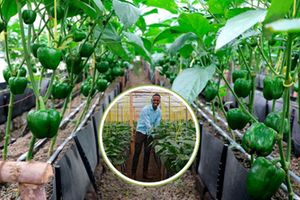
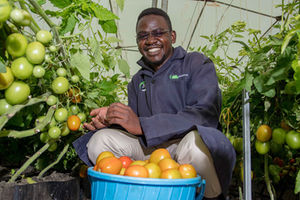
Mugodo’s automated vertical hydroponic system is designed to maximise space and can be used to grow a variety of crops, including vegetables and fruits such as strawberries and grapes, as well as cucumbers and capsicum — all of which are short-maturing crops.
Operating from his Nairobi workshop, Mugodo produces systems in a range of sizes.
“The smallest unit, which measures 1.5 square metres, can accommodate up to 50 plants. The medium-sized unit, which measures 6 square metres, can hold around 300 plants. The largest size depends on the customer’s specifications,” explains the agripreneur.
He reveals that the smallest system costs Sh5,000.
Since setting up AgriPlant Kenya, he has installed over 150 systems for commercial use and for household kitchen gardens.
Having started alone, Mugodo now employs three permanent staff and contracts about 15 youths on a casual basis.
When asked how he has remained sustainable in agribusiness and achieved profitability, Mugodo credits the power of partnerships and collaboration with key stakeholders in both the private and public sectors.
As well as serving homeowners with kitchen gardens, he collaborates with schools in Nairobi, Nakuru, Kiambu, Nyandarua and Kakamega counties to contribute to the revival of 4K Clubs, which aim to nurture young farmers.
However, his journey to success has not been without challenges.
The young entrepreneur cites a lack of sufficient finances, especially during the start-up phase, as a major hurdle.
This is a common challenge for start-ups, but Mugodo believes that taking risks is essential for growth.