Hello

Your subscription is almost coming to an end. Don’t miss out on the great content on Nation.Africa

Ready to continue your informative journey with us?

Hello

Your premium access has ended, but the best of Nation.Africa is still within reach. Renew now to unlock exclusive stories and in-depth features.

Reclaim your full access. Click below to renew.

GOLDFRANCISKUKU5
Caption for the landscape image:

Digital poultry king: How one man’s quest sparked a national poultry business

Scroll down to read the article

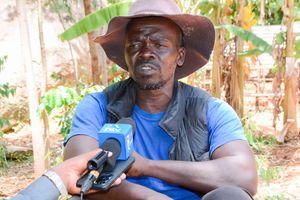
Poultry farmer Francis Muiruri Njeri alias Francis wa Kuku during an interview at his poultry farm in Ruiru, Kiambu county on January 26, 2026

Photo credit: Evans Habil | Nation

When Francis Muiruri stood on his modest piece of land in Juja, Kiambu County, the advice from friends and neighbours was familiar and well-meaning.

They said he should build rental rooms, collect rent at the end of every month, and slowly grow his real estate portfolio.
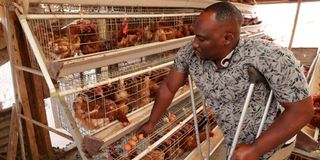
It was the safe path — the approach that many Kenyans swear by. Francis listened, weighed the idea carefully, then quietly dismissed it.

“I didn't want to wait for tenants or deal with empty rooms and late payments. I wanted something that would give me money every single day,' he says.

This decision led him to start a poultry farm, a venture which has since made him one of the most recognisable poultry entrepreneurs in Kiambu County.

GOLDFRANCISKUKU10

Chicken in cages at Poultry farmer Francis Muiruri Njeri alias Francis wa Kuku farm in Ruiru, Kiambu county on January 26, 2026.

Photo credit: Evans Habil | Nation

He is now popularly known as Francis Wa Kuku, founder of Francis Wa Kuku Digital Farm. This enterprise has grown from a small-scale operation to a large commercial enterprise supplying eggs, poultry, equipment, and training to farmers across the country.

Long before chickens became his livelihood, Francis's life had been shaped by hardship. Born in Kigio, Gatanga, in Murang'a County, he developed a physical disability that requires him to use crutches to get around.

Schooling was difficult and expensive, and poverty forced interruptions that would have broken many people.

“From childhood, I learned that life with a disability is more expensive and unforgiving,” he says.

He attended Joytown Special School in Thika, but dropped out when the fees became impossible to raise.

Like many children forced to leave school early, he learned to survive through work. He did casual jobs, hawked goods and kept a few chickens wherever opportunity arose.

Over time, he returned to school and completed both his primary and secondary education. After several years of uncertainty, a chance encounter opened the door to training as an accountant.

Francis pushed through college life, balancing CPA classes during the day with selling wallpapers, groundnuts and ice cream in the evenings.

GOLDFRANCISKUKU4

Poultry farmer Francis Muiruri Njeri alias Francis wa Kuku taking notes during an interview at his poultry farm in Ruiru, Kiambu county on January 26, 2026.

Photo credit: Evans Habil | Nation

His breakthrough came in 2015, when he secured a position as an accountant with the Kiambu County government after a competitive interview process.

“I told myself that even though I now had a salary, I still had to think like a hustler,” he says.

With a stable income, Francis took out a loan to build a home in Gatanga, Murang'a County. Soon after, tragedy struck when his mother was diagnosed with cancer. Determined to save her life, he took out a loan of Sh2.5 million for her treatment.

Birth of poultry venture

Around the same time, in 2020, the lockdown caused by the Covid-19 pandemic disrupted food supply chains, making eggs scarce and expensive.

“I bought 50 chickens almost out of necessity. They produced about 40 eggs a day and there was a high demand for eggs,” he explains.

He invested Sh50,000 as seed capital, which went towards building wooden cages and buying feed.
As his mother's health deteriorated, she told Francis that he would go far if he loved the chickens she had left him.

After her burial, Francis’s son posted a short video of him farming on Facebook without his knowledge.

GOLDFRANCISKUKU14

A Chicken in a cage at Poultry farmer Francis Muiruri Njeri alias Francis wa Kuku farm in Ruiru, Kiambu county on January 26, 2026.

Photo credit: Evans Habil | Nation

The clip went viral, drawing attention from across the country. He later uploaded another video with detailed information about his poultry venture.

It was through this exposure that a notable preacher reached out to him and offered to give his venture more visibility.

“Bishop Benson Gathungu, also known as Mzee Kiengei and the founder of Jesus Compassion Ministries (JCM), publicised my poultry venture through a radio programme and social media platforms,” says Francis.

Mzee Kiengei is a popular Kenyan media personality and comedian with a strong online following.

“The videos changed everything. People started calling me, asking for advice and asking me to help them set up poultry farms,” he adds.

One of the opportunities that followed was a poultry installation project worth approximately 13 million Kenyan shillings — an experience that forced him to reconsider his approach.

"That is when I realised that poultry farming was more than just a way to survive. It was a serious, scalable business,” he says.

Stepping into Francis Wa Kuku Digital Farm in Nyacaba, Juja, today is an experience that immediately speaks to production.

From the entrance, a steady chorus of clucking can be heard, rising and falling as the birds respond to footsteps.

Sharp calls from active layers mix with the softer rustling of birds settling back into their cages, accompanied by the faint metallic rattle of wire.

The cages stretch neatly from the homestead into adjoining structures, arranged in clean rows for easy access and inspection.

Feed troughs run uniformly along the cages, water lines drip steadily, and the faint smell of feed and warm birds hangs in the air.

“This is where I can monitor everything. When you hear the birds, you can tell if something is wrong," Francis told Seeds of Gold during an interview at the farm.

He uses a battery cage system, which he prefers for its benefits in terms of disease control, reduced feed wastage, lower labour requirements, and ease of monitoring.
The system also suits him physically, enabling him to manage large numbers of birds efficiently despite his disability.

"I don't struggle moving around the cages. Everything is organised. I can see production, feeding and health at a glance,” he explained.

At the time of the interview, Francis was preparing to travel to Nanyuki to visit a client.

"We have just collected the first batch of eggs, and the birds are still laying. Later in the afternoon, we will collect another batch,” he said.

The farm keeps over 5,000 chickens and 200 pigs. Around 3,000 of the birds are currently laying, producing an average of 90 trays of eggs per day. However, demand consistently exceeds supply. He supplies customers across the country.

“Some days, the market needs 6,000 trays, but only 2,000 are available. Eggs sell very quickly,” he says.

Francis has built a fully integrated poultry business beyond egg production. He breeds and sells fully vaccinated chickens, supplies quality feed and imports original battery cages from India and Germany.

GOLDFRANCISKUKU5

Poultry farmer Francis Muiruri Njeri alias Francis wa Kuku during an interview at his poultry farm in Ruiru, Kiambu county on January 26, 2026

Photo credit: Evans Habil | Nation

He also sells two-month-old chicks for 1,000 Kenyan shillings each, which has set him apart in this niche market. Around 20 per cent of his sales go to export markets in Uganda and Tanzania.

“I vaccinate day-old chicks, transfer them to cages at around two-and-a-half months, and expect them to start laying at five months. If you follow the right system, poultry farming is very predictable,” he says.

The enterprise directly employs around 36 young people, many of whom had limited opportunities prior to joining the farm. When he started in 2020, he and his spouse were the only ones providing labour.

“I want young people to see farming as a business, not a last resort,” he says.

Francis often demonstrates why poultry farming is a better investment than rental housing. With just 100 chickens housed in a 10-by-10-foot space, a farmer can earn around Sh15,000 per month.

“Try building rental rooms in that same space and see if you will get the same return,” he says. “With poultry, you get income almost daily.”

He adds that eggs are among the most reliable products on the market.

"Almost every household consumes eggs. That market does not disappear.”

He is firm on quality, warning farmers against taking shortcuts that promise quick profits but lead to losses.

“Cheap feed and poor cages will ruin you. In poultry farming, quality is not negotiable. If you do it right, the birds will reward you daily.”

However, building the business has not been without challenges.

Francis cites financial constraints and limited access to technical knowledge as major hurdles for start-ups, especially for people living with disabilities.

When asked how he balances his accounting job with poultry farming, he replies, “I have invested in workers and automated systems, so it is easy to monitor operations.”

What lessons has he learned?

“Cheap is very expensive. Always go for quality. With the right strategy, farming is profitable.”

Follow our WhatsApp channel for breaking news updates and more stories like this.