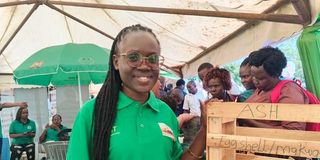
After graduating from Machakos University in 2020, 29-year-old Cecilia Bunoro returned home to find her parents struggling with declining crop yields and depleted soils on their family farm in Shitao village, Kakamega County.
Years of relying on inorganic fertilisers and conventional cultivation practices had gradually stripped the land of its fertility — a problem she was determined to solve.
"With the knowledge I gained at university, I wanted to find a better way," she recalls.
Ms Bunoro, who had studied Agribusiness Management, drew on the composting techniques she had learned in class and from her peers.
In 2021, she set up her first compost heap using poultry manure from her own chickens, dry maize stalks, tithonia leaves, ash and fertile topsoil rich in microorganisms.
"Most of the materials needed are readily available. You just need to layer them properly and manage moisture and temperature. In two months, the compost is ready," she explains, outlining a process that she now teaches to other farmers.
Organic waste on a farm. Degradable waste should be collected from the farm and placed in a composting site.
Photo credit: File | Nation Media Group
Composting has not only restored the fertility of the soil on her family's land, it has also become a source of income for her.
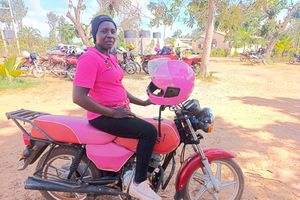
Depending on the season and demand, she earns between Sh5,000 and Sh15,000 a month assembling compost heaps for neighbouring farmers, charging Sh500 when farmers provide materials and Sh1,000 when she supplies everything herself.
In a good month, when training sessions, youth mentorship engagements and poultry sales coincide, she can earn between Sh5,000 and Sh10,000.
However, convincing other farmers to embrace composting hasn't been easy.
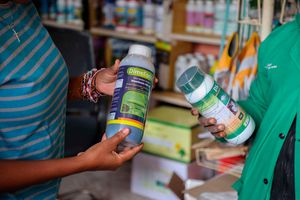
"Most farmers are still used to agrovet products because they seem quicker and more familiar," she says.
She believes that professionalising farming is crucial if agriculture is to attract the next generation.
"You can't encourage young people to join agriculture if it looks like you're struggling. It must be attractive and viable," she adds.
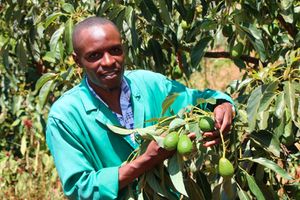
The challenges she faces are similar to those experienced by thousands of smallholder farmers across Kenya: degraded soils, over-reliance on expensive chemical fertilisers, limited access to advisory services and increasingly unpredictable weather.
However, a new Sh600 million initiative aims to turn the tide. In partnership with the International Fund for Agricultural Development (IFAD) and funded by the European Union, the Government of Kenya has launched a programme that could validate and scale up soil fertility interventions.
The three-year Investing in Livelihood Resilience and Soil Health (ILSA) programme will support 40,000 smallholder farmers across six counties, including Kakamega, Trans Nzoia, Embu, Kilifi, Makueni and Taita Taveta, by focusing on interventions that improve soil fertility, cut production costs and build resilience against climate shocks.
It will fund composting training, bio-input production, soil testing services, agroforestry, sustainable land management and improved post-harvest practices.
"This action builds on what has already been implemented and tested. We are not introducing something entirely new; we are scaling up approaches that have already demonstrated impact," said Mariatu Kamara, IFAD Country Director for Kenya, during the launch in Kakamega on January 13.
Mariatu Kamara, the Country Director of the International Fund for Agricultural Development (IFAD) Kenya, during an interview with Seeds of Gold on October 15, 2025.
Photo credit: Richard Maosi | Nation
Ms Kamara explained that earlier EU-supported interventions under the BOOST initiative had revealed a high demand for bio-inputs, composting, agroecological training and digital soil information systems — precisely the kinds of services that Ms Bunoro provides.
For farmers who have watched their yields decline year after year, the programme offers practical solutions.
Ms Kamara added that soil testing will help farmers understand what their land actually needs, putting an end to the costly guesswork involved in buying fertilisers that may not address the real problem.
"Training in composting and bio-input production will provide them with affordable alternatives to expensive chemicals," she added.
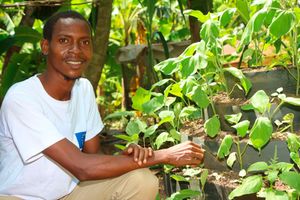
According to her, agroforestry interventions will protect crops from increasingly erratic weather while providing an extra source of income from timber and fruit.
"We looked at counties that are already experiencing climate stress, where it is possible to improve productivity, and where county governments are ready to integrate these interventions into existing agricultural programmes," said Ms Kamara.
Rashid Khator, Secretary of Administration at the State Department for Agriculture, stated that the initiative is part of Kenya's broader shift towards soil restoration.
"The objective is to enhance soil fertility, reduce land degradation and increase the resilience of agro-ecosystems. These interventions are essential to improving crop yields, food security and household incomes," he said.