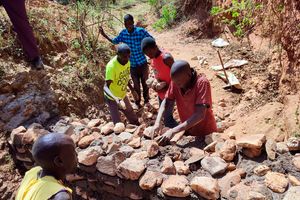
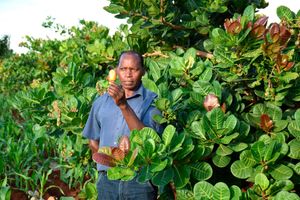
When the March rains begin, farms across Homa Bay and other parts of the Lake Region turn green, signalling active crop growth and the promise of food security.
Farmers spend most of their time in the fields tending young crops, predominantly maize and sorghum, often intercropped with beans and other grains. Weeding and scaring away birds are daily tasks while the weather remains favourable.
But as the rains cease by the end of May, life on these farms changes drastically. Crops wither, water sources dry up, and livestock struggle to survive. Communities face food scarcity, particularly in areas where rain-fed agriculture dominates. In these regions, farming is highly vulnerable to climate variability, with prolonged dry spells causing inconsistent yields and crop failure.
Climate change has intensified these challenges. With rainfall patterns becoming unpredictable, farmers must innovate to sustain livelihoods. In Gwassi South Ward, Homa Bay County, Eunice Ondere, 32, has turned adversity into opportunity through climate-smart farming.
Her farm in Sanjweru Village is now a model for local farmers seeking resilient agricultural practices.
Eunice Ondere inspects a water gutter at her farm in Sanjweru Village in Gwassi South ward in Homa Bay County on January 27,2026. She uses rainwater catchment to harvest water for irrigation.
Photo credit: George Odiwuor | Nation Media Group
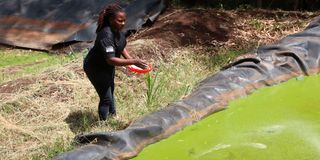
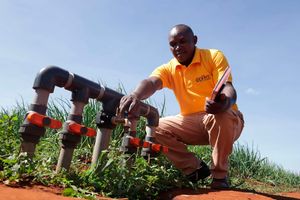
A trained social worker, Eunice ventured into farming after growing tired of waiting for formal employment. Her five-acre farm produces yellow maize, soya beans, and sunflower, crops that remain green even during prolonged dry spells. A key to her success is irrigation: her farm draws water from a communal borehole drilled by World Vision and collects rainwater in greenhouses. This water also supports fish production in ponds, ensuring crops remain healthy and yields are consistent.
While only a fraction of her produce is sold or consumed, much is used to support poultry and aquaculture, her primary income sources. Her farm currently holds over 1,000 birds introduced in mid-November and 500 mudfish ready for market. Despite the village’s dry conditions and water scarcity, Eunice leveraged the large farmland owned by her husband, Michael Ogallo, to implement intensive, climate-resilient agriculture.
Eunice began her poultry venture in 2015, initially housing 200 birds in a small coop. She started with rainbow roosters, a hardy dual-purpose breed, but lost some to cannibalism. Following advice, she switched to Sasso chickens, sourcing day-old chicks from a reliable supplier and brooding them to maturity. Attempts at chick production using an incubator were hampered by frequent power outages, making the operation uneconomical.
Feed costs, a major challenge for many farmers, led Eunice to formulate her own poultry and fish feeds. Using locally sourced ingredients—including maize, soya beans, sunflower, kales, cabbages, shrimp, and snails—she creates affordable, nutritious rations. Protein-rich feeds ensure birds mature quickly, while fish ponds are enriched with leucaena tree leaves, which also fall into ponds, supplementing their diet.
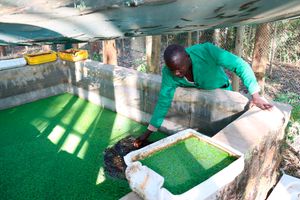
Eunice initially introduced tilapia in her ponds but later switched to mudfish, which tolerate low water levels. Water from the ponds, rich in nutrients from fish waste, doubles as natural fertiliser for greenhouse crops, enhancing soil health and yields.
“Fingerlings were introduced in April 2025 and are ready for harvest. The pond water will then fertilise vegetables in the greenhouse,” she explains.
Eunice Ondere (right) explains to her neighbours aquaculture management at her farm in Sanjweru Village in Gwassi South ward in Homa Bay County on January 27,2026. The farmer practices climate smart agriculture.
Photo credit: George Odiwuor | Nation Media Group
Poor access roads have historically limited the village’s economic potential. Eunice addressed this by opening an agrovet in nearby Magunga, selling veterinary chemicals, poultry vaccines, and crop inputs. Local farmers now access essential supplies conveniently, while she ensures her birds remain healthy until market maturity.
Eunice also mentors 33 young farmers through the Resilient Agriculture that Works for Young People (RAY) programme, supported by Practical Action. The initiative equips young agripreneurs across nine counties with sustainable farming solutions and supports them in building livelihoods through agribusiness.
Initially a mentee, Eunice has now become a mentor, guiding others in marketing, disease control, and innovative practices.
Linda Owako, Practical Action’s project officer, says the mentorship model fosters knowledge transfer and community-level agribusiness growth. Youth groups linked to the programme also form table-banking associations to build financial stability and access mainstream bank loans, enabling transitions from small- to medium-scale enterprises.
Everly Otieno, a teacher at Sanjweru Primary School, is another success story. She began rearing local poultry in 2015 but switched to improved kienyeji breeds for higher income. Owning a motorcycle enables her to manage farming alongside teaching, efficiently sourcing inputs and transporting produce to market.
Climatologist Clifford Omondi of the Environment Institute of Kenya emphasises that climate change is an existential threat to agriculture. Rising temperatures, droughts, and floods disrupt food systems, reduce yields, and threaten food security. He advises farmers to adopt climate-smart practices and locally sourced inputs to withstand adverse conditions.
Homa Bay County Climate Change Director Roy Odongo notes that dry spells are normal in tropical regions between rainy seasons.
The current dryness followed the August–September short rains and will give way to the March–April long rains. He calls for resource conservation, pasture growth, and innovation in livestock management to mitigate drought effects.
The county government, through the Financing Focally Led Climate Actions (Flocca) programme, has begun initiatives to support livestock during drought. Identified fodder production units provide cuttings for farmers to cultivate animal feed on their farms.
Farmers will also receive drought-resistant juncao grass, a high-protein fodder that ensures sustainable livestock feeding. “Farmers should move away from conventional grazing, which is unsustainable during dry seasons. Alternative feed sources are essential to prevent livestock deaths,” Mr Odongo urges.
Eunice Ondere’s story illustrates the potential of climate-smart agriculture to transform livelihoods in Homa Bay. By integrating irrigation, poultry, aquaculture, feed formulation, and mentorship, she has built a resilient farming model that not only sustains her family but also inspires young agripreneurs in the region.
Through local innovation, strategic resource management, and knowledge transfer, farmers can overcome climatic challenges, secure food production, and unlock new economic opportunities. Eunice’s farm stands as a testament that with determination and ingenuity, communities can thrive even under adverse conditions.