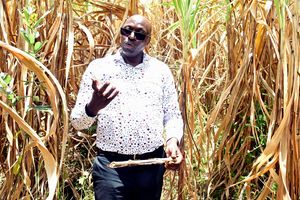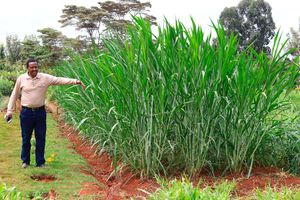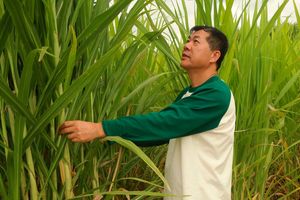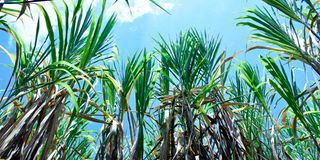
A Juncao grass plantation in Maragua, Murang'a County in this photo taken on September 19, 2025.

With the escalating impacts of climate change—ranging from prolonged droughts and floods to destructive pests and diseases—farmers in Kenya and across Africa are being forced to rethink their approaches, increasingly embracing climate-resilient technologies.
For Abdirahman Ali Hassan, a pastoralist based in Wajir County, the mention of climate shocks evokes painful memories.
During the 2021–2022 drought, he lost livestock worth millions of shillings. Widely regarded as one of the worst in Kenya’s 40-year history, the famine saw Mr Hassan, who also works as a teacher, watch a lifetime of effort vanish within months.
In Wajir, where pastoralism is both a culture and a livelihood, the drought showed no mercy. He told Seeds of Gold that he lost more than 100 cows and about 60 camels—animals that would have fetched him millions.
“The losses were not just economic; they were deeply personal—a collapse of a system I had relied on for decades,” he recalls.
“It was devastating. You wake up every day to count losses,” he adds.
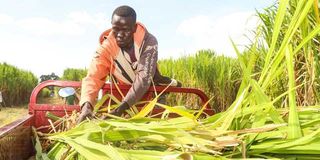
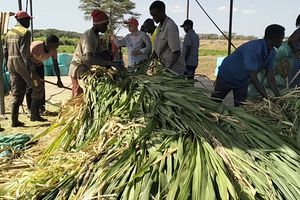
A farmhand harvests Juncao grass at J and V farm at Kampi ya Moto in Nakuru.
Across Kenya’s arid and semi-arid lands (ASALs), the story was similar. The Ministry of Agriculture and Livestock Development, alongside development partners, estimates that the country lost more than 2.5 million animals worth billions of shillings during the drought.
Pastures dried up under the scorching sun, and water sources dwindled. For Hassan, the crisis became a turning point, prompting him to search for a lasting solution.
Juncao grass
In 2023, his journey took him to Malindi, where he visited a farm practising intensive zero-grazing supported by cultivated fodder. There, he encountered something unfamiliar but promising—Juncao grass, a towering, fast-growing fodder crop originally developed in China.
“I saw how they had green fodder even during dry periods. That is when I knew I had to change my approach,” he says.
He started small, planting one acre of Juncao after sourcing cuttings from Nakuru.
Today, that experiment has grown into a 10-acre fodder system, transforming his farm into a model of climate resilience.
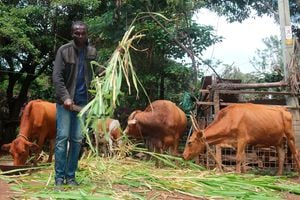
Alongside Juncao, Mr Hassan has integrated Brachiaria grass and sweet potato vines to create a balanced feeding system. He has also invested in machinery, including a chaff cutter, pelletiser and hay baler, and built two silage bunkers, each with a capacity of 90 tonnes.
During this year’s dry spell, while neighbouring farms struggled, Hassan’s livestock remained healthy.
“I sold surplus fodder and earned about Sh1.7 million. I turned a crisis into an opportunity,” he says.
His farm has since become a demonstration site, attracting farmers eager to learn how to adapt to a changing climate.
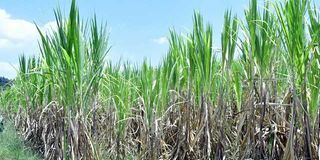
A Juncao grass plantation in Maragua, Murang’a County, on September 19, 2025. The grass can grow up to 3.5 metres.
He has also shifted from keeping large herds to rearing fewer, improved breeds, including Sahiwal crosses, which produce between 14 and 16 litres of milk per cow daily.
“I now get more value from a smaller herd. It’s about quality, not numbers,” he explains.
Hundreds of kilometres away in Nairobi, Kevin Mwangi Kamau is applying the same grass in a completely different way.
For Kamau, Juncao is not just livestock feed—it is the foundation of a fast-growing mushroom business.
His journey into farming began in 2021 after he lost his job in the matatu industry during the Covid-19 pandemic.
With just Sh15,000 in savings, he ventured into mushroom farming using wheat straw as a substrate.
“Using wheat straw, I was producing about 100 kilogrammes of mushrooms every two weeks. With Juncao, that changed completely,” he says.
Today, Kamau produces up to 2,000 kilogrammes of oyster mushrooms per month, alongside 800 kilogrammes of button mushrooms. His produce sells at about Sh250 per 250-gram punnet, targeting both local and premium markets.
Preparing wheat straw substrate previously took nearly a week. With Juncao, the process now takes just two days.
“Juncao is faster, cheaper and more reliable,” he says.
His venture has also created jobs. At peak production, Kamau employs up to 10 workers—many of them women—to assist with substrate preparation and packaging.
Operating on just an eighth of an acre, his farm demonstrates how innovation and knowledge can turn small spaces into profitable enterprises.
The story of Juncao grass begins in China, where it was developed by a scientist seeking alternatives to traditional mushroom substrates and livestock feed.

Director of Livestock Production Bishar Fille Elmi (left) shakes hands with Prof Lin Zhanxi of the China National Engineering Research Center of Juncao Technology during a Juncao capacity-building workshop.
Professor Lin Dongmei Zhanxi of Fujian Agriculture and Forestry University, the inventor of the drought-tolerant fodder, describes Juncao as a “versatile, climate-resilient technology”.
Kenya, he explains, was selected due to its high potential, particularly in addressing feed shortages and improving agricultural resilience.
“Juncao is not just grass. It is a system that supports livestock, crop production and environmental restoration,” Prof Lin told Seeds of Gold in an interview in Nairobi.
Apart from livestock feed—which reduces reliance on grain-based feeds—and mushroom substrate, Juncao is also used in environmental conservation, flood mitigation, desertification control, and the production of paper, fibreboard, textiles and biomass energy.
The Kenyan government, through the Ministry of Agriculture and Livestock Development, is partnering with the United Nations Department of Economic and Social Affairs (UNDESA) to promote Juncao technology under a project titled: “Accelerating Sustainable Development Goals (SDGs) in Developing Countries: Promoting Juncao Technology for Resilient Food Systems, Poverty Eradication and Climate Adaptation.
The initiative is being implemented in collaboration with the National Engineering Research Centre for Juncao Technology at Fujian Agriculture and Forestry University in China.
“Juncao is central to efforts to address a persistent feed crisis. The country faces a feed deficit of about 60 per cent, a gap that continues to limit meat and milk production,” says Bishar Fille Elmi, Director of Livestock Production at the State Department of Livestock Development.
Annual meat demand stands at about 600 metric tonnes, but production lags at around 495 metric tonnes—a gap that could be bridged by adopting climate-resilient fodder crops such as Juncao, he adds.
To scale up adoption, the government plans to allocate two acres per ward for multiplication, translating to about 2,900 acres nationwide.
Farmers will receive subsidised planting materials, with strict price controls to ensure affordability.
The United Nations views Juncao as more than just an agricultural innovation.
Amson Sibanda, Chief of the National Strategies and Capacity Building Branch for the Sustainable Development Goals at UNDESA, says the technology aligns with global efforts to address poverty, food insecurity and environmental sustainability.
“The real value of Juncao lies in its entire value chain. It creates jobs, supports industries and builds resilience,” he says.
Globally, more than 400,000 hectares have been planted with Juncao grass, demonstrating its scalability.
The grass, a member of the Pennisetum family, has a protein content of between 13 and 16 per cent, with yields of up to 240 tonnes per acre under good agricultural practices.
Reaching heights of over eight metres, the grass takes about four months to establish, after which it can be harvested every two months.
Since its introduction in Kenya in 2021, Juncao has shown strong potential to support the country’s agricultural transformation.
Farmers in Kiambu, Nakuru and Kajiado counties have reported improved milk yields due to a more consistent supply of fodder. However, experts advise supplementing it with other nutrient-rich feeds and minerals to maximise production.
Apart from Kenya, the grass is cultivated in several African countries, including Rwanda, South Africa, Tanzania, Lesotho, Nigeria and Zimbabwe, as well as parts of Asia and the South Pacific.
Follow our WhatsApp channel for breaking news updates and more stories like this.