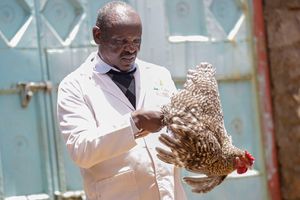
Some years ago, when she was still in school, Ms Lucy Ichuga loved agriculture and was passionate about becoming a poultry farmer. Following the post-election violence of 2007, Ms Ichuga started selling onions wholesale at Molo market in Nakuru County.
“In late 2019, I read a post shared by a farmer selling chicks online. When I called her, I realised that she was a brooder from my neighbourhood, so it was easy to get the chicks from her,” she said, adding that during the countrywide lockdown imposed by the government following the outbreak of Coronavirus, she had built a temporary structure and bought 80 premium chicks at Sh350 each.
During a recent interview at her residence in Molo town, Ms Ichuga said that, after two-and-a-half months, the hens started hatching. While advertising the eggs and chickens online, she came across a farmer who showed her how to brood, and she continued learning online as she became more interested.
In the same year, she decided to build a modern, spacious structure to accommodate the chickens and provide enough space to brood her chicks easily. Using the capital she had available, Sh350,000, Ms Ichuga bought timber, wire mesh, boards and feeding and watering containers. She partitioned the house into five rooms that could hold over 500 mature hens and chicks. As a businesswoman, she had set aside an additional Sh70,000, which she said was enough to buy 70 chicks retailing at 100 shillings each.
“After brooding my chicks for one month, I continued to feed them. By the end of four-and-a-half months, they were ready to hatch. During this time, I sold mature cocks for between 1,400 and 1,500 shillings each, depending on their size,” said Ms Ichuga, adding that she sold her eggs at the local market for Sh15 each. She noted that there were plenty of eggs and that it was challenging to sell them because customers were scarce, which led to a backlog. She therefore decided to sell the mature chickens through social media.
In 2021, she realised that her improved kienyeji chickens had grown larger and that some of them died due to overcrowding. She said that demand was low and that the few customers who came to buy her chickens wanted to purchase them at a lower price, unaware of the challenges she had faced, especially the high cost of feeding them. She added that a mature chicken could eat 140–150 grams of food every day.
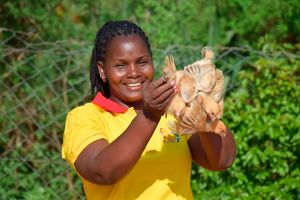
Ms Lucy Ichuga (left) and Ms Ann Wambui hold some of the chickens she rears at her residence in Molo town, Nakuru County on June 18, 2026.
Photo credit: John Njoroge | Nation Media Group
She noted that the period of the Coronavirus pandemic affected her poultry farming business. She sold all her flock and gave up on poultry farming because there was no ready market for her chickens. A few months later, she reintroduced her business when officers from a company approached her and offered her and other women in the community one-day-old chicks to raise and sell. She has become a skilled brooder since 2022 and says that other farmers and corporations have approached her for advice.
"Months after giving up on poultry farming, I succeeded on my second attempt when I started selling one-month-old chicks for Sh300 each, as they didn't consume much feed. Unlike mature chickens, which consume a lot, this business model was more profitable as the chicks require less feed,” said Ms Ichuga. She added that she visits agricultural shows, interacts with experienced farmers, and conducts online research to improve her skills.
Currently, she has around 500 chicks and over 200 adult chickens. She sells three- to five-week-old chicks for between Sh300 and Sh350, three-and-a-half- to four-month-old cocks for between Sh1,200 and Sh1,300 depending on the size, and five-month-old cocks for Sh1,500 shillings. Six- to seven-month-old layers retail at between Sh1,200 and Sh1,300 at the local market. She has gained more customers online. She adds that maintaining her flock's health through vaccination, quality feed and regular deworming has helped her to gain and retain customers. To keep her new chicks safe, she keeps the brooders clean and disinfects them before introducing new chicks, in order to prevent diseases such as coccidiosis.
She says that chicken droppings are in demand in the area. She uses them as manure on her own farm and sells the surplus to other farmers at 500 shillings per 90 kg bag. She cites a lack of knowledge when sourcing recommended chicks and quality feeds, and an overproduction of eggs, among other things, as major challenges during the brooding process.
Ms Ichuga is now fully invested in her 250 layers, which are doing well. She says that they do not consume much feed compared to improved Kienyeji chickens. "I plan to build a larger chicken coop to house more layers while I continue with my chick project. I am optimistic that I will have over 1,000 layers by next year,” she said, adding that the eggs are popular with customers and retail at 20 shillings each, with a tray of 30 eggs selling for 600 shillings. When demand for chicks and chickens increases, especially between August and December, she sources them from other farmers to satisfy her customers. "Keeping records has helped me balance my project with growing crops, and this has enabled me to thrive. I urge farmers to form groups to benefit from government support,” says Ms Ichuga.
Her vision is to access better markets and become the leading poultry farmer in the region. In order to give back to the community, Ms Ichuga voluntarily provides training to other farmers on topics such as challenges, feeding, diseases and vaccination, and maintains the cleanliness of the chicken coops.
She calls on the county government to help farmers acquire raw materials such as sunflower and soya seeds, which are rich in protein, at subsidised prices. She also calls on the government to help farmers acquire skills and training, access funding, connect with companies, find better markets and ensure product security.