About 100 metres off the Elburgon–Molo road in Nakuru County, retired primary school teacher Dickson Kanyua moves calmly around a wooden poultry structure, checking on his flock of Sasso Kienyeji chickens. The modest enterprise, located a few kilometres from Elburgon town, has become a reliable source of income since he left the teaching profession in 2015.
Mr Kanyua had been rearing indigenous chickens long before retirement, but in 2023 he introduced the Sasso Kienyeji breed to improve productivity and boost returns.
“I previously kept more than 100 Kenbrow chicks. They were doing well, but I wanted a breed that could grow faster and produce larger eggs,” he says.
He sourced 51 Sasso chicks from a Nakuru-based trader who had imported them from Tanzania. Each chick cost Sh100, bringing the initial investment to about Sh50,000 when housing, feeding and other inputs were included.
Like many small-scale farmers, Mr Kanyua relies on creativity to manage costs. Instead of using electricity to keep the chicks warm during their early days, he improvised a simple heating system using hot water.
“I collect wooden waste from nearby carpentry workshops and use plastic containers filled with hot water,” he explains. “After sealing the containers, I place them inside ventilated cartons to keep the chicks warm.”
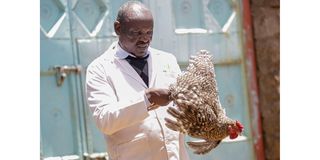
Dickson Kanyua, a retired teacher feeds some of his new breed of Sasso Kienyeji chickens at his home in Elburgon, Nakuru County, on March 10, 2026.
Photo credit: John Njoroge | Nation
The method worked well. Only one chick died during the brooding period, leaving him with 50 healthy birds. For this flock, he used four hot-water containers to maintain adequate warmth.
After one month, the cockerels were separated from the hens. By the second month, the male birds had reached market weight, ranging between 2.5kg and 3.5kg. Each cock sold for between Sh1,000 and Sh1,200.
Mr Kanyua says poultry farmers must carefully plan their production cycles to coincide with periods of high demand, particularly during festive seasons.
“Timing is very important in poultry farming. If you sell during peak seasons like December, the returns are much better,” he notes.
His strategy paid off. In December, he sold his first batch of 25 roosters for Sh26,000, retaining the remaining hens for egg production. Compared with other indigenous breeds, the Sasso Kienyeji chickens grow larger and produce bigger eggs. Mature hens weigh between 4.5kg and 6kg, while traditional kienyeji breeds typically weigh between 1.8kg and 2.5kg.
According to Mr Kanyua, quality feed and proper management are key factors behind the improved performance.
“I use recommended feeds from certified companies and supplement them with green vegetables and weeds,” he says.
He also consults livestock officers and experienced poultry farmers to ensure proper disease management. In case of minor disease outbreaks, he mixes powdered medication with drinking water at a ratio of one teaspoon to five litres and administers it for five days.
Maintaining hygiene is equally important. Mr Kanyua keeps the poultry house dry and ensures there is no stagnant water around the cages to prevent disease outbreaks.
Egg production provides a steady income. He sells eggs at Sh20 each at the local market. A mature hen fetches between Sh1,500 and Sh2,000 depending on its size, while cockerels aged between two-and-a-half and four months sell for about Sh1,000.
The chickens are housed in a raised wooden structure measuring about eight by 20 feet. The coop is partly covered with wire mesh at the front for ventilation and roofed with iron sheets to protect the birds from predators.
Inside the structure are hatch cages, feeding troughs and water containers. Mr Kanyua does not use incubators because he prefers buying day-old chicks rather than hatching eggs.
Dickson Kanyua holds one of his new breed of Sasso Kienyeji chickens he rears at his home in Elburgon, Nakuru County on March 10, 2026. The breed, which is big in size, retails at between Sh 1,500 and Sh 2,000.
Photo credit: John Njoroge | Nation
“As a small-scale farmer, using incubators can be expensive, especially when there are power outages,” he explains. “Running a generator to keep the incubator operating would increase costs.”
The coop can accommodate more than 200 birds, giving him room to expand production.
Currently, his layers produce between 19 and 21 eggs a day, translating to about four or five trays a week. Each tray holds 30 eggs.
“As the hens mature, production increases. At about seven months, I can collect between 25 and 36 eggs a day, which is roughly seven trays a week,” he says.
Feed management is another critical aspect of the enterprise. Mr Kanyua estimates that 25 Sasso chickens consume about four kilogrammes of quality feed during the day, supplemented with 1.5kg of maize grains in the evening.
Every year in August, he introduces about 80 new chicks so that they mature in time for the December festive market.
“During the peak season in December and January, I usually sell most of the flock. The income allows me to buy new chicks and more feed,” he says.
He prefers maintaining a manageable flock of about 100 birds, noting that larger numbers require more space and higher feed costs. A 90kg bag of poultry feed costs about Sh3,500 and can sustain 80 chickens for roughly three weeks.
Apart from eggs and meat, Mr Kanyua also earns additional income by selling poultry manure. Each month, he collects about five bags of droppings, with each 70kg bag selling for Sh300 to crop farmers who use it as organic fertiliser.
The farmer says poultry farming has enabled him to educate his children and support other household investments.
“I get enough eggs for sale, and the surplus is used at home. Poultry farming has been a dependable source of income,” he says.
He also encourages retirees and small-scale farmers to venture into poultry farming, noting that it requires relatively little land compared with livestock such as cattle.
Dickson Kanyua holds one of his new breed of Sasso Kienyeji chickens he rears at his home in Elburgon, Nakuru County, on March 10, 2026.
Photo credit: John Njoroge | Nation
However, he advises farmers to maintain consistency in feed quality.
“Changing feed brands frequently can affect growth and reduce egg production. Farmers should always buy feed from certified dealers,” he says.
To strengthen egg shells and improve growth, he adds calcium supplements to the birds’ diet each month.
Charles Bosire, another farmer who recently switched from cattle rearing to poultry farming, says the breed offers better returns on small pieces of land.
“The chickens are bigger and produce more eggs. Demand for both meat and eggs has been rising,” he says. Mr Bosire plans to expand his operation by constructing a larger poultry house to increase production and meet growing market demand.
Molo Sub-County Livestock Production Officer Samuel Kinyua says proper housing, quality feed and vaccination are essential for maintaining healthy flocks.
“Farmers should vaccinate their birds to control diseases such as Newcastle and fowlpox,” he says. “Maintaining hygiene in the poultry houses is also important to prevent bacterial infections such as coccidiosis.”
Mr Kinyua also urges farmers to seek technical advice from livestock officers and certified poultry experts.
For Mr Kanyua, the future of his enterprise lies in gradual expansion. He hopes to eventually increase his flock to about 500 birds, provided he acquires enough land and manages the rising cost of feed. “Poultry farming can be very profitable if it is well managed,” he says. “With proper planning and good husbandry practices, farmers can earn a steady income.”