Access to safe, clean and quality fruits and vegetables remains a challenge for many urban households, with concerns mounting over produce grown in raw sewage channels and contaminated water.
The situation has raised questions about food safety and the risks associated with consuming vegetables grown under unhygienic conditions.
A group of young people in Mosop, Nakuru County, now seeks to change this through a system that combines hydroponics and aquaculture.
The group operates as Jua Farm Umoja Youths. Aquaponics integrates fish farming with soilless vegetable production in a controlled environment.
The Seeds of Gold team found Sila Ooko, the innovator, attending to farmers from the region who were visiting to get more information on the technology and how it can improve productivity.
“The technology is adaptable. It can be used on rooftops, corridors and greenhouse structures, making it suitable for urban farming,” Ooko said.
The innovation has attracted funding from a European Union programme that supports eight Living Labs across Africa. The initiative introduces learners to practical agricultural technology and innovations.
After developing and submitting a proposal, Ooko secured financing to adapt the aquaponics system for smallholder farmers.
He is installing the structures in schools and establishing demonstration farms in Nairobi, Machakos, Mombasa and Nakuru to give students and farmers practical exposure to the technology while encouraging them to produce food sustainably.
One of his demonstration farms is in Boror, Rongai sub-county. It has a greenhouse measuring eight by 24 metres. Its purpose is to demonstrate how limited space can be transformed into a productive farming unit.
The structure has approximately 2,700 seedlings, with a farmer able to harvest up to 200 kilogrammes of vegetables a week under favourable conditions.
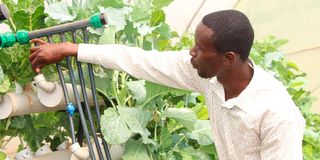
Sila Ooko, an innovator from Mosop Ward, Nakuru County, demonstrates an integrated farming system for producing clean vegetables for urban consumers on October 7, 2026.
Photo credit: Richard Maosi | Nation Media Group
Chinese cabbage, capsicum, onions, tomatoes and collard greens are among the crops thriving in the system.
According to Ooko, the technology provides an alternative for farmers in regions with unreliable rainfall and prolonged dry spells as it relies on a controlled water circulation system.
The project was inspired by shrinking arable land, climate change-induced aridity and declining soil fertility associated with excessive use of synthetic fertiliser in food basket counties close to urban centres.
Through hydroponics, urban farmers can grow vegetables without relying on conventional soil. They use inert growing media like pumice and locally available substrates.
The porous growing medium allows water and nutrients to circulate efficiently while providing structural support for the plants.
The greenhouse structure is assembled using metallic frames and locally available materials, including plastics. That makes it relatively easy to install, dismantle and transport.
Water conservation is another advantage associated with the tech. The closed-loop system recycles more than 90 per cent of the water used in production.
The water draining from the growing channels is collected in a reservoir – or sump tank – before being pumped back into the system for reuse, reducing wastage.
The greenhouse environment protects crops from excessive sunlight, birds and other external disturbances.
According to the group, the system reduces dependence on chemical pesticides by limiting exposure to pests and diseases associated with open-field farming.
This means the farmer produces clean vegetables while responding to growing consumer demand for safe food.
The project also incorporates black soldier fly (BSF) technology. The larvae are used as a protein-rich feed source for fish, while frass provides organic fertiliser for the crops.
This creates a circular farming model in which different enterprises complement one another, reducing waste and improving resource utilisation.
The greenhouse technology can also support the production of high-value crops like red and yellow capsicum, which perform well under controlled growing conditions.
“Beyond improving food safety, the programme demonstrates how young people can embrace agricultural innovation to create jobs and sustainable livelihoods,” Ooko says.
Sila Ooko, an innovator from Mosop Ward, Nakuru County, demonstrates how an integrated farming system for growing clean vegetables for urban consumers works, on October 7, 2026.
Photo credit: Richard Maosi | Nation Media Group
With urban populations growing fast and pressure on farming land increasing, integrated systems such as aquaponics and hydroponics could offer an alternative pathway towards reliable food production and climate-resilient agriculture.
Emmanuel Langat, a group member, says that at the heart of the aquaponics system is a tank where fish are reared under carefully monitored conditions, requiring regular feeding and a continuous supply of clean, well-maintained water.
“Fish excrete waste that releases ammonia into the water. If left untreated, the ammonia can become toxic to fish,” Langat says.
Through a biofilter containing pumice, beneficial bacteria convert ammonia into nitrites and eventually nitrates, which are absorbed by plants as natural nutrients.
The nutrient-rich water is then channelled to the plants, providing an organic source of nourishment before being filtered and circulated back into the fish tank.
This creates a sustainable production cycle in which fish waste supports plant growth while the plants help remove nutrients from the water, contributing to its purification before it returns to the fish.
The farmer regularly monitors pH levels of the water to ensure they remain within the appropriate range for fish and plants. Some water is drained and replenished twice a week to maintain suitable growing conditions.