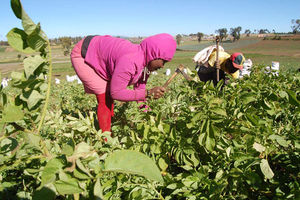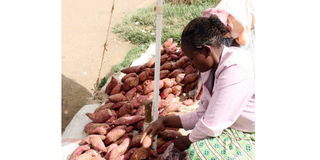
A woman sells sweet potatoes in Olkalau, Nyandarua County, on October 23, 2011, sourced from Kisii and Othaya.

The lower parts of Othaya Constituency—Karima, Mahiga and sections of Iria-ini—are known for coffee farming, while the upper areas specialise in tea. Most families grow one or both of the two cash crops.
However, a farmer from Kianduhiu village is breaking from tradition by venturing into sweet potato farming—a crop long associated with Western and Nyanza regions, traditionally grown for subsistence but now increasingly emerging as a lucrative agribusiness.
According to last year’s Agriculture and Food Authority (AFA) statistics, Nyeri County is not among the leading sweet potato producers, meaning traders and consumers rely heavily on supplies from Western and Nyanza regions.
It is this gap that Mr Anthony Kinya is exploiting, earning substantial returns from the tubers.
He started the venture on a quarter-acre plot in 2024 and, encouraged by the returns, has this year expanded the acreage to about three acres. Sweet potato farming has also opened another opportunity for Mr Kinya, who keeps dairy goats, specialising in imported German Alpine and Saanen breeds, often referred to as the “milk queens”.
He grows purple- and orange-fleshed sweet potato varieties and attributes his success to innovation and climate-smart farming practices, which help the vines withstand harsh weather conditions.
Mr Kinya uses two planting methods—the mound and ridge systems—both designed to maximise land use. In the mound method, he plants six to eight vine cuttings in an area that would typically accommodate two to three using conventional methods.
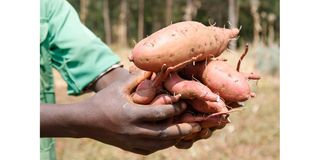
A farmer displays some of his sweet potatoes harvested on a small portion of land
Agronomist Michael Waithaka says recommended spacing is about 45 centimetres between vines, meaning a metre can accommodate about two vines depending on terrain and land preparation.
At Mr Kinya’s farm, both methods involve digging to a depth of about one metre and mixing topsoil and subsoil when forming mounds or ridges. “My mounds are about one metre high and cover roughly one square metre each. This allows roots to penetrate easily and produce tubers,” he says.
“In 2024, I harvested about 20 bags from a quarter-acre and sold each at Sh6,000, earning Sh160,000, which I reinvested. This season, I am preparing an additional half-acre.”
When Seeds of Gold visited the farm, workers were uprooting coffee bushes on half an acre earmarked for expansion.
The dense vine cover helps conserve moisture and control soil erosion. Mr Kinya says the method enables the crop to withstand prolonged dry spells.
“The deep soil preparation allows water to seep in gradually, while the vines protect the soil. The crop can withstand up to six months of drought,” he says.
Excess vines have also enabled him to expand into dairy goat farming. “I sell vines at Sh15 per cutting, but I still have surplus. That is why I introduced dairy goat breeding,” he says, adding that he recently sold a 10-month-old doe for Sh20,000.
He has engaged a veterinary officer to oversee the enterprise.
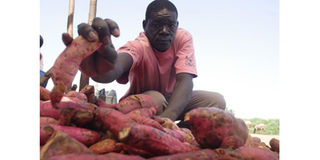
A sweet potato retailers arranges potatoes for sale in his stall at Kondele market, Kisumu.
However, labour remains a key challenge. “Preparing a quarter-acre can cost up to Sh30,000. But once established, the mounds and ridges are easy to maintain and harvesting is less labour-intensive,” he says.
To ease management, the farm is subdivided into quarter-acre plots.
Mr Waithaka says mound and ridge systems are ideal for efficient land use, especially as land sizes shrink due to subdivision.
According to AFA data, acreage under sweet potato cultivation increased from 57,535 hectares in 2019 to 68,448 hectares in 2024. However, production declined from 976,691 metric tonnes to 862,724 tonnes over the same period.
Yield dropped from 16 tonnes per hectare to 12 tonnes, even as demand rose sharply.
The mismatch between rising consumption and declining production has pushed farm-gate prices from Sh3,218 to Sh7,975 per 98-kilogramme bag between 2019 and 2024.
By 2024, Homa Bay was the leading producer at 247,246 tonnes, followed by Migori at 204,683 tonnes. Nyeri recorded 4,576 tonnes, up from 1,724 tonnes in 2020.
AFA says sweet potato remains a highly productive crop suited to marginal areas, with growing potential as a commercial venture.
“Traditionally grown for subsistence, sweet potatoes are increasingly being adopted as a cash crop due to rising demand, improved market access and their short maturity period,” the report states.
Follow our WhatsApp channel for breaking news updates and more stories like this.