What started with Francis Thoya baking about a kilogramme of fish-based snacks in a small kitchen has grown into an emerging agribusiness that links farmers to value addition while targeting nutrition challenges in Kenya’s coastal region.
Through his company, EcoAfia Initiative, Mr Thoya processes locally available fish, cassava, moringa, groundnuts, cashew nuts, coconut and baobab into fortified food products. The enterprise currently operates in Kilifi County, where it works with about 500 farmers organised in 10 groups, mainly women, who produce some of the raw materials used in its products.
“The business is still operating on a small scale, producing between two and five kilogrammes of snacks a day and up to 10 kilogrammes of fortified products,” Thoya tells ‘Seeds of Gold’. However, he says demand has been stronger than his current production capacity.
A 250-gramme packet of the Samaki Cookie snack retails at about Sh50, while individual cookies are sold at about Sh5 to make the products affordable to local consumers and common mwananchi.
According to the founder, the enterprise has three direct employees, with farmers forming an important part of its wider supply chain. “I want everybody to eat. The issue here is the nutritional aspect. The money will come,” says Thoya, who views food processing as a way of creating livelihoods while addressing malnutrition.
EcoAfia Initiative was established in 2020, following the onset of the Covid-19 pandemic. Mr Thoya says the disruption caused by the pandemic made him rethink how he could contribute to food systems and livelihoods during periods of crisis.
His idea was to combine the region’s agricultural and marine resources into commercially viable food products, instead of leaving farmers and fishers dependent on selling raw produce at low prices.
One of the products that emerged from the initiative is Samaki Cookie, a snack made from a blend of cassava flour, fish flour, moringa, groundnuts, cashew nuts, coconut and baobab seeds. Thoya narrates that he developed the product to respond to what he identifies as two major gaps in the coastal food system — nutrition and markets. “Many farmers in Kilifi engage in subsistence production, while the region also faces food and nutrition challenges,” he says. He adds, “Let people commercialise agriculture. Let them earn more, instead of just selling raw products.”
He gives the example of coconut, which can fetch a small amount when sold at the farm gate (as raw) but can generate substantially more value after processing into products such as flour, milk and other consumer foods.
Francis Thoya, founder of EcoAfia Initiative in Kilifi County, during the Kenya Youth in Agrifood Systems Summit 2026 at the Kenya School of Government, Kabete, Nairobi, on September 2, 2026.
Photo credit: Sammy Waweru | Nation Media Group
According to Mr Thoya, processing is the opportunity presented by value addition. Farmers can produce cassava, coconut, cashew nuts, moringa and groundnuts, while processors create products that reach consumers at higher prices.
His model is designed to create a market for the farmers while reducing food waste. In fish processing, he uses parts that would ordinarily be discarded, including the head, scales, intestines and bones, which are dried and crushed into fine powder.
The fish powder is then incorporated into the other ingredients to make the snacks and fortified products. He says the approach allows the enterprise to make better use of the fish while adding nutrients such as omega-3 and calcium to the food.
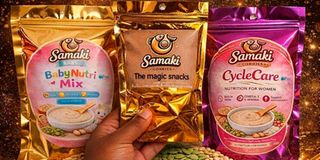
The business has three main products. These include Samaki Cookie Magic Snack, Samaki Cookie Cycle Care, a nutrition product targeting women, and Samaki Cookie Baby Nutrient, a fortified product designed for children. “The latter is intended to be prepared as porridge, with the enterprise focusing on early childhood nutrition and development,” he explains.
The development of the products, however, was not straightforward. Mr Thoya began experimenting at home with a small cooking pot and initially produced only about one kilogramme a day. I had no formal baking background and had to experiment with the ratios of cassava flour, fish powder, nuts, moringa and other ingredients, he shares. The first batches had an unpleasant smell, forcing him to repeatedly adjust the formulation.
After several years of experimentation and customer feedback, he says the enterprise settled on its formula in 2024. “The products have since undergone certification and patenting processes, opening the way for commercial expansion,” he stated in an exclusive interview.
Mr Thoya received support from organisations that saw potential in the innovation. Planet Ash sponsored him with an oven, while Farm Africa supported him with aspects of the fish processing and certification journey. However, the first oven was later stolen, forcing him to use his savings to acquire another small oven.
His main challenge now is scaling. The same equipment is used for drying fish and baking the snacks, limiting production capacity. He wants to establish a larger processing facility that can handle bigger volumes and allow the enterprise to introduce more products.
The company currently buys cassava flour from farmers, while Thoya handles the technical processing of fish into powder and blends the ingredients.
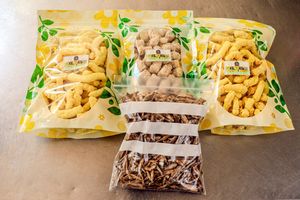
Some of the fish and climate-resilient produce value-added products processed by EcoAfia Initiative in Kilifi County.
Photo credit: Pool
To prepare for expansion, EcoAfia Initiative is encouraging its farmer groups to increase production of cassava, moringa, groundnuts and cashew nuts. The idea, he says, is to ensure sufficient raw materials are available when processing capacity increases.
The enterprise has also started exploring fish farming as another source of raw materials. Mr Thoya says farmers producing fish can supply the enterprise, creating a link between aquaculture and food processing. “Climate change is another reason I am promoting crops such as cassava, which I consider more resilient to changing weather conditions in the region,” he says.
His enterprise was among the companies and agripreneurs who attended the Kenya Youth in Agrifood Systems Summit (KYASS) 2026, held at the Kenya School of Government, Kabete, Nairobi, from September 2 to 4, where he shared his entrepreneurial journey and experience in developing food products from locally available agricultural and fishery resources with delegates.
Although his current market is mainly Kilifi, individual orders have reached customers in Nairobi, Kisumu and Nanyuki. He hopes certification and increased production will eventually enable the products to access wider markets, including exports.
Mr Thoya attributes the enterprise’s progress from producing about one kilogramme a day to several kilogrammes to consistency, customer feedback, support from partners and doing extensive research to improve the quality of his value-added products.
He was also recently elected continental president in Uganda, a recognition he attributes to his work in food systems and efforts to engage young people in implementing the Kampala CAADP Declaration.
The Kampala CAADP Declaration on Building Resilient and Sustainable Agrifood Systems in Africa is a 10-year roadmap adopted by African Union member states in January 2025 to guide the transformation of Africa’s agriculture and food systems, as well as strengthen food security, between 2026 and 2035.
Despite the progress and the remarkable growth he has recorded, financing remains a major hurdle. “Innovative enterprises require research, testing, certification and product development before they can generate returns, making them more difficult to finance than conventional small businesses,” he says. Thoya is now seeking partnerships to mobilise resources for a processing factory.