From poor workmanship in some parts of the network and missing infrastructure such as footbridges to careless drivers and pedestrians, a lot has ailed Kenyan roads and claimed lives.
In the last 10 years alone, more than 40,000 people have died on Kenya’s roads, according to government data.
The World Health Organisation (WHO) has previously observed that the number of Kenyans dying in road accidents could be as many as four times the figure recorded in official government records, a fact that the National Transport and Safety Authority (NTSA) also acknowledges.
Dr Nhan Tran, WHO’s Head of Safety and Mobility, said in a previous statement that Kenya also does not factor in the total number of road accident deaths, including those who die in hospital after crashes.
“We know that many more deaths occur after the crash, in the hospital and sometimes many months after the crash. So, the main reason for the under-reporting of deaths in Kenya is due to the very narrow definition of a road traffic death that is used,” Dr Tran said.
This could mean that in the past five years alone, deaths from road accidents could have exceeded 90,000, or 82 per cent of Kenyans involved in road accidents, given the WHO estimate that the deaths recorded in government data could be as many as four times higher.
Data by the Kenya National Bureau of Statistics (KNBS) shows that in the five years to 2025, 114,466 Kenyans were involved in road crashes. About 22,894 people died, while 90,927 sustained injuries.
The road network, number of vehicles and deaths have one thing in common – they have all gone up in the last 15 years.
Deaths recorded on Kenyan roads between 2021 and 2025 were 42 per cent higher than those recorded in the previous period.
Annual deaths from crashes have grown, underlining worsening safety levels, as the as the road network grew from 63,640km in 2013 to 239,123km last year.
In the national road safety action plan, the NTSA reckons that rapid increases in human and vehicle populations are part of causes for the rise in road accidents, acknowledging that more Kenyans are dying on the roads.
“Our road safety problem has been driven by rapid increases in human and vehicle populations, which have in turn led to rapid increases in traffic. The whole road traffic system in Kenya in its current state cannot cope, and very large numbers of people are being killed and seriously injured as a result,” NTSA says in the 2024-28 action plan.
The Road Safety Association of Kenya (RSAK) says the number of Kenyans dying from road crashes has grown fourfold over the past 30 years, and reckons that pedestrians and passengers are the most vulnerable, accounting for 80 per cent of the deaths.
KNBS data shows that in the five years to 2025, 114,466 Kenyans were involved in road crashes and bout 22,894 people died.
Photo credit: File
The lobby attributes road crashes to prevalence of unqualified drivers, faulty speed limiters, overspeeding, driver fatigue, unroadworthy vehicles and poor road infrastructure.
“Crossing of roads by pedestrians at undesignated places. Overloading goods and excess passengers. Failure to observe traffic rules. Boda boda ignoring traffic rules, including failure to wear reflective jackets to boost visibility and speeding,” RSAK says.
Kenya’s most dangerous roads
In the road safety action plan, NTSA reckons that 36 per cent of all road crash fatalities in the country between January 2021 and June 2023 occurred in seven counties.
The counties are Nairobi, Kiambu, Nakuru, Machakos, Kakamega, Kisumu and Makueni
“Five roads in Nairobi County, representing 2 per cent of the road network, account for 36 per cent of all fatal crashes in the county. 26 per cent of crashes in Nairobi (30 per cent of crashes for the whole country) occur between 19:00 and 22:00,” NTSA says.
A few years ago, the agency released a report ranking Outering Road, Waiyaki Way, Mombasa Road, Northern and Southern bypasses, among Nairobi’s most dangerous roads.
In 2021, Outering accounted for 44 of the 371 deaths recorded, followed by Waiyaki Way which claimed 38 lives, while each of the remaining three roads caused 29 deaths.
At the time, construction of the James Gichuru-Rironi highway, which Waiyaki Way is part of, was ongoing.
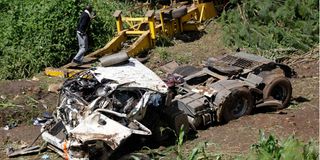
The wreckage of a matatu belonging to Eldoret Crossroads that was involved in an accident that killed seven people in Kamara, Mau Summit along Nakuru-Eldoret highway on July 03, 2026.
Photo credit: Mercy Koskei | Nation Media Group
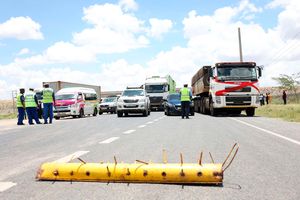
As construction was still a long way out, and pedestrians had limited safe options when crossing the road, the Kenya National Highways Authority (KeNHA) put up speed bumps and rumble strips in populous areas like Kangemi, Kinoo, Regen, Sigona and others along the way.
During the same year, Thika Superhighway and Eastern Bypass claimed 27 lives each, Kangundo Road caused 23 deaths, Ngong Road (22) and Jogoo Road (14).
Major causes of road accidents have been drink driving, overspeeding, lack of road infrastructure including road signs, foot bridges to cater for pedestrians, and a general disregard to traffic laws.
“Based on video data collected at 38 blackspot locations in Nairobi, only 24 per cent of pedestrians use the designated crosswalk when it is available. Pedestrians may not use crosswalks because drivers may not stop at these locations, making them unsafe for crossing,” NTSA says.
Some road contractors have also been accused of failing to deliver projects as planned, failing to put up support infrastructure such as foot bridges, interchanges and cyclist paths, despite being budgeted for.
A 2020 audit on installation and maintenance of road furniture in the country revealed that agencies had failed to install road signs, guard rails on some roads, triggering a rise in road crashes.
The Auditor-General inspected installation of the road furniture to establish causes for road accidents and amid calls from stakeholders for erection of appropriate road furniture, and dilapidated road furniture.
“A review of sampled KURA (Kenya Urban Roads Authority) and KeRRA (Kenya Rural Roads Authority) road contracts revealed that some contracts either had minimal or no provision for road furniture. Four out of 22 KURA contracts did not have provision for road furniture, while eight contracts only had provision for kerbs. For KeRRA, out of 11 contracts, one did not have provision for road furniture while six only had provision for kerbs,” the public auditor said.
More than half of the roads sampled lacked warning signs for bumps, bends and pedestrian crossings at crucial locations. Of the 786 bumps in roads under Kura, KeRRA and Kenya National Highways Authority (KeNHA), 430 did not have signs to warn motorists.
“Absence of these critical road furniture poses safety risks to road users. Lack of safety fences renders limited or no protection to road users while absence of markings in areas where traffic is expected to slow down exposes road users to accidents,” the report said.
Pedestrians have been biggest casualties of road accidents in the country, accounting for 36.4 per cent of the official deaths recorded in the past five years. They are followed by motor and pedal cyclists, passengers and pillion passengers, then drivers account for the lowest deaths.
“The current road safety situation is concerning, especially in the face of a rapidly growing vehicle fleet. Vulnerable road users—especially pedestrians and motorcyclists—are the most at risk,” NTSA says in the road safety action plan.
Caskets bearing remains of some of the 16 victims of a road crash that occurred in Nyeri on March 28, 2026, on April 7, 2026 during an interdenominational funeral service at Kabirui-ni grounds.
Photo credit: Gitonga Marete| Nation Media Group
The burden of road crashes has not only been on human life where many families lose bread winners, but also an economic cost estimated at Sh300 billion annually, RSAK says
“Most families lose their breadwinners leaving them more vulnerable and poor and there is the element of long-time recoveries for those involved in road accidents. In most cases, the victims become physically challenged which inhibits them from working in various sectors or losing their jobs entirely,” says David Kiarie, RSAK Chairman.
RSAK says among measures to prevent road crashes is adherence to speed limits on the roads, developing a policy to accredit driver training institutions and more severe penalties for drunk driving.
During the same period when thousands of Kenyans have died on the roads, more citizens have been importing vehicles for personal and business use, perhaps motivated by new roads that keep cropping up.
The number of newly registered vehicles per year also shot up more than twice from 173,044 in 2012 to 395,235 last year.
The government is addressing road crash problems through a multi-agency approach that includes the agencies that construct and maintain the roads.
“KURA, together with sister agencies NTSA, KeRRA, and KENHA, is working on strategies to effectively reduce road carnage. Approach includes re-looking at infrastructure, analyzing data, and public awareness programs,” Kura said.