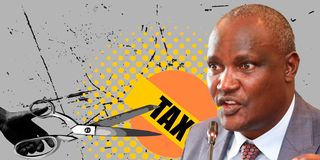
Fuel tax cuts following the Iran war and fear of a Sh35 billion revenue hole forced the Treasury to backtrack on the pledge to include income tax cuts for salaried workers earning below Sh50,000 in the Finance Bill.
The National Treasury says it has been forced to pause the payslip relief after it cut Value-Added Tax on petroleum products to eight per cent from 13 percent for three months to cushion consumers from a surge in fuel prices following the Middle East conflict.
It reckons that the cuts on VAT and the Sh35 billion personal income tax relief posed risks to Kenya's public finances.
The State promised that salaried workers earning Sh50,000 and below would enjoy income tax cuts of between Sh731 and Sh2,127 under proposed changes to Pay-As –You- Earn (PAYE) tax brackets aimed at cushioning low-income earners from inflation.
The Treasury shelved a special Tax Laws (Amendment) Bill 2026 that would have facilitated the tax cuts and signalled the reliefs would be included in the Finance Bill 2026. The proposal to cut payroll taxes for low-income earners had been mulled before the start of a new Middle East war at the end of February 2026.
National Treasury and Economic Planning Cabinet Secretary John Mbadi when he appeared before the National Assembly Finance and Planning Committee at Bunge Tower in Nairobi on April 2, 2026.
Photo credit: Dennis Onsongo | Nation Media Group
“We are looking at the impact of the war and are unclear on how long that lasts. Already, we have reduced VAT on petroleum products," Mr John Mbadi, National Treasury Cabinet Secretary, said yesterday.
“The first simulation was that we are going to lose revenue of about Sh35 billion per year (from the Paye reduction). We are looking at the economic situation as it is.”
The promise to include income tax cuts for low-income salaried workers is conspicuously missing from the Finance Bill, 2026, despite both Mr Mbadi and President William Ruto popularising the intervention recently.
The freezing of the PAYE revision has dealt a blow to more than one million employees who expected the measure to be adopted as a cushion to the rising cost of living.
The halving of VAT on petroleum products, which is expected to be in effect for at least three months from April 15, 2026, has presented another headache for the exchequer, which is under pressure to improve domestic revenue mobilisation and cut its dependency on debt to plug the fiscal deficit.
The halving of VAT on fuel is expected to deliver a revenue loss of about Sh12.9 billion in the next three months.
The emergency measure was in response to a public outcry that followed the sharp jump in pump prices in the April 14 pricing review.
VAT on petroleum products accounts for about one-third of annual value-added tax collections, or Sh100 billion.
Without the VAT cut, the State would have risked a fall in collections due to reduced consumption of fuel on account of higher pump prices.
The National Treasury says it is still keen on having both the cut on fuel VAT and PAYE to ease consumers' burden.
“We are looking at records from the Kenya Revenue Authority (KRA) on the impact of personal income tax reforms realised in March, April, and May to assess the final impact,” added Mr Mbadi.
The National Treasury Building in Nairobi.
Photo credit: Pool
“The consideration is being made to include the (PAYE) adjustment in this (Finance) Bill. We have agreed with the Head of State (President Ruto) that this is an amendment we may carry regardless of the impact it will have on our revenues because we feel it is important for the economy.”
Payroll taxes were the largest revenue head for the Exchequer in the fiscal year ended June 30, 2025, netting Sh560.5 billion for State coffers from Sh488.1 billion previously, underlining the impact of personal income taxes on Kenya’s public finances.
The Iran conflict has left Kenya scrambling to stave off shortages of essential commodities like fuel, and the war's ripple effects are expected to spur inflationary pressures that could dampen Kenya's growth prospects.
The National Treasury has revised its growth projection for 2026 from 5.3 per cent to five per cent and expects output to be much lower if the conflict persists. Mr Mbadi, in February, said the ministry had prepared a Tax Laws (Amendment) Bill that would raise the threshold of untaxed income from Sh24,000 to Sh30,000, while income falling between Sh30,000 and Sh50,000 would be taxed at 25 percent.
Under the promised changes, workers earning Sh30,000 would have seen a Sh731.25 increase in their monthly net pay to Sh26,925—after statutory and PAYE deductions.
Those earning Sh35,000 per month would see a Sh1,500 jump in net pay to Sh31,059.38, with their PAYE falling to Sh353.13 from Sh1,853.13.
According to the now delayed plans by the Treasury, the net pay for those on a gross salary of Sh50,000 would have risen by Sh2,127.10 to Sh41,156.25 per month.
The government has recently come under intense pressure to review the recent statutory deductions, specifically the National Social Security Fund (NSSF), the Social Health Insurance Fund (SHIF), and the Affordable Housing Levy (AHL).
The Kenya Bankers Association proposed a uniform 5.0 percent reduction in PAYE rates across all existing tax bands.
Last year, real wages, which have been adjusted for inflation, rose marginally to Sh56,566 from Sh55,450 in 2024. The earnings are, however, still lower than in 2020, when they stood at Sh62,256.