The government abandoned plans to construct a second runway at the Jomo Kenyatta International Airport (JKIA) to cut project costs and the lack of immediacy for a twin strip.
Cabinet Secretary for Roads and Transport Davies Chirchir says the current runway adequately serves the airport and a second one will not be needed in the short term, making it unnecessary to spend borrowed money on it.
This is a U-turn from the earlier upgrade plan, which included the construction of a new terminal that will improve JKIA’s capacity to over 22 million passengers annually, and a second runway to support the expected rise in aircraft movements at the country’s main airport.
“The current runway has two rapid exits and a terminal exit at the end, and can handle up to 25 flight take-offs and 40 flight landings per hour, and we’re not about to reach that until 2029,” Mr Chirchir said in an interview.
Transport Cabinet Secretary Davis Chirchir.
Photo credit: File | Nation Media Group
The initial JKIA Development Masterplan developed by consultant Dar Sidara included the construction of a second runway which was to be used as the primary one for international flights.
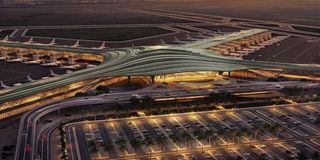
Design renders of what JKIA will look like after the airport is upgraded.
Photo credit: Pool
Sidara’s analysis was that the runway can accommodate up to 30 aircraft movements per hour - both landings and takeoffs in a mixed-mode operation, and that it will reach its operational limit by 2027.
The current runway is 4,117 metres long and 45 metres wide with a partial parallel taxiway. Dar recommended the construction of a second runway measuring 4,117 metres long and 75 metres wide to accommodate larger aircraft. It would have a capacity of handling up to 31 take-offs and 40 landings per hour.
As of 2024, JKIA recorded an average of 2 aircraft landings and 24 take-offs per hour, but this is expected to grow to over 32 arrivals and 34 departures by 2029, which the current runway will not be able to accommodate, leading to flight delays and congestion.
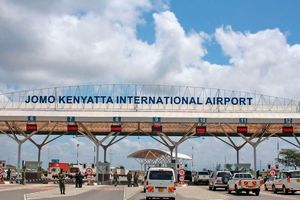
A section of Jomo Kenyatta International Airport's International departure in April 27, 2025.
Photo credit: Francis Nderitu | Nation Media Group
The consultant contracted to develop the masterplan warned that the airport can still operate with the current runway, but this will not be possible beyond 2029, urging the construction of a second runway.
“Beyond 2029, the upgraded single-runway system will no longer be sufficient to meet peak hour demand. At this point, the construction of a second runway will become necessary to ensure continued operational resilience and support JKIA’s role as a regional aviation hub,” the consultant said in the masterplan presented to the ministry.
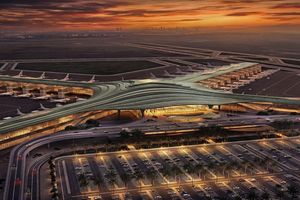
Design renders of what JKIA will look like after the airport is upgraded.
Photo credit: Pool
CS Chirchir said that since the airport will be financed from a loan, it doesn’t make sense to spend money on a second runway, for which there is no immediate need.
“To invest and build a runway today and start paying a loan for a runway that we don’t need would not be in line with a project finance that you would be looking at the bottom line in terms of the profitability level,” he told Business Daily.
“If we are going to be paying so much loan for assets which we are not utilising today, what is the purpose?”
Without the runway, the airport upgrade project is estimated to cost Sh154 billion ($1.2 billion), a significant drop from Sh260 billion earlier proposed under the Adani concession plan, which would’ve involved the construction of a new terminal, a second runway, and the renovation of the current terminal and existing facilities.
However, the single runway status of the airport has proven disastrous in the past, when aircraft failures on the runway have forced a shutdown of the airport due to the lack of an alternative runway for arrivals and departures.
In 2023, for instance, when a Singapore Airlines cargo plane stalled on the runway during take-off due to a bird strike, the airport was shut for hours with several flights being diverted as far as Entebbe, Mombasa, and Dar es Salaam.
A similar situation occurred in 2022, when a Fly540 aircraft developed a mechanical issue during take-off and stalled on the runway, forcing a 4-hour shutdown that led to 15 flights being diverted.
In the region, major airports generally have second runways, albeit much smaller than the primary ones.
In Entebbe, Uganda’s main airport, the primary runway is 3,650 metres long, while the secondary runway is 2,400 metres long and is reserved for smaller aircraft or alternative use by larger ones.
At the Julius Nyerere International Airport in Dar es Salaam, the primary runway is 3,000 metres long, while the secondary one is 1,000 metres long, used only by light aircraft.