Kenya's mineral production declined by about 20 percent in 2025, falling from Sh25.5 billion to Sh20.3 billion, after Base Titanium, the country's largest mineral exporter, wound down operations in Kwale County following the depletion of economically viable ore reserves.
The decline is documented in the Economic Survey 2026, which shows that the Australian mining company had accounted for the bulk of Kenya's mineral export earnings for over a decade. Its exit left a gap that no other mineral came close to filling.
"The decline is largely attributable to the exit of Base Titanium following the depletion of economically viable ore reserves," the survey stated.
The impact was sharpest in titanium-related minerals. Ilmenite production fell by 54.7 percent, rutile by 28.3 percent and zircon by 56 percent.
Combined, the three minerals brought in Sh7.8 billion in 2025, down from Sh17.0 billion the year before. Titanium had alone accounted for more than half of total mineral production value in previous years.
Base Titanium had operated in Kenya for 11 years, exporting a total of 5.2 million tonnes of titanium minerals including 3.9 million tonnes of ilmenite, 804,000 tonnes of rutile and 295,000 tonnes of zircon. The company invested more than $380 million in its Kwale project and paid approximately Sh2 billion in mineral royalties to the government in the 2023 financial year.
Not all minerals recorded losses. Soda ash production rose by 9.3 percent to 289,610 tonnes, with its value climbing to Sh4.0 billion from Sh2.2 billion in 2024. Crushed refined soda grew by 32.7 percent to 697,769 tonnes, valued at Sh1.7 billion. Carbon dioxide output more than doubled to 31,526 tonnes, with its value rising to Sh1.3 billion. Gold production eased slightly to 329.1 kg but held a steady value of Sh3.3 billion.
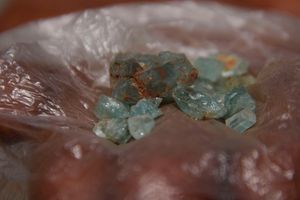
Rough gemstone production surged from 145,100 carats in 2024 to 2.17 million carats in 2025, lifting that segment's value to Sh438 million. Construction minerals recorded the strongest volume growth, rising from 78,805 tonnes to over 1 million tonnes, with a value of Sh1.0 billion.
Despite the fall in production value, total mining revenue from royalties and licences rose from Sh3.3 billion in 2023/24 to Sh3.8 billion in 2024/25.
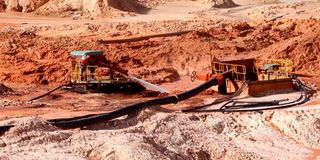
Operations at the Base Titanium Mining Plant in Kwale County in this photo taken on June 29, 2022.
Photo credit: Kevin Odit | Nation Media Group
The levy on cement minerals was the largest contributor at Sh1.5 billion, while carbon dioxide royalties grew more than fivefold to Sh175.5 million. Base Titanium's royalty contribution fell by 37.2 percent to Sh706 million as operations wound down.
The survey also shows that the wider mining and quarrying sector, measured by Gross Value Added, grew by 25.9 percent to Sh141.7 billion in 2025, as part of a broader expansion in Kenya's environment and natural resources sector whose total GVA rose by 19.9 percent to Sh759.3 billion.
At the Kenya Mining Investment Conference and Expo 2026 in Nairobi, Cabinet Secretary for Mining Hassan Joho used the sector data as a backdrop to push for stronger licensing compliance and community accountability.
He raised concern about the growing number of operators registering as small-scale miners to avoid the fuller obligations attached to a full mining licence, including royalty payments and community benefit-sharing.
"Everybody is focused on being registered as a small-scale miner, meaning that you only acquire a permit. You are escaping responsibility by taking a permit," he said.
Joho said permit holders frequently extract minerals from community land without engaging residents or agreeing on compensation.
"You don't engage the community because you just have a permit that will enable you to extract minerals, load in the truck and transport it," he said.
"But you don't take responsibility to even pay royalty, to even have an agreement with the community of their fair share from your gross sales."
He pointed to physical dangers left by unregulated extraction, including open and abandoned pits.
"In some instances, livestock have fallen in and died. The other day, two young kids were rescued because someone was able to dive in and rescue," he said.
Joho called on miners to apply for full licences and provide rehabilitation bonds. "So just rightfully apply for your mining licence. Give us some insurance or some bond for rehabilitation and move on," he said.
He added that the ministry is working to publish a verified list of licensed operators on its website to strengthen public accountability and help tackle fraud in the sector.