Flower sector owed Sh12bn VAT refunds
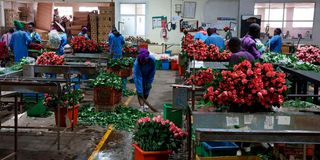
Workers package flowers at the Xflora Group in Njoro, Nakuru County on April 8, 2026.

What you need to know:
- The industry that exports about 230,000 tonnes of flowers a year is struggling to stay competitive abroad.
- Climate-related shocks affecting water availability and quality, and disruption from the protests, have added to the strain.
Kenya's flower growers are asking the government to release Sh12 billion in Value Added Tax (VAT) refunds, saying delayed payments are squeezing cash flow as fuel and freight costs, geopolitical tensions, climate shocks and recent youth-led protests pile on pressure.
The Kenya Flower Council (KFC) says some refunds have gone unpaid for two to three years. The industry exports about 230,000 tonnes of flowers a year, according to KFC, and is struggling to stay competitive abroad.
KFC chief executive Clement Tulezi said growers and exporters are focused on keeping operations running rather than expanding.


"The war in the Middle East has hit us very hard, and I would not say that we are enjoying the times," Mr Tulezi said. "Business has become very difficult because the cost of doing business is very high, not just in Kenya but also within the region."
The past five months have been particularly difficult, Mr Tulezi said, with freight costs rising to levels that make Kenyan flowers less competitive overseas. High fuel prices add to costs across production, transport and the cold chain that a perishable export depends on.
"Growers and exporters are basically surviving at the moment, and what we can do is maintain operations," he said.
Mr Tulezi spoke this week at the launch of the Horticulture Council of Eastern Africa (HoCEA) in Nairobi, held alongside a regional public-private dialogue on horticultural logistics and trade facilitation.
HoCEA brings together horticulture associations from nine countries and aims to give the sector a unified regional voice.
Mr Tulezi said the industry wants the government to set up an export support fund. "That is the only way we can continue surviving when we have money back into circulation that can at least supplement our cash flows," he said.
On VAT, he said: "On VAT in Kenya alone, we are looking at about Sh12 billion that the government owes us. Some of these refunds date back two or three years. According to Kenyan regulations, VAT is supposed to be paid within six months, and that has not been done."

Chief Executive Officer and head of the Kenya Flower Council Clement Tulezi during the launch of the Horticulture Council of Eastern Africa (HoCEA) in Nairobi on September 22, 2026.
He questioned why businesses are penalised for missing statutory deadlines while government agencies can hold taxpayers' money for long periods.
The alternative VAT voucher system is no answer, he said, because growers apply for refunds in cash and the Kenya Revenue Authority (KRA) restricts what the vouchers can offset.
"For example, you cannot offset it against PAYE," Mr Tulezi said.
Some companies are owed more than Sh2 billion each, he said, and the amount grows daily. Mr Tulezi warned that accumulated refunds could reach Sh20 billion or Sh30 billion, making them harder for the government to settle. Growers also carry a heavy tax load.
"Anyone growing fresh produce in Kenya pays more than 50 taxes and levies in a year. That is not sustainable," Mr Tulezi said.
Because flowers are grown and exported daily, he added, every new levy hits the same day. Climate-related shocks affecting water availability and quality, and disruption from the protests, have added to the strain.
With only a narrow window between harvest and consumer, any break in the cold-chain, airport or freight chain has an immediate cost.
KFC is also pushing for deeper regional integration. Mr Tulezi said HoCEA would let growers press for harmonised policies, taxes and standards.
The East African Community, the Common Market for Eastern and Southern Africa and the African Continental Free Trade Area already offer trade frameworks, he said, but implementation is fragmented.
Mr Tulezi said flowers grown in Kenya or Ethiopia may pass through the Netherlands before reaching markets such as Ghana.
"This should never happen," he said.
The council wants African countries to harmonise sanitary and phytosanitary requirements, ease the movement of goods and people, and negotiate freight costs collectively.
The region depends heavily on foreign airlines, he said. Ethiopia has 13 Boeing 777 aircraft, but against the need for freight that is "a drop in the ocean".
Flower production across the wider region is approaching 500,000 tonnes, according to KFC figures.
Follow our WhatsApp channel for breaking news updates and more stories like this.