Floriculture is one of the industries facing the devastating effects of climate change, as unpredictable weather patterns, particularly rainfall, drought, destructive pests, and diseases impact the agriculture sector at large, forcing florists and farmers to rethink their approaches.
In the flower industry, for instance, growers are compelled to go for climate-resilient flowers in a bid to maintain Kenya’s primary glory of flowers in the international markets. Kenya is Africa’s leading flower exporter and ranks among the world’s top four exporters of cut flowers. The country supplies more than 35 per cent of the European Union’s rose imports, depicting its dominant position in the global floriculture industry.
Nelly Thuo, the founder of Chalvin Farm Fresh Ltd, has been growing flowers since 2020, a venture she says is a Covid-19-born baby, and when climate shocks are mentioned, she clearly understands what they mean.
Nelly Thuo, founder of Chalvin Farm Fresh Ltd, gazes at eucalyptus trees she grows as export flowers during the 13th International Flower Trade Exhibition (IFTEX) held in Nairobi on June 4, 2026.
Photo credit: Sammy Waweru | Nation
What began as a small post-pandemic venture has since evolved into a diversified export business, with eucalyptus emerging as one of the most strategic crops on her farm.
Traditionally known as a forestry tree, eucalyptus is now increasingly being repositioned in the global floriculture market as a foliage product used in bouquets and floral arrangements, particularly in the Middle East and parts of Europe. According to Ms Thuo, the crop has also become a practical response to the growing unpredictability of climate patterns affecting flower production.
“I introduced eucalyptus about two years ago after noticing that many conventional flower varieties were becoming difficult to sustain under erratic rainfall and rising temperatures,” she says.
Unlike most cut flowers, eucalyptus has shown greater tolerance to harsh weather conditions, making it a reliable alternative for export production.
She notes that her farm embraced eucalyptus because it is more resilient to climate variations than many other flowers. “Most flower varieties are highly sensitive to weather changes, but eucalyptus can withstand harsher conditions,” adds the grower.
Today, Chalvin Farm Fresh has about three acres under eucalyptus production, and the crop has become one of the most stable contributors to weekly export volumes.
The farm, according to Nelly Thuo mainly supplies markets in Dubai, the United Arab Emirates (UAE) and Oman, where demand for foliage in floral arrangements continues to grow.
The farm exports about 10,000 eucalyptus stems every week, she reveals to ‘Seeds of Gold’, adding that the volume remains relatively stable even during periods when other flower varieties fluctuate due to seasonal or climate pressures.
The eucalyptus success story is part of a broader growth journey for the farm. Before venturing into business, Ms Thuo was employed as an administrator in a Chinese company. However, her connection to floriculture dates back to her childhood in Kinangop, Nyandarua County, where she grew up watching her mother, one of the pioneer flower farmers in the area, rely on flowers to support the family.
“That early exposure shaped my long-term interest in agriculture, which I eventually pursued when coronavirus struck the country in 2020,” she explains.
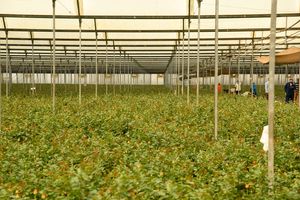
Chalvin Farm Fresh Limited specialises in summer flowers grown in open fields. With a farm in Kinangop, Nelly says that she started with about one acre of land, but today it has expanded to over 12 acres.
“I began small with a capital investment of about Sh50,000 which covered basic expenses such as labour and other initial costs,” she shares.
When the business started, the farm mainly focused on regiums, craspedias and agapanthus. Over time, it has expanded into more than 10 flower varieties including kangaroo paw, alstroemeria, ruscus, eucalyptus, arabicum and bupleurum, among others.
Nelly Thuo, founder of Chalvin Farm Fresh Ltd, gazes at eucalyptus trees she grows as export flowers during the 13th International Flower Trade Exhibition (IFTEX) held in Nairobi on June 4, 2026.
Photo credit: Sammy Waweru | Nation
Eucalyptus, however, has stood out not only for its resilience but also for its commercial value in export markets. It has proved to be a profitable crop. “Our main export markets are Dubai, the UAE and Oman, although we continue to seek buyers in other countries,” Ms Thuo explains.
According to the Kenya Flower Council (KFC), growers are increasingly shifting toward climate-resilient flower varieties as weather patterns become more unpredictable.
“Climate resilient flowers are gradually being embraced by growers and the recipient is good,” says Clement Tulezi, CEO of the Kenya Flower Council.
Apart from eucalyptus, Mr Tulezi says the council has also seen growers embracing climate-smart floriculture, with a strong push toward drought-resistant ornamental amaranth and resilient summer flowers such as craspedia, eryngium and spray roses, as farmers seek to conserve water and adapt to increasingly unpredictable weather conditions.
The volumes Nelly Thuo’s farm exports vary depending on the flower type. Craspedia, for example, says that the flower variety can reach up to 50,000 stems per week because the stems are smaller, while regiums average about 15,000 stems weekly. During off-season periods, particularly in June and July, exports to the Netherlands decline significantly. However, eucalyptus remains relatively stable because it does not experience a pronounced off-season. “Our flowers are sold per stem, with prices ranging between Sh10 and Sh30 depending on the variety,” she states.
The growth the farmer has experienced from one acre to more than 12 acres, she says, has been driven by consistency, quality and hard work. Customers require a reliable supply of flowers every week. As demand grows, her company gradually expands production to meet their needs.
Research is also critical. “We continuously engage with buyers to understand their quality requirements because different markets and customers have different standards. Producing flowers that meet those specifications is key to maintaining business relationships.”
Nelly Thuo, founder of Chalvin Farm Fresh Ltd, gazes at eucalyptus trees she grows as export flowers during the 13th International Flower Trade Exhibition (IFTEX) held in Nairobi on June 4, 2026.
Photo credit: Sammy Waweru | Nation
Just like other flower growers, one of the major challenges she faces is climate variability. Sometimes conditions are extremely hot and dry, while at other times rainfall is excessive.
Since she grows summer flowers, both extremes can affect production. Excess rain can damage flowers, while prolonged heat increases moisture stress.
Another major challenge is the rising cost of air freight. Freight charges have become so high that some flower varieties, especially heavier flowers such as regiums, are no longer economical to export. “In some cases, the selling price does not cover transportation costs,” she laments. Her view is echoed by the Kenya Flower Council, which is calling on the government to put in place measures to cushion the sector.
Over the past two months, Ms Thuo says she has incurred losses exporting flowers to the Netherlands because the market prices have not been sufficient to cover freight charges. This, she notes, has forced her to suspend exports of some varieties even though they are still growing on the farm.
On average, she estimates that her farm has been losing more than Sh100,000 per week yet they still have to pay workers, maintain flower quality and meet other operational costs despite reduced returns from exports.
Currently, Chalvin Farm Fresh employs 22 people. It started with only four employees.
Her company was among the exhibitors at the 13th edition of the International Flower Trade Exhibition (IFTEX), held in Nairobi from June 2 to 4 this year.
Despite the challenges facing the floriculture sector, it continues to demonstrate strong resilience. In 2025, the industry generated Dollars 845 million (approximately Ksh110 billion), contributing about 1.5 per cent of GDP, therefore remaining the largest contributor within horticulture.
The sector supports more than 200,000 direct jobs and sustains over one million livelihoods across farms, logistics chains, cold rooms, air cargo operations and rural economies, with women making up more than 60 per cent of the workforce.
Kenya exports flowers to more than 60 countries globally, with about 70 per cent destined for the European Union.