By the shores of Lakes Nakuru and Naivasha, water is redrawing the map of the Rift Valley.
What looks from afar like a victory for nature: a swelling lake, lusher wetlands, and vegetation reclaiming once-barren ground is forging a far more complicated reality for wildlife.
A Kenya Wildlife Service ranger guards a section of the submerged electric fence at Lake Nakuru National Park on January 26, 2026. Rising waters continue to affect wildlife’s grazing land and habitat.
Photo credit: Boniface Mwangi I Nation Media Group
As dry land disappears, animals are being squeezed into smaller territories, forcing species into closer competition with one another and, increasingly, into contact with people. At the same time, the expanding waters are creating new ecological niches, encouraging vegetation in places that were previously too dry to support it and allowing aquatic and wetland plants to spread.
The first impression is deceptive. After years of concern about drought and disappearing water, the swollen waters of Rift Valley lakes might seem like good news. Around Lake Nakuru and Lake Naivasha, the landscape has in places become visibly greener. Areas that once appeared dry, dusty, and almost devoid of plant life have begun supporting grasses, shrubs, and wetland vegetation.
But beneath that greening landscape lies a profound ecological upheaval. The lakes are not simply becoming larger; they are changing the amount and distribution of land available to wildlife. Shores are moving inland. Grasslands and woodland are being submerged. Wetlands are expanding into areas that were once terrestrial habitats. Animals that depended on those dry habitats have been forced to retreat to the remaining patches of suitable ground.
“The result is a territorial squeeze,” notes Gideon Kebati, former Kenya Wildlife Service (KWS) Central Rift senior assistant director who was recently moved to Coast Conservation Area in the same capacity.
A buffalo grazes on the shores of Lake Nakuru.
Photo credit: Boniface Mwangi I Nation Media Group
At Lake Naivasha, the consequences have become particularly visible. Rising water has displaced wildlife, including hippos, buffaloes, giraffes, and other animals, from flooded pasture and shoreline habitats. In June 2026, reports from the lake described wild animals moving into private farms, homes, and roads as water swallowed areas they had previously occupied.
According to Kebati, Lake Nakuru occupies 180 square kilometres, but already 80 square kilometres of the park have been claimed by the waters.
“For the animals, there is no concept of private property,” he says. “A buffalo pushed out of its grazing range does not know that the green field ahead belongs to a farmer. A hippo searching for a route between water and feeding grounds does not recognise a settlement boundary. And a giraffe that is losing its familiar browsing area simply follows whatever vegetation remains.”
“And when hundreds of animals are displaced at the same time, the traditional boundaries between wildlife territories can begin to break down. A shrinking map for wildlife,” he continues.
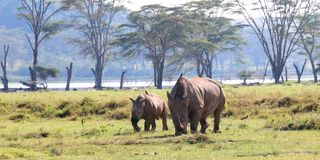
In Lake Nakuru National Park, says Kebati, the most affected animals are rhinos. He notes that this animal has a specific place where it sleeps, where it breeds and gives birth. It becomes very hard for it to move unless otherwise. With the current situation, they have been compelled to move, and when they do so, they move into other animals’ territory. This, according to the director, results in fierce fights that at times lead to death.
A case in point is the death of two hippos in Lake Naivasha after they engaged in a fight that led to the death of the two male herbivores.
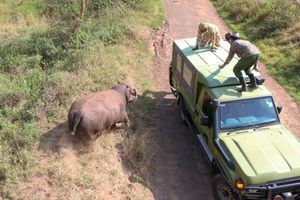
Last week, KWS conducted the translocation of three black rhinos from Lake Nakuru National Park to a newly established rhino sanctuary in Laikipia County under the Rhino Range Expansion Programme.
“The exercise aims to create more space for rhinos and reduce territorial fights among them. This is necessary because the increasing rhino population has put pressure on the available habitat and reduced the park’s carrying capacity,” says Lake Nakuru National Park Director Martin Omondi.
Wild animals require space, not only for food, but also for breeding, resting, moving between water and feeding areas, and avoiding competitors.
Lake Nakuru National Park provides a striking example of what happens when that space is taken by water. Research into flooding in the park found that the inundation of important wildlife home ranges has forced animals into smaller areas. The resulting concentration increases trampling, competition, and pressure on the remaining vegetation.
According to Kebati, rising waters have rendered a larger section of the electric fence dead. This allows wild animals to break through the park's perimeter fence in search of pasture.
"Buffaloes are among the animals that wander out of the park, and several have been killed by villagers when they invade their farms. A case in point is where buffaloes were killed in Barut, a village in the neighbourhood of the park. The same has happened in Lake Naivasha, where hippos, giraffes, and buffaloes too have invaded private farms," he affirms.
KWS, alongside partners like the Giraffe Conservation Foundation and The Safari Collection, rescued and moved 15 Masai giraffes and about 150 zebras from Manera Farm in Naivasha. Rising waters of Lake Naivasha and human settlements had trapped the animals and cut off their migration paths. They were relocated to Nairobi National Park and the Naivasha Wildlife Sanctuary.
"When large herbivores are concentrated in smaller grazing areas, they consume vegetation faster. Buffaloes, zebras, giraffes, rhinos, and other herbivores that might previously have occupied different parts of the landscape can find themselves sharing increasingly limited feeding grounds," he continues.
"The competition is not necessarily a dramatic fight between animals. More often, it is a slow territorial conflict; one species consumes vegetation before another can reach it. Dominant animals occupy the best remaining grazing grounds, while weaker or more specialised species are pushed towards poorer habitats."
This greatly affects predators too. Where herbivores congregate, predators may follow. That can alter hunting patterns and increase encounters between species that previously maintained greater spatial separation. The same pressure can push wildlife beyond protected areas.
Omondi, on the other hand, says they have been compelled to reroute the park's circuit due to the rising waters.
"In preparation for the El Niño rains, we anticipate the current roads will be swallowed by water, though some sections have already been covered.
Currently, we have done 54km out of the 57km that we are targeting," he affirms.
At Lake Nakuru, flooding has also altered the lake's chemistry. Research by the University of Nairobi shows that reduced salinity has affected the growth of blue-green algae, an important food source for flamingos, contributing to changes in flamingo distribution. This illustrates how one physical change can ripple through an entire food web.
At Naivasha, the conflict extends beyond wildlife territories and into human territory. Kebati says their research on the effects of rising lake levels has documented the destruction of terrestrial wildlife habitat and an increase in wildlife–human conflict as dry land is inundated.
"In other words, the territorial battle is occurring on two fronts: wildlife competing for diminishing dry land, and wildlife increasingly coming into contact with human settlements and farms," he says.
However, he notes it would be misleading to describe the rising waters only as an ecological disaster. According to him, water is a powerful landscape-maker. Where the lake advances, it destroys some vegetation. But where moisture reaches previously dry ground, it creates conditions for new plant communities to establish.
The transformation is particularly important around the lake margins. Wetland plants can colonise newly saturated soils, while grasses and other vegetation can benefit from increased moisture in areas that were previously too dry to sustain dense growth.
"This creates an ecological paradox: the same rising water that destroys one habitat can create another," he confirms.
A dry patch that offers little food to wildlife may become productive after receiving sustained moisture. Kenya's Lake Naivasha management framework actually recognises the ecological importance of this transition.
At Lake Nakuru, researchers have documented a substantial presence of invasive plants. Several of these species have become established in areas that were previously dominated by grasslands used by large grazers such as buffalo and zebra.
According to him, more green does not automatically mean more food. A landscape can look healthier from above while becoming less useful to wildlife.
"An invasive shrub may cover ground that once supported nutritious grasses. A plant can colonise bare soil and make the landscape appear lush while offering little nutritional value or even becoming unpalatable or harmful to herbivores," says Kebati.
That is one of the concerns at Lake Nakuru, where invasive plants have been linked to the loss of grassland quality and quantity. The rising water therefore introduces another layer to the territorial struggle. Wildlife is not merely fighting over space, it is increasingly competing over the quality of that space.
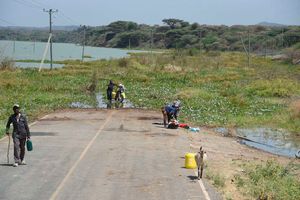
At Lake Naivasha, another transformation is unfolding in the water itself. For the lake as a whole, excessive growth can alter water movement and ecosystem processes. And as the shoreline advances, the boundary between land and water becomes increasingly fluid. A field that was once pasture becomes marsh, a road becomes a waterway, and the wildlife corridor disappears.
"The landscape is effectively being redrawn. This is perhaps the most important lesson emerging from both Lake Nakuru and Naivasha," he says.
There can even be more wildlife in one location and a greater risk to individual animals, because crowding increases competition, disease transmission, and conflict.
For wildlife managers, the greatest challenge may be that the traditional map of conservation is becoming less reliable. When a lake expands into a park, animals do not remain inside the original boundaries simply because those boundaries exist on a map. When pasture disappears, they search for pasture elsewhere. When water and food move, wildlife follows.
That means future conservation around the Rift Valley lakes will require more than protecting animals inside fixed parks. It will require protecting movement corridors, restoring native vegetation, controlling invasive plants, and identifying areas where wildlife can retreat as water levels fluctuate.
Scientists have linked the long-term rise of Kenya's Rift Valley lakes primarily to changing rainfall patterns, while also pointing to factors such as sedimentation, geology, and changes in groundwater systems.