For more than a decade, thousands of families around Lake Baringo and Lake Bogoria have watched floodwaters swallow their homes, farms, schools and roads. Images of submerged buildings have become familiar, but they tell only part of the story.
Behind every flooded homestead is a family forced to leave land inherited over generations, a livelihood destroyed overnight, a community displaced yet again with no certainty of what comes next.
A visit across Baringo County reveals a crisis that goes far beyond environmental change. It is a humanitarian one, driven by rising lake levels, shifting rivers and a climate that no longer behaves the way it used to — a crisis measured not in square kilometres, but in the number of families who no longer know where home is.
Richard Yegon, 82, from Loboi village who has been displaced by the flooding in Lake Bogoria three times. He says his land is now approximately 10 kilometres inside the lake.
Photo credit: Florah Koech | Nation
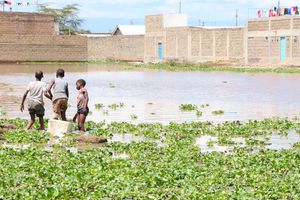
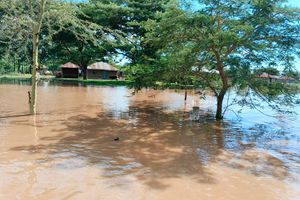
In Loboi, what was once a thriving settlement now lies beneath the expanding waters of Lake Bogoria. Only scattered trees rising out of the water mark where houses and farms used to stand. The roads that linked neighbours are gone. Schools, health facilities and trading centres have either drowned or been relocated.
Residents say the lake, once nearly two kilometres from their homes, has been advancing every year since 2012.
Elder Joseph Biwott remembers watching the water creep toward the village before it swallowed homes, farms, even the hospital.
"Mbeleni nilikuwa naishi kona huko, kwa hii mbugani hapo, halafu tukasonga (Before, I used to live over there, in that grassland area, then we had to move)," he says.
"Hii mambo ya maji ilianza 2012, ikaanza kukuja, 2013 ikakuja ikasonga, 2014 ikafikia kwa manyumba ya watu, ndio ikakahamisha watu (This problem started in 2012. It began creeping in, and by 2013 it had advanced further. By 2014 it had reached people's houses, and that's when it displaced them)."
Hundreds of families scattered — some to the edge of the game reserve, others to whatever relatives and neighbours would take them in. Biwott says the water is still climbing the hillside, threatening to displace people all over again. Residents are now appealing for compensation and permanent resettlement.
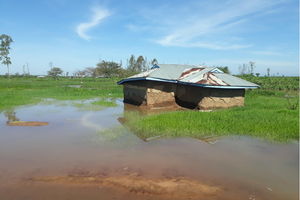
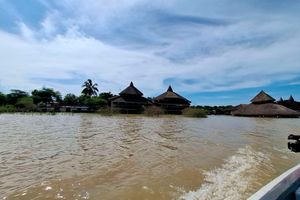
Homes surrounded by rising Lake Baringo waters.
Photo credit: Jane Gatwiri | Nation Media Group
For generations, families here farmed maize, beans and vegetables and kept cattle on land that fed their households and their incomes. Much of that land now lies underwater, and with it, people's independence. Many now depend on casual labour or humanitarian handouts to survive.
Robert Majanga has lived in Loboi since 1977. He has watched roads built under Presidents Jomo Kenyatta and Daniel arap Moi vanish beneath the lake.
"What Kenyatta built in 1976 is now under water. What Moi built in 1979 was also taken by the lake," he says.
"If it rains again we will have to move. We have no options left. Right now I am only 50 metres away from the water."
Another resident, Bakulutu, estimates more than 600 households have already been displaced. The flooding has destroyed businesses and farms and forced the local dispensary to relocate to a facility without electricity, leaving nowhere safe to store anti-snake venom.
"We had businesses here. We were farmers. But now we have nothing," he says.
Photo credit: Nation Media Group
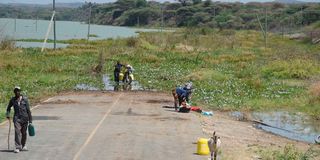
Beyond the expanding lakes, residents say rivers that have flowed the same way for generations are behaving differently. In Loboi, locals believe River Loboi now drains differently into Bogoria. Further north in Sandai, residents say River Waseges has shifted course, sending more water into the lake and disrupting transport, farming and access to basic services. In Mbechot, overflowing rivers regularly cut villages off from Marigat, keeping children from school and health workers from reaching the sick.
"We had maize farms that were swept away into Bogoria," says Stella Kiploman, a Mbechot resident. "We are asking God for mercy."
Learners at Noosukro Primary School in Baringo South learn under trees after their institution was swallowed by rising water levels.
Photo credit: Florah Koech | Nation Media Group
Scientists attribute the rising lake levels to a combination of climate variability, increased rainfall and geological processes tied to the Great Rift Valley itself. According to geologists, underground water systems have become increasingly saturated, allowing water to seep through fault lines before eventually flowing into rivers and lakes. The phenomenon is not unique to Baringo — similar increases in water levels have been recorded at Lake Nakuru and Lake Naivasha, prompting scientists to continue studying the changing hydrology of the entire Rift Valley.
The evidence surfaced in an unexpected place. In May 2026, underground water suddenly broke through in Olkokwee, Mogotio Constituency, flooding more than 250 acres of farmland and threatening dozens of homes. Resident Vincent Rotich woke in the night to find water entering his house, then rising until it reached his bed. With nowhere else to go, he and his family stayed inside until morning, not knowing if they would survive the night.
Geologist Elizabeth Oloo says climate change, volcanic activity and the Rift Valley's fault lines are letting rainwater sink underground and resurface elsewhere — a process she says is also driving rising water levels in rivers, lakes and oceans worldwide.
Professor Simon Onywere has proposed diverting River Waseges into Lake Baringo instead of Bogoria, then channelling Baringo's excess toward the Suguta Valley for irrigation, turning floodwater into a resource rather than a threat. Scientists say the idea needs far more research before anyone attempts it, and that emergency response alone will not solve the crisis. For residents living through it, understanding why the water keeps rising matters just as much as any fix — it could decide whether their children face the same fate.
The changing lakes are threatening one of Baringo's most important economic sectors, too. Lake Bogoria is internationally known for its flamingos, hot springs and geysers, while Lake Baringo supports fishing, bird watching and tourism activities that sustain thousands of livelihoods beyond the lakeshore. James Kimaru, senior warden at Lake Bogoria National Reserve, says the lake has swallowed nearly 20 square kilometres beyond its old boundaries, taking the entry gate, roads and park infrastructure with it.
"Our entry gate, which used to be one of the best gates in this region, is now under water," Kimaru says. "There is a lot of infrastructure — the road from the main gate to the outpost, the Emsos gate towards Mogotio — most of it has submerged. This has impacted a lot in terms of development, and our worry now has gone beyond where we were expecting, which is now people's farms."
Lake Baringo and Lake Bogoria are drawing closer to each other every year, and scientists fear they could eventually merge. Baringo is freshwater, home to the region's largest fish stocks. Bogoria is alkaline. Experts warn that if the two mix, it could devastate fish populations, tourism and an ecological balance that has held for generations.
"We are really concerned, because one of the biggest challenges we are likely to face is Lake Baringo and Lake Bogoria meeting," says Deputy Governor Felix Maiyo. "It's going to have a lot of ecosystem interference, because we are dealing with two lakes of different natures. Lake Baringo has the highest number of fish in the region, so it's likely to tamper with the ecosystems within these lakes. We are in consultation with the national government and development partners to see what we can best do to prevent the coming together of these lakes, to be able to maintain our normal ecosystem."
County leaders say they are no longer just responding to floods but trying to get ahead of them, pushing for stronger climate adaptation, better drainage and long-term water management. Humanitarian aid still matters for families already displaced, they say, but only long-term planning will stop the cycle from repeating itself.