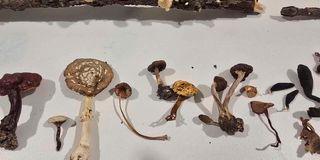
Scientists are advocating for fungi to be formally recognised and protected as a vital pillar of global biodiversity, warning that the world cannot save nature while overlooking an entire kingdom of life.
“We are here to advocate for fungi,” said Shiva Devkota, founder and research director of Fungi Network.
As climate change intensifies pressure on land, water, and food systems, this subterranean kingdom could hold key answers for restoring degraded soils, strengthening ecosystems, and protecting rural livelihoods across Kenya.
Yet much of the fungal world remains scientifically unexplored, poorly documented, and largely absent from conservation strategies.
At the 17th Conference of the Parties to the Convention on Biological Diversity (COP17) in Yerevan, Armenia, scientists and conservation advocates are calling for an end to this neglect.
“How can we achieve our species conservation targets while leaving out an entire kingdom of life? We cannot effectively conserve biodiversity if we overlook fungi,” said Claire Rumsey Holliss, a fungal conservation advocate.
Indigenous community representatives from different parts of the world gather at COP17 in Yerevan, Armenia, to demand recognition of their rights, protection of their lands and meaningful participation in decisions affecting biodiversity conservation.
Photo credit: Fatuma Bugu|Nation Media Group
This call coincides with the launch of the Global Strategy for Fungal Conservation, an international framework designed to integrate fungi into biodiversity policy, scientific research, restoration efforts, and conservation planning.
Scientists estimate the world harbors roughly 2.5 million fungal species across terrestrial, freshwater, coastal, marine, and urban environments. Yet fewer than 10 percent have been formally described, and less than one percent have been evaluated for the International Union for Conservation of Nature (IUCN) Red List of Threatened Species. Of those assessed, over 30 percent are classified as threatened.
At least 1,500 fungal species are actively used by communities worldwide, underscoring their importance to ecosystems, food security, and human survival.
This stark contrast highlights a major conservation blind spot with millions of species likely exist without scientists knowing their geographic distribution, ecological functions, or extinction risk.
Georgina Pereira, an IUCN species survival manager, noted that this information shortage severely hinders conservation efforts.
“We can only conserve what we know exists. Without data, we cannot tell which species are declining, which are threatened, or where conservation funding is most urgently needed,” explained Pereira.
While Red List assessments guide governments and organizations in prioritizing scarce resources, fungi remain heavily underrepresented. However, experts stress that missing data should not justify inaction and that habitat protection, species documentation, and research funding can begin immediately.
For Kenya, the stakes extend far beyond statistics. Communities nationwide face severe droughts, unpredictable rainfall, severe soil degradation, and pressure on natural reserves threats that directly endanger agricultural productivity and food security.
While fungi are not a quick fix for climate change, their ability to sustain soil health makes them indispensable.
Efforts to protect fungi must also center the wisdom of Indigenous peoples and local communities, whose livelihoods and traditions are deeply interconnected with the natural environment, experts said.
Basele Stephen Galgesa, executive director of the Pastoralist Goals Foundation, emphasised that caring for biodiversity is not a novel concept introduced by international frameworks but it is an everyday way of life.
“For us as Indigenous people, there is nothing like 'biodiversity conservation' as a separate idea, because this is something we do every day as part of our livelihood and our systems,” said Galgesa.
“Every mother knows you are not supposed to cut a tree because it will sustain your tomorrow and even grasses, fungi, and algae within our landscape play a crucial role, we have that relationship with the landscape. It feeds us, so we must take care of it,” added Galgesa.
Galgesa urged decision makers to treat Indigenous communities as vital knowledge holders rather than mere beneficiaries of external programs.
Kenya is taking steps to ensure these voices are included at the highest level. Dr Festus Ng’eno, Principal Secretary in Kenya’s State Department for Environment and Climate Change, noted their inclusion in the presidential summit.
“Kenya has taken a firm position on this, ensuring that communities, traditional knowledge holders, and Indigenous peoples are actively involved in biodiversity conservation,” said Dr Ng’eno.
However, international participation is only part of the solution. These commitments must translate into meaningful involvement in national policies and resource management on the ground.
Galgesa also raised concerns over the financing nature, questioning whether assigning economic value to ecosystems could overshadow their cultural and ecological significance.
“We have commodified carbon credits and now we are talking about biodiversity credits. Next, maybe we will have breathing credits,” he cautioned, highlighting the need to protect nature without reducing ecosystems to financial assets or sidelining their historic guardians.
Beyond preservation, experts see immense potential in developing sustainable products and income streams from fungi, provided these initiatives are backed by research, solid policy, and community involvement.
Verenardo Meeme emphasized that governments must bridge the gap between academic research and community action.
“Government can establish targeted programs and special funds to work with academia and emerging scientists to better understand fungi because it is important first to build awareness, second to formulate guiding policy frameworks, and third to ensure the government intentionally collaborates with impacted communities, “said Meeme.
Meeme also advocated for partnerships between local institutions and international universities with established mycological expertise to help process and commercialize local fungal resources safely.
For Kenya, this approach could mean building comprehensive fungal inventories, supporting young researchers, and linking laboratory discoveries with farmers, pastoralists, and local cooperatives.
Across Africa, practical applications of fungal science are already delivering tangible social and economic benefits. In Zambia, the Tuswayane Women’s Club adopted mushroom cultivation after climate stress disrupted traditional vegetable farming and poultry rearing, securing an alternative source of food and income.
In Benin, Training initiatives in mushroom cultivation have equipped local women with new technical skills and economic opportunities. In Uganda & Rwanda, Mushroom growing ventures are serving as alternative livelihood models designed to reduce human encroachment on sensitive wetland ecosystems.
However, wild mushrooms require strict caution due to toxicity risks “Please do not eat unknown mushrooms unless you are absolutely sure they are safe,” warned Shiva Devkota.
The push for a global framework gathered momentum at the 12th International Mycological Congress in Maastricht, Netherlands, in 2024. The resulting Global Strategy for Fungal Conservation aims to align fungal management with national targets under the Kunming Montreal Global Biodiversity Framework, spanning species recovery, protected areas, ecosystem restoration, and sustainable trade.
Razan Khalifa Al Mubarak, President of the IUCN, reinforced the necessity of this shift.
“Fungi are fundamental to the health and resilience of ecosystems. They sustain soils, enable nutrient cycling, and support the survival of countless species. Protecting biodiversity means recognizing all forms of life including those that are less visible but no less vital,” said Razan.
Dr Arsen Gasparyan, assistant professor and biodiversity expert at the American University of Armenia, called for a “whole-of-organisms” approach that mainstreams fungi alongside plants and animals.
“The strategy is designed to adapt to each country's capacity, emphasizing that action can start even with limited fungal data,” noted Gasparyan.
Armenia offers a working model, the country added fungi to its Red Data Book in 2010, expands its lichen and fungal evaluations regularly, and has signed the Fungal Conservation Pledge.
At COP17, the launch of the Global Strategy for Fungal Conservation presents an opportunity to widen the scope of global biodiversity action.
Devkota says public awareness remains an important part of the challenge, advocating for a wider campaign to ensure that fungi are no longer treated as an afterthought in conservation policies designed largely around plants and animals.
The future of biodiversity may depend not only on what the world can see, but also on what it has spent too long ignoring beneath its feet.