For decades, a wooden cross at the summit of Morop Hill has drawn Catholic faithful up its steep, forested slopes to pray. Several times, unknown people have vandalised it, only for worshippers to put it back.
Now, a plan to transform the site into a Sh50 million pilgrimage shrine and tourism heritage destination has triggered a fresh battle over who should determine the hill’s future.
Residents living around the hill in Baringo Central want the project stopped, warning that the proposed development could threaten the forest, interfere with natural water sources and undermine a landscape they regard as both an ancestral sanctuary and a lifeline for surrounding communities.
At stake is more than a religious landmark. Locals say the forest shelters indigenous trees, protects the steep slopes and feeds natural springs on which thousands of people depend.
The proposed development includes a cross measuring between 15 and 30 metres, a chapel and tourism facilities. But residents accuse the county government and other project stakeholders of advancing the plan without adequate public participation and before completing the required environmental approval process.
They are demanding that construction and other implementation activities be halted until their concerns are addressed.
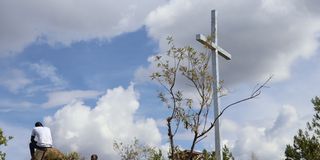
As one makes the steep climb towards the summit, the dense vegetation offers a glimpse of the landscape residents are determined to protect. At the top stands the wooden cross, its iron-sheet covering visible from Kabarnet town and surrounding areas.
For Catholic faithful, the hill has long provided a quiet place for prayer and reflection, away from the bustle of everyday life.
But residents say the proposed transformation into a major pilgrimage destination could bring increased human activity, excavation and infrastructure development to an ecologically sensitive area.
Pastor Mordechai Jackson (in grey suit) with locals during a briefing, protesting the construction of a Sh50 million pilgrimage and shrine at Morop Hill in Baringo Central on October 26, 2026.
Photo credit: Florah Koech | Nation
“The forest surrounding Morop Hill is a water tower that we rely on. Our concern is that construction and increased human activity will interfere with the sources of water that feed several rivers,” said Mordechai Jackson, a religious leader opposed to the project.
Residents estimate that about 11,500 people living in approximately 2,000 households around the hill depend on 15 natural springs originating from the forest.
They fear that excavation, construction and the movement of heavy machinery up the steep slopes could accelerate soil erosion, destabilise the hillside and interfere with the springs.
Michael Boit, an elder from Kapkomoi, said the community had protected the forest for generations because of its importance to the water supply and the survival of surrounding villages.
“We have guarded this forest since time immemorial, and no human activity is allowed because we want to protect the ecosystem. Erecting a pilgrimage site here will attract human activities, including interference with our water sources,” he said.
The residents also fear that disturbing the rocky slopes could increase the risk of rockfalls and landslides, putting people living downhill in danger.
Andrew Kiptui, a youth from Kapkomoi, said the hill’s terrain was vulnerable to erosion and land degradation, particularly during heavy rains.
“Whenever it rains, rocks fall downstream. Any human activity on the hill could worsen the situation and put people living below it at risk,” he said.
The residents point to previous incidents of rockfalls and landslides, including one at Kabiteni in March, as evidence of the dangers they believe further disturbance could pose.
Margaret Targok, another resident, said the proposed development risked damaging an ecosystem that communities had protected over the years.
According to a statement issued by the residents on Monday, Morop Hill lies within the gazetted Kabarnet Forest Station. They describe the area as ecologically sensitive, with steep slopes, cliffs, exposed rocks and indigenous vegetation.
The forest also provides habitat for wildlife, including rock hyraxes, snakes, birds, jackals and insects.
A close range view of Morop hill, the second highest point of Tugen Hills. Baringo is well-known for Lake Baringo and the Bogoria hot springs, but few have experienced the captivating and breathtaking views of Tugen Hills that run from Tenges Town to Kipsaraman. PHOTO | NATION MEDIA GROUP
A dispute over who was consulted
Beyond the environmental concerns, residents are questioning how a project described as an interdenominational pilgrimage shrine could have advanced without what they consider meaningful engagement with other churches and the affected community.
Jackson said residents learnt that a concept paper for the proposed development, reportedly titled an interdenominational pilgrimage and shrine, had already been prepared before adequate consultations took place.
“When you investigate, none of the churches except the Catholic Church has been involved in the project, yet we are told it is for all churches. How can you call it interdenominational when other churches were not involved? That is where the conflict started,” he said.
He acknowledged that Catholic faithful had worshipped at the existing cross for years but argued that this history did not justify a larger development without the involvement of the wider community.
Jackson also opposed plans for a bigger cross and additional structures, saying the hill’s spiritual significance should not be defined exclusively by one denomination.
He questioned the proposed expenditure, arguing that the county should prioritise urgent public needs, including the struggling health sector, instead of committing millions of shillings to the project.
“There are other projects that the devolved unit should prioritize, including the derailing health sector, instead of pumping millions of shillings into putting structures on top of a hill in the name of pilgrimage,” he said.
Jackson further claimed that a fundraising dinner held at a hotel in Kabarnet about a month earlier, led by Catholic Bishop Dominic Kimengich, raised more than Sh2 million within 20 minutes towards the proposed project.
He maintained that if the Catholic Church was spearheading the initiative, it should consult other denominations and the affected community rather than rely on the county government to lead the process.
Conservancy raises concerns over exclusion
The Morop-Tarambas Community Conservancy, which works to protect the area’s natural environment, has also questioned its involvement in the proposed development.
Shadrack Kiplagat, a board member of the conservancy, said its members and local residents had not been adequately consulted despite their role in protecting the forest.
According to the residents’ statement, the conservancy was registered in 2010 and operates within Morop Forest under a licence from the Kenya Forest Service. Its activities include conservation, a nature trail, a picnic site and a campsite.
Kiplagat questioned why preparations for the pilgrimage project had advanced without consultations with the conservancy, which considers Morop and Tarambas hills part of its conservation areas.
“They bypassed us by drafting a concept paper and conducting a visibility exercise at the top of the hill where the pilgrimage site is to be erected without informing us,” he said.
He said residents submitted a petition to the governor’s office on September 3, 2026, but remained concerned that the project could proceed despite their objections.
A cross erected on top of Morop Hill in Baringo Central on October 26, 2026. A section of locals and religious leaders have opposed the construction of a pilgrimage and shrine at the area.
Photo credit: Florah Koech | Nation
The residents’ statement says the county scheduled a public participation exercise for October 29, 2026, after preparations and resource mobilisation had reportedly begun.
The timing has raised fears among residents that the exercise could be treated as a formality rather than an opportunity to influence the project.
“Why did they go ahead with drafting a concept and conducting a visibility study before public participation? We, as a community and members of the conservancy board, have not sat down to deliberate on the project and air our concerns,” Kiplagat said.
Questions over environmental approval
The residents have also questioned whether the project has obtained the necessary environmental approvals.
In their statement, they said they contacted the National Environment Management Authority (NEMA) office in Kabarnet after learning of the proposal.
They cited a response dated August 26, 2026, which they say indicated that the project proponents had not submitted an Environmental Impact Assessment report and that the authority was not aware of the proposed development.
The residents argue that an environmental assessment, meaningful public participation and the necessary approvals should precede implementation.
They want all infrastructure development on the hill stopped, the site preserved in its natural state, and resource mobilisation and other implementation activities suspended until their concerns are addressed.
Their position, they insist, is not opposition to religious worship but a demand to protect a shared environmental resource and ancestral heritage.
Water fears at the heart of the dispute
For Boit, the issue is inseparable from the community’s struggle to secure reliable water supplies.
He said residents continued to face water challenges despite the presence of Kirandich Dam in the area, making the protection of springs and rivers flowing from Morop Hill particularly important.
“We must protect these rivers because we are not getting water from Kirandich Dam, which is in our own village. We have a responsibility to protect the sources that sustain us,” he said.
The residents want the county government and other project stakeholders to suspend the plan until the community has been consulted and its concerns addressed.
They argue that the hill’s value extends beyond its proposed use as a pilgrimage destination: its forest, water sources and ancestral significance are resources whose preservation affects present and future generations.
For now, the wooden cross remains a familiar landmark above Kabarnet. But beneath it, the dispute over the hill’s future has become a test of how religious aspirations, environmental conservation, community heritage and public participation can be reconciled.