Kabarnet town, the hometown of Kenya’s second President Daniel arap Moi, remains without a functional sewer system more than six decades after Kenya’s independence.
The town, which is the administrative headquarters of Baringo County, was supposed to be counting down to a major sanitation breakthrough this year.
By September, the town was expected to have its first sewer system in place, a long-promised project meant to end decades of raw sewage flowing through streets, trenches and waterways.
But on the ground, that promise remains far from reality.
Months before the projected completion date, little progress is visible at the site of the much-publicised sewerage project under the Sh2.9 billion Kirandich Phase Two programme. Apart from a few abandoned manholes, heaps of rocks and partially completed trunk lines, there is barely any sign of active construction work.
The stalled works have deepened frustration among residents and business owners, who say the sanitation crisis continues to expose the town to serious public health risks.
The town has expanded steadily since colonial times, but has never had a functional sewer system. For decades, residents have relied on septic tanks, open waste lagoons and unsafe waste disposal methods, systems they say can no longer sustain the town’s growing population and expanding commercial activity.
During heavy rains, untreated sewage from some hotels and commercial premises is reportedly discharged into storm water channels, turning downpours into a health hazard.
The sewerage project forms part of the Kirandich Phase Two water programme, which was launched in 2021 to address chronic water shortages in Baringo Central and Baringo North sub-counties. The programme included a Sh700 million sewerage and waste management system for Kabarnet, Kituro and Kabartonjo towns.
Last September, Central Rift Valley Water Works Development Agency executive officer Douglas Murei announced that the project had resumed after stalling due to funding challenges.
At the time, he said the sewerage component was 20 per cent complete while last-mile water connectivity works stood at 45 per cent.
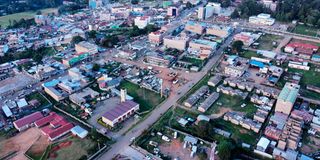
An aerial view of Kabarnet town in Baringo County.
Photo credit: Florah Koech | Nation Media Group
“The project stalled for some time, but we are optimistic it will be complete by September next year,” Mr Murei had said.
But with the deadline drawing closer, little progress is visible on the ground.
For many residents, rainfall now brings fear of contamination and possible outbreaks of waterborne diseases.
“When it rains, you will not want to stay in this town because of the stench caused by raw waste discharged to be washed away by flowing water since there is no sewer line,” said resident Ms Rebecca Yator.
“We fear walking around when it rains because you do not know where the sewage is coming from, and it flows everywhere, raising fears of outbreaks of waterborne diseases,” she said.
Children are among the most exposed, often walking through sewage-contaminated roads on their way to and from school.
“Most of the time, schoolchildren step on sludge flowing freely on roads as they go to school or return home. It is that bad,” Ms Yator said.
Downstream communities are also paying the price, with rivers carrying contaminated waste to areas where residents rely on the same water for domestic use and farming.
Even during dry weather, the situation remains dire in some estates, where raw sewage is discharged into open trenches, forcing pedestrians to navigate around foul-smelling sludge.
Business owners say the absence of a proper sewer system has left them grappling with soaring waste management costs and limited disposal options.
According to Mr Richard Khaemba, manager of Paradise Plaza in Kabarnet town, some establishments had resorted to costly makeshift measures to survive, including laying pipes from their premises to a septic tank at the Kenya School of Government, about 500 metres away.
“The lack of a sewer system in this town has affected us so much that we incur huge costs disposing of waste,” said Mr Khaemba.
“There is a sewer management system under construction on the outskirts of the town, but we do not know why it has taken so long to be completed,” he added.
He said some businesses had resorted to discharging untreated waste during rainfall because there was nowhere else to dispose of it.
A manager at one of the town’s major hotels, who sought anonymity for fear of victimisation, confirmed the challenges, saying hoteliers spend more than Sh7,000 per trip to empty septic tanks, depending on size.
“From the business licence issued by the county government, Sh1,000 is allocated for waste collection, but the waste is rarely collected,” said the manager.
“We are forced to pay Sh7,000 for a single trip to empty the septic tank when full. In our case, we do this more than three times, meaning we spend over Sh21,000. But the major problem is where to dispose of the waste,” he said.
The hotel manager admitted that some operators illegally dump sewage at night or during rainfall to avoid high disposal costs.
“Sadly, because of the many challenges, some hoteliers have been forced to discharge waste at night or during rainfall so it is washed downstream, which is also a health hazard,” he said.
Kenya National Chamber of Commerce and Industry (KNCCI) Baringo chapter chairman Musa Mulwo described the lack of a sewer system as both an economic and public health burden.
“This town has grown tremendously over the years, but, sadly, we still do not have a sewer system,” said Mr Mulwo.
“There is an urgent need for intervention because people do not have a place to discharge liquid waste, and this is posing a health risk because some businesses have been forced to release it during the rains,” he added.
Mr Mulwo claimed that some businesses transport waste as far as Eldoret and Nakuru for disposal, sharply increasing operating costs.
He also raised concerns over raw sewage allegedly flowing from Kabarnet GK Prison into open land and roads within the town.
“We have raised complaints over the years, and we need the stalled facility completed urgently because when we visited the site, there was no activity going on,” he said.
The medic and businessman added that Kabarnet’s rocky terrain has made private sanitation systems prohibitively expensive.
“It is quite expensive even to dig a pit latrine in this town because the ground is rocky,” he said.
“I have personally been forced to install a bio-digester at my premises at a cost of more than Sh500,000.”
Kirandich Water Company manager Richard Ruto, however, maintained that the project remains active.
He said trunk lines had already been installed, although excavation of the wastewater treatment plant had yet to begin.
“There are supposed to be trunk lines and a wastewater treatment plant, but the latter is yet to be done, including piping around the town,” said Mr Ruto.
“We expect the contractor to first complete the pipeline before resuming excavation. There is enough funding for the project. At the moment, moulding of manholes is ongoing to pave the way for digging the trunk lines, which had stopped for some time,” he added.