Every morning, before he ferries his first passenger, boda-boda rider Richard Bett must make a choice: use the pothole-riddled Chebole-Siongiroi-Chebunyo road or take the dusty murram detours that snake through villages and farms.
Neither option is appealing.
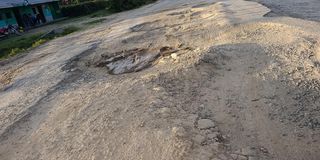
On this particular Wednesday morning, Bett is carefully navigating a crater-filled stretch of the 32-kilometre road in Bomet County with two passengers clinging tightly. He keeps his motorcycle below 20 kilometres per hour, swerving from one side of the road to the other to avoid deep potholes that have turned the once-tarmacked highway into a dangerous obstacle course.
Around him, tractors, trucks and private vehicles weave erratically across the road, each driver desperately searching for the least damaged section.
"What remains of this road looks like land that has been ploughed by a tractor," Bett says. "A journey that used to take 30 minutes now takes one-and-a-half hours."
A section of the 32-kilometre Chebole-Siongiroi-Chebunyo road in Chepalungu Constituency, Bomet County in this photo taken on April 7, 2026.
Photo credit: Vitalis Kimutai | Nation
For residents of Bomet and neighbouring Narok counties, the Chebole-Siongiroi-Chebunyo road has become more than an infrastructure failure. It is a symbol of broken promises, government neglect and growing public frustration.
For more than seven years, motorists, traders, dairy farmers and schoolchildren have endured one of the most dilapidated tarmac roads in the South Rift.
Former President Uhuru Kenyatta pledged to repair the road but left office before fulfilling his promise. His successor, President William Ruto, has repeatedly assured residents that the road would be reconstructed.
Yet, years later, the road continues to deteriorate.
On May 6, 2026, President Ruto told residents in Emurua Dikirr that he had directed the Ministry of Roads to cancel an ongoing procurement process and restart it to allow for an upgraded road design.
While the announcement was intended to reassure residents, many viewed it differently. Some interpreted it as another postponement tactic, one that could eventually transform the road into a campaign issue ahead of the 2027 General Election.
The road passes almost within sight of Roads Cabinet Secretary Davis Chirchir's home. The turnoff at Chebole Trading Centre leading to his residence in Kipketii village marks the beginning of one of the most damaged sections of the highway.
To residents, the irony is difficult to ignore.
Kanusin bridge on the pothole riddled Chebole-Siongiroi-Chebunyo road in Chepalungu Constituency, Bomet County in this photo taken on April 7, 2026.
Photo credit: Vitalis Kimutai | Nation
East African Legislative Assembly member David Sangok does not mince his words when describing the road. "Driving through the Chebole-Siongiroi-Chebunyo road is like driving through hell. This is perhaps the worst tarmac road in Kenya," he says.
Mr Sangok argues that the state of the road is particularly frustrating because it serves an area that overwhelmingly supported the current administration. "As a region that voted overwhelmingly for the government, we should quickly sort out this mess," he says.
The road links Chepalungu Constituency in Bomet County with Emurua Dikirr in Narok County and serves a region heavily dependent on dairy and livestock farming.
Instead of facilitating trade and movement, it has become an economic burden.
Motorists spend thousands of shillings repairing damaged suspensions, tyres and shock absorbers. Public transport operators charge higher fares to offset maintenance costs while some drivers have abandoned the road altogether in favour of rough village tracks.
Residents such as Beatrice Langat of Kongasis in Chepalungu Constituency have reached a point of such frustration that any alternative seems preferable. "If the government cannot repair it, let them remove the tarmac and make it a proper murram road. A murram road would be more useful than what we have now," she says.
She adds that road users do not obey traffic rules on the stretch because survival takes precedence.
"It is impossible to drive normally. You are constantly avoiding potholes, getting stuck during the rainy season or trying not to collide with vehicles approaching from the wrong side,” she says, adding that the poor condition of the road is not a recent discovery.
In October 2022, Chepalungu MP Victor Koech raised the matter in Parliament, warning that the road required urgent reconstruction. He said the road was launched in December 2015 and implemented in 2016 under the Kenya Rural Roads Authority (KeRRA) Low Volume Seal programme. However, signs of failure emerged almost immediately.
Mr Koech cited potholes, alligator cracking, poor drainage, missing bus bays, lack of road markings and ageing bridges that were never replaced. "There is a need to pre-empt further deterioration before it becomes impossible to salvage the situation," he told Parliament.
Nearly four years later, little has changed.
"The road is critical because it connects Emurua Dikirr, Chepalungu and Sotik constituencies," the MP says.
A section of the 32-kilometre Chebole-Siongiroi-Chebunyo road in Chepalungu Constituency, Bomet County in this photo taken on April 7, 2026.
Photo credit: Vitalis Kimutai | Nation
During a recent tour of stalled county projects, Kisii Senator Richard Onyonka contrasted the road network in Bomet with infrastructure in opposition strongholds. He argued that residents who overwhelmingly backed President Ruto and UDA in the last election have little to show for their support.
"Some of the worst roads in Bomet are found in Chepalungu and Bomet East constituencies. While you voted for the President and UDA leaders, your infrastructure remains in a pathetic state," he told residents.
The remarks struck a chord with many locals who increasingly view the road as a test of the government's commitment to regions that delivered significant votes during the 2022 elections.
Recently, the government advertised a tender for the reconstruction of the road, raising hopes among residents. Those hopes were temporarily dashed when President Ruto ordered the process halted and restarted.
Speaking during a funeral service in Emurua Dikirr, Narok County, the President urged residents to remain patient. He attributed the road's rapid deterioration partly to the area's black cotton soil, which he said requires a different engineering approach.
"The plan to upgrade the road is currently in the tendering stage. It will be constructed from scratch for the benefit of residents," he said.
However, for many residents, such assurances sound painfully familiar; they have heard them before from President Kenyatta and from President Ruto.
The Chebole-Siongiroi-Chebunyo road is one of 4,400 kilometres of Low Volume Seal roads introduced across the country beginning in 2013 as many were intended to provide affordable road connectivity in rural areas.
However, poor workmanship, inadequate drainage, floods, overloaded trucks and limited maintenance funding have left many of the roads severely damaged long before their intended lifespan.