Mbombo is a typical rural village located approximately three kilometres from Maragua town, on the Murang'a–Kenol road.
This densely populated area boasts breathtaking views of maize, banana and potato plantations, and some households are also involved in subsistence livestock farming.
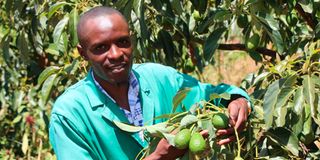
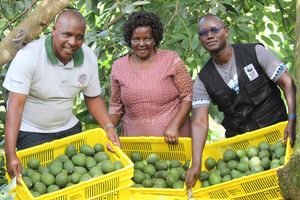
Tucked away from the main highway, a narrow path leads the Seeds of Gold team to Paul Chege's farm. The young farmer is also the director and founder of Dynasty Green Farms, an agricultural enterprise that has employed more than 30 young people from different professions.
"Initially, most farmers in Murang'a County relied heavily on indigenous bananas, a venture that was not profitable and did not generate much revenue," he reflects.
The rich, well-drained volcanic soils had little significance in terms of supporting a wide range of crops.
Currently, over 80 per cent of farmers in the area grow Hass avocados and earn good incomes, with some looking to export in the near future.
Chege says that Hass avocado farming is expanding rapidly across Murang'a County due to strong global demand, high profitability and supportive market dynamics.
Over the past five years, increased market demand has encouraged smallholder farmers to adopt the crop more aggressively, as it does not require expertise to thrive.
He explains that, in order to start the agribusiness, he needed clean, certified seedlings that would guarantee high yields and be free from pests and diseases.
Paul Chege demonstrates how a mechanical tool designed to control pest works at Dynasty Green Farms in Murang'a County on January 20, 2026.
Photo credit: Richard Maosi | Nation Media Group
In addition, access to a reliable water source and manure is essential for replenishing the soil and supporting sustainable crop production.
"The optimal spacing for Hass avocado trees depends on the cultivation system, climate patterns, soil conditions, and management strategies."
For commercial orchards, a spacing of 6 metres by 6 metres (6×6 m) is preferable in order to prevent overcrowding, which leads to intense competition for sunlight, water and soil nutrients, resulting in stunted growth, weak plants and reduced yields.
This means that on an acre of land, a farmer can plant between 80 and 120 trees.
Chege also advises that land and soil preparation is a vital step. Farmers must select deep, well-drained soils with a pH level between 5.5 and 7.0, and conduct soil testing before planting.
"Farmers should also apply sustainable practices such as minimal tillage and the incorporation of organic matter to improve soil structure," he adds.
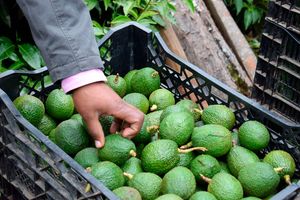
A healthy avocado tree can produce between 350 and 500 fruits per season, although this varies depending on factors such as the tree's age and the climate.
The trees start bearing fruit after about one and a half years, reaching maximum production at around three years of age.
Chege adds that, from the first day of planting, he ensures that the seedlings are hilled in order to establish a strong foundation. Applying phosphorus during the early stages of development also fosters rapid root growth.
“Mulching suppresses weeds and retains moisture in the soil,” he says.
Paul Chege demonstrates how a mechanical tool designed to control pest works at Dynasty Green Farms in Murang'a County on January 20, 2026.
Photo credit: Richard Maosi | Nation Media Group
Pruning, on the other hand, is equally important as it allows sunlight to penetrate easily and helps the tree to focus on fruit-bearing branches. It also helps to control pests by exposing them to the sun, thus reducing the need for frequent spraying and lowering production costs.
Chege says that most of his buyers come from Kiambu, Kirinyaga, Murang'a and Nairobi, with some travelling from as far as Nakuru.
Although the crop is not easily affected by weather or other external factors, such as pests and diseases, it is susceptible to the persea mite.
“It causes circular, yellow-to-brown spots on the undersides of leaves, which later become visible on the upper surface,” he explains.
This pest can be controlled through regular monitoring and early spraying once farmers identify the first signs of infestation, before it spreads to the rest of the plant.
Wasp populations can be effectively managed on avocado farms using integrated pest management (IPM), as well as mechanical tools called FCMs, which are designed to block, capture or remove pests without heavy reliance on chemical pesticides.
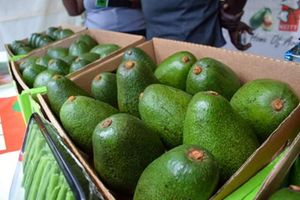
The farm-gate price of Hass avocados ranges between Sh80 and Sh120 per fruit, depending on the season and market demand.
To reap maximum benefits from the crop, he advises farmers to start small and scale up gradually, noting that returns are good and investments pay off over time.
He also encourages farmers to seek knowledge and investment opportunities in state-of-the-art machinery that aims to minimise post-harvest losses and increase farmers' disposable income.