At around 9.00pm last Friday, Ms Margaret Kipkech from Kwenoi village in Marakwet East sub-County, Elgeyo Marakwet County, arrived at Chesongoch Primary School with her seven children in tow.
Inside the congested classrooms, murmurs mixed with the sobs of children and occasional coughs rent the air, with a heavy sense of uncertainty.
For hundreds of people displaced by the November 1, 2025, landslides, the classrooms at Chesongoch Primary School are their new home, at least for now. The school was earmarked by local authorities to host survivors from Kwenoi, Kasegei, Kaptul, and Kipkirwon villages.
Survivors who lost homes, farms, and loved ones in the disaster are now sleeping on dusty floors in overcrowded classrooms, some enduring the cold with no bedding, anxiously waiting for aid.
Ms Kipkech arrived carrying her one-year-old daughter on her back and holding two toddlers by the hands, while her other four children trailed closely behind.
A county government official was on hand, registering incoming families to ensure aid reached the right people. As she waited, Ms Kipkech spread a lesso on the bare, cold floor and laid her three daughters down to sleep, while the others sat exhausted beside them.
After verification, she was finally able to settle in a dimly lit classroom after receiving a single mattress and blanket. It was barely enough for the family of eight, forcing her to spread the mattress and blanket diagonally across the floor to accommodate everyone.
Like many others, Ms Kipkech lost everything in the landslides, including her two-roomed house and farm. Until Friday, she had been seeking refuge at a relative’s home, leaving one child at his grandmother’s house in a neighboring village.
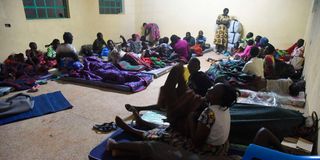
Women and children survivors of the mudslides which occurred on October 31, in Chesongoch, Kerio Valley of Elgeyo Marakwet County, prepare to sleep in one of the classrooms at Chesongoch Primary School on November 08, 2025.
Photo credit: Jared Nyataya | Nation Media Group
“I lost everything in the landslide. This is where I will be staying onwards,” she said.
Conditions at the temporary camp are, however, challenging, with health and sanitation concerns mounting, particularly for the elderly and children.
According to Mr Lawrence Mutwol, Elgeyo Marakwet County Chief Officer in charge of disaster management, more than 600 families were displaced, with at least 300 households currently at Chesongoch Primary School. Aid in the form of food and non-food items has been provided to most of those at the camp, he said.
By Friday, three classrooms had been allocated for the displaced, two for women and children, and one for men.
Yet as late as 10:40 pm, families were still arriving, many without mattresses or blankets. Aid teams prioritised those who had lost homes or relatives, but because of the shortage, not everyone could be accommodated immediately.
Officials distribute mattresses and blankets to women survivors of the mudslides, which occurred on October 31, in Chesongoch, Kerio Valley of Elgeyo Marakwet County.
Photo credit: Jared Nyataya | Nation Media Group
“As you can see, there are many families here, and not all have mattresses and blankets. We just have to cope. I will sit beside the children until dawn,” Ms Kipkech said.
On Thursday evening, she received aid from the Kenya Red Cross, including a 50 kg bag of maize and beans, cooking oil, green grams, maize flour, and utensils.
Men survivors of the mudslides which occurred on October 31, in Chesongoch, Kerio Valley of Elgeyo Marakwet County, sleep in one of the classrooms at Chesongoch Primary School on November 08, 2025.
Photo credit: Jared Nyataya | Nation Media Group
She said many families have been wearing the same clothes since the tragedy, with nothing to change into.
“I do not know how long we will be spending the nights here, but we have nowhere else to go,” she said.
Beside her, Ms Celestine Komen from the neighboring Kasegei village, which lost more than 15 people to the landslides, had also just arrived.
She sat on the dusty floor, breastfeeding her five-month-old baby as her three other children napped, unbothered by the cold.
For six days, Ms Komen had sought refuge at Chesongoch Polytechnic before being directed to the primary school camp. Like many others, her home was destroyed, and her farm now lies buried under rocks.
“I do not want to go back to that village. It brings back bad memories. I lost more than 15 neighbors, and some are still missing,” she said.
Women and children survivors of the mudslides, which occurred on October 31, in Chesongoch, Kerio Valley of Elgeyo Marakwet County, wait to be issued with mattresses and blankets.
Photo credit: Jared Nyataya | Nation Media Group
Another survivor, Ms Dorothy Domocholia, a mother of four from Kwenoi, had initially taken refuge at a friend’s house in Kipkirwon village before moving to the camp.
“Save for the clothes we had on our bodies, we have nothing. Our house was filled with mud, and everything was swept away,” she said.
At the camp, her four children, aged between six months and eight years, slept on a single mattress without a blanket.
“I was lucky to get a mattress from the Red Cross, but we do not even have a blanket. We have been sleeping like this for five days. Even one blanket would be enough for all of us,” she said.
With the deplorable living conditions, coupled with poor water supply, a sanitation crisis is looming at the camp.
Men survivors of the mudslides which occurred on October 31, in Chesongoch, Kerio Valley of Elgeyo Marakwet County, sleep in one of the classrooms at Chesongoch Primary School on November 08, 2025.
Photo credit: Jared Nyataya | Nation Media Group
The mudslides cut off the local water supply, leaving families relying on two water boozers stationed at St. Benedict Catholic Church. However, the supply is insufficient for hundreds of residents, raising fears of waterborne diseases.
“The situation is so bad that young children and the elderly are starting to fall ill from the cold. Mosquitoes are everywhere,” Ms Domocholia noted.
According to Mr Mutwol, over 10,350 iron sheets have been delivered for families to rebuild their homes, with distribution to begin once survivors choose resettlement locations.
“The families will tell us where they want to resettle before we distribute the materials so they can rebuild their lives,” he said.
He said medical supplies have been distributed to local health facilities, and teams are attending to the unwell at the camp.