The Garissa County Assembly is conducting its business on a land it cannot legally prove its ownership, a new report by the Auditor-General has revealed
In the 2024/2025 audit report, the Auditor-General Nancy Gathungu flagged that the Assembly lacks a title deed for its premises, raising fears that the prime public land could be grabbed or lost in a legal dispute.
The report further warns that without ownership documents, the Assembly cannot secure the land, undertake permanent developments, or defend it against encroachment.
When reached for comment, Mr Mohmoud Santur, the assembly clerk confirmed the reports, and blamed other government institutions for frustrating the process.
“I have been a clerk since the days of Town Council and we have tried our best to obtain a title deed but nothing has been forthcoming,” he said, adding that laxity at the Lands ministry was to blame.
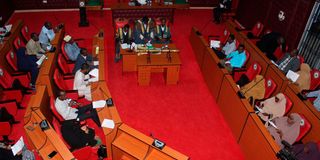
Garissa County assembly in session.
Photo credit: Pool
In a statement to the auditor, the County Assembly presented a financial position reflecting property, plant and equipment balance of Sh258 million.
Included in the balance was Sh60 million relating to a parcel of land on which the County Assembly Chambers, Office Block and other buildings are built.
However, the Management did not provide ownership documents, such as land title deeds or allotment letters, to confirm ownership of the land.
Failure to confirm ownership of the land by the assembly left the Auditor General to conclude that there was no effective governance structure to safeguard land.
Within the same period, the Auditor General flagged irregular payment of mileage allowances to Members of the County Assembly.
The statement of financial performance reflected an expenditure of Sh686 million on employees’ costs including Sh222 million on personal allowances paid as part of salary while Sh68 million was paid as mileage claims to MCAs.
The Auditor General noted that 16 nominated MCAs were consistently paid the maximum reimbursable monthly mileage allowance of Sh147,481 and cumulatively were reimbursed Sh29 million.
“The basis for management’s decision to award the maximum monthly reimbursement to nominated Members was not explained or supported by documentation. In the circumstances, the regularity of the mileage reimbursements amounting to Sh29 million could not be confirmed,” read the report.
The Auditor General also flagged unsupported domestic travel and subsistence allowances at the county assembly.
The assembly spent Sh280 million on goods and services spending a total of Sh149 million on domestic travel and subsistence allowances.
“Review of payment records provided for audit revealed that an amount of Sh2.5 million was paid to officers as allowances for attending workshops, training and other duties outside Garissa County. However, the payments were not supported by minutes of the meetings, workshop attendance registers and evidence of travel,” Ms Gathungu said.
She said the accuracy and occurrence of expenditure of the Sh2.5 million on domestic and subsistence could not be confirmed.
The County Assembly had failed to resolve budgetary control and performance, she said, adding that the institution had failed to comply with staffing levels as well as the one third rule in employee composition.
The Assembly also breached the law by employing partisan staff above the approved ceiling, according to the report.
It engaged 214 partisan staff members against the maximum recommended 144, resulting in an excess of 70 staff members.
This was contrary to Commission on Revenue Allocation Circular No. CRA/CSO/CMG//9/VOL V/59 dated October 21, 2020 which recommended a maximum number of three staff to be attached to Members of County Assembly both elected and nominated, each earning a minimum salary of Sh30,341.
A review of the Human Resource Information System (HRIS) revealed that the County Assembly had 120 permanent employees against the approved 100.
The Commission on Revenue Allocation recommendation through Circular Number CRA/FA/01 Vol 11 (22) dated 28 June, 2018 on County Government Recurrent Expenditure ceilings, capped the maximum number of employees of County Assemblies under group two under which County Assembly of Garissa falls, at one hundred.
However, analysis of the employees’ data revealed that 95 percent of the employees were from the dominant ethnic community with only 5 percent from other ethnic communities contrary to Section 7(1) and (2) of the National Cohesion and Integration Act, 2008 which provides that no public establishment shall have more than one third of its staff from the same ethnic community.
Within the same period, it was discovered that the County Assembly’s payroll Management maintained two parallel payrolls: one in the Human Resource Information System (HRIS) and another in an MS Excel spreadsheet.
The Excel payroll included thirty-three staff members, among them three Members of the County Assembly who were elected three years ago.
Management attributed the continued use of the manual payroll to the lack of personal numbers. However, no satisfactory explanation was provided for the prolonged delay in obtaining personal numbers.
Due to lack of an Approved Internal Audit Charter, the local assembly could not spell out the internal audit purpose, authority and responsibility. This affected the effectiveness and independence of the internal audit according to the Auditor-General.
Audit review revealed that the County Assembly Management had developed a formal Risk Management Policy and Fraud Prevention Mechanisms but the same document was not approved by the Chairperson of the Audit Committee nor endorsed by the Secretary to the Board and was not signed by the chairperson of the County Assembly Service Board.
The Auditor General said the omission undermines the formal adoption and effective operationalization of the policy and limits its authority within the governance and internal control framework of the County Assembly.
In response, Mr Santur, said the process to streamline proper use of public funds has since been initiated, further stating that the next financial report shall be different reflecting positive steps in management of funds at the Assembly.