Despite being overworked, receiving little recognition from the Teachers Service Commission (TSC) and earning meagre monthly salaries, teachers in refugee camps have one of the highest levels of commitment to their work.
A study by the African Population and Health Research Centre (APHRC), a research-to-policy institution, found that most of teachers in refugee camps (around 87 percent) earn less than Sh9,000 per month. This is compared to 71.4 percent of teachers employed by the TSC who earn an average monthly salary of Sh30,000.
The study also noted a severe shortage of female teachers, who account for less than 10 percent of educators in refugee camp schools in Garissa and Turkana counties.
The skewed ratio against women teachers creates a gender inequality gap, denying girls access to female role models and safe learning environments. This not only affects their well-being but also negatively impacts their educational pursuits. The study shows that despite the low pay, teachers have a 90 percent commitment to their work as they seek to impart knowledge to children who are eager for an education.
The report shows most of the refugee teachers (92 percent) are employed on one-year contracts, unlike TSC employees, who are hired on permanent, pensionable terms.
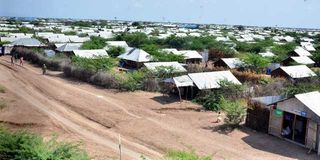
Tents in Dadaab refugee camp.
Photo credit: File | Nation Media Group
Most schools in refugee camps are informal institutions, where families pay teachers with support from NGOs.
The Teacher Well-Being Study Report, unveiled in Nairobi, examined teacher well-being in refugee camps and host communities in Garissa and Turkana. The report shows Kenya hosts a substantial refugee population, more than half of whom are children in need of an education.
“In refugee and host community settings, schools are among the most important spaces for learning, protection, social inclusion and psychosocial support, with teachers playing a central role in sustaining these functions,” states the report, whose project interventions were funded by the LEGO Foundation and the Grundfos Foundation.
It adds: “Yet the working conditions and professional experience of teachers, particularly refugee teachers, remain insufficiently examined and addressed within national education policies and systems.”
“Intrinsic teacher motivation is exceptionally high and nearly identical across settings, with a composite index of 91.0 per cent, yet overall well-being averages only 59.2 out of 100. Teachers are highly committed despite difficult working conditions,” the report states.
It further states: “TSC registration stands at 92.8 per cent among Kenyan citizen teachers and zero per cent among refugee teachers, limiting refugee teachers’ access to professional recognition, career progression, employment protections, and associated benefits.”
The report also says refugee camp school teachers manage an average of 90 learners per class, with a quarter teaching more than 100 learners, compared with an average of approximately 56 learners in host community schools.
APHRC conducted the study in refugee camps and surrounding host communities. Using a concurrent mixed-methods approach, the study surveyed 927 teachers in 74 schools. It involved 105 qualitative participants through interviews and 11 focus group discussions.
“The study findings come at a critical time as the country seeks to strengthen inclusive, equitable and quality education for refugee and host community teachers and learners,” the report says.
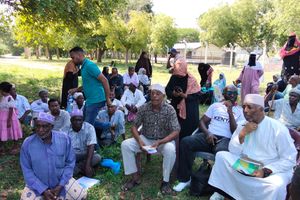
Mr Hezbon Otieno, Kenya National Union of Teachers Deputy Secretary-General, said the government should establish formal schools in refugee camps to ensure minimum learning conditions are provided for children displaced by war, persecution or inter-clan clashes in their countries of origin.
It adds: “They reveal a striking tension: teacher commitment remains exceptionally high, yet commitment alone cannot compensate indefinitely for gaps in professional recognition, remuneration, employment security, workload, working conditions and representations.”
Teachers Service Commission (TSC) headquarters in Upper Hill, Nairobi.
Photo credit: File | Nation Media Group
Mr Hezbon Otieno, the Kenya National Union of Teachers (KNUT) Deputy Secretary-General, and Senior Executive Officer Idris Ibrahim Aden said the government should establish formal schools in refugee camps to ensure that minimum learning conditions are provided for children displaced by war, persecution or inter-clan clashes in their countries of origin.
“The Ministry of Education, the Department of Refugee Services, Teachers Service Commission, the Ministry of Interior, Social Services and county governments should team up with Non-Governmental Organizations and unions to address the issue of learning conditions in the refugee camps and seek to alleviate the suffering of the learners and teachers,” Mr Otieno said.
Mr Malel Langat, the KNUT First National Vice-Chairman, said a conducive learning and teaching environment should be created in refugee camps, some of which have existed for decades.
“The working conditions for the teachers in the refugee camps and other spaces affects their mental health and well-being, thus the need for the government and all actors in the education sector to address the gaps and all the existing challenges,” Mr Langat said.
Mr Langat said: “The children in refugee camps deserve an education, irrespective of their country of origin, as that is a basic human right. The teachers imparting knowledge on the learners should be posted by TSC while those who are qualified should be employed.”
Dr Reuben Nthamburi Mugwuku, who is in charge of Teacher Professional Management at the TSC, admitted that there were challenges in the management of refugee schools in the country.
“Refugee teachers may have considerable teaching experience, and demonstrated competence, but face barriers associated with existing qualification and documentation and registration requirements,” Dr Mugwuku stated.
Mr William Ogeta, from the Department of Refugee Services, stated that the study had demonstrated that the way refugee-serving schools are currently classified and governed affects teacher deployment, quality assurance and predictable financing.
Ms Zipporah Kawira, from the Ministry of Education’s Directorate of Policy, Partnership and East African Community Affairs, said Kenya’s regional commitments, including the Djibouti Declaration, call for improved certification pathways, equivalency mechanisms and greater inclusion of refugee teachers within the national education system.
President William Ruto’s administration has employed 100,000 teachers in public schools in the last three years, with another 20,000 expected to be employed at the end of this year, in a bid to bridge the gap in the teacher-pupil ratio in learning institutions.
Despite the high number of teachers employed by the TSC, there are still shortages of tutors in primary and secondary schools across the country due to years of skewed recruitment and annual natural attrition.