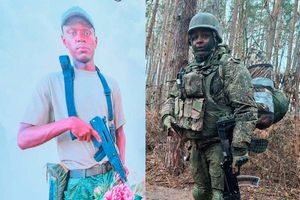
On August 7, 2025, Richard Omondi sent a quiet cry for help from the distant frontlines of war in Russia. That message would become his family’s last thread of hope.
The message arrived via Facebook Messenger, the only lifeline he had to reach his family back home in Kodumo Village, Rachuonyo East, in Homa Bay County.
“I’m good, otek kodwa (I am good, but the situation is difficult),” he wrote to his sister-in-law, Beryl Awuor, at 11.49 am.
When she pressed for clarity, his reply at 12.14 pm was in Luo… ok oyot (it is not easy). Then, silence.
Despite the family’s desperate attempts to reach him, the response never came, and the digital thread that bound them to him simply went still.
Mr Omondi was 30. He had once served as a Kenya Defence Forces (KDF) officer at Nanyuki Barracks for seven years before losing his job in 2022.
For a year, he remained at home after appealing the decision, hoping to be reinstated. But when that door closed, he began searching for another path, one that would ultimately lead him far from home into the shadows of a foreign war.
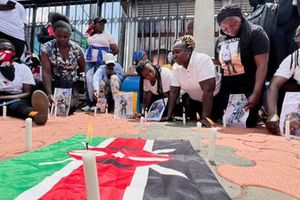
Relatives of Kenyans recruited to fight in Ukraine for Russia pray outside Parliament Buildings, calling for clarity on the suspected involvement of State officials in the recruitment.
Photo credit: Reuters
His father, John Okiri, recalls the quiet determination that preceded his departure.
“He did not tell us about his plans to fight for Russia. We only learnt after he had left. He said he had found an opportunity, but not that it was on the battlefield,” he said.
Documents allegedly sent by an agent who claimed to have facilitated Mr Omondi’s journey outlined promises of employment abroad. They spoke of visa processing, paid travel to Russia and financial rewards, with assurances of support and more opportunities.
By the time his family realised that their son had travelled to join a foreign military, it was too late to intervene.
“He called to say someone would take him to Russia. He did not say what he would be doing, and he left in July,” Mr Okiri said.
Along the way, Mr Omondi kept in touch. His journey first took him to Turkey, where he and others bound for the same mission paused briefly before continuing. He shared a photograph of a meal, accompanied by a simple caption: “Life in Turkey.”
“Kama ata hatujafika. Tuliingia Turkey asubuhi kesho ndio tunaenda sasa (We have not reached our destination. We arrived in Turkey in the morning. We travel to Russia tomorrow),” he wrote.
Ten days later, on July 20, he sent another message with instructions. The family was to sell a cow, and part of the proceeds was to be used for a relative’s funeral. It was a practical request, but one that now echoes with an unspoken finality.
Soon after arriving in Russia, the tone of his messages shifted.
According to his family, Mr Omondi was handed a gun almost immediately and deployed to the battlefield. His prior military training meant he was not taken through further weapons instruction.
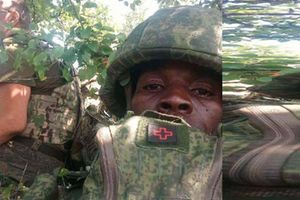
He sent photographs showing him in a bulletproof vest and helmet, with a rifle in hand. In the photo, there were other African recruits and a Russian soldier.
At first, the family was not overly alarmed by his decision to work abroad. But as reports of African fighters dying in the conflict began to surface, anxiety took hold.
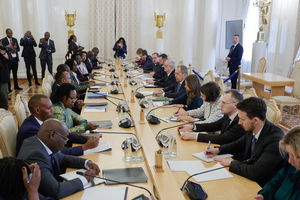
Members of the delegations, led by Russian Foreign Minister Sergei Lavrov and Kenyan Foreign Minister Musalia Mudavadi, hold talks in Moscow, Russia, March 16, 2026.
Photo credit: Reuters
Mr Omondi’s photograph appeared in a newspaper report, accompanying a story about Kenyans stranded in the war and pleading for rescue. His name was listed among those in urgent need of help.
The headline read: “Help, we are dying… Mr President, don’t turn your back.”
It was then that his earlier words, Ok oyot, made sense, and for the first time, his family understood the depth of his distress.
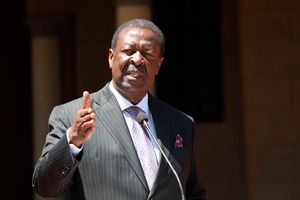
Hope flickered briefly when Prime Cabinet Secretary and Foreign Affairs Minister Musalia Mudavadi travelled to Russia in an effort to repatriate stranded Kenyans. But the optimism soon faded. Mr Mudavadi later cited significant challenges in tracing those recruited into the Russian army, pointing to complex travel routes and altered documentation.
For the Okiri family, the path back to their son grew ever more uncertain.
His mother, Teresa Okiri, clings to faith.
“I still believe he is somewhere in Russia and that he will come back home,” she says.
In December 2025, the family sought assistance from Kodumo Central Sub-location Assistant Chief Conslate Odira, who issued them with an official letter to support their appeals to government offices.
“He had been a military officer who was taken to Russia. Due to hardship, the parents would wish for him to be brought back to Kenya. The purpose of this letter is to confirm the same for your necessary assistance,” the letter reads.