Vuvuzelas will remain silent inside stadiums during the 2026 FIFA World Cup in the United States, Canada and Mexico, and at future World Cup tournaments.
Under FIFA’s stadium code of conduct, excessive noise-making devices, including plastic horns, air horns and whistles, are prohibited inside match venues.
That, however, does not signal the end of the plastic horn.
Far from the football terraces where it first captured global attention, the vuvuzela is being reinvented for entirely different purposes. Across Africa, communities are discovering new ways to put the once-controversial instrument to use in places few would have imagined.
Today, it is heard in churches as a musical instrument, at political rallies, during street demonstrations and, increasingly, in the countryside, where it has become an unlikely ally for farmers.
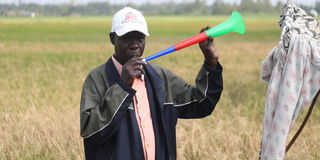
James Nyagwala uses a vuvuzela to keep birds away from his rice farm in Oriang Kogweno Village in Rachuonyo North, Homa Bay County on June 30, 2026.
Photo credit: George Odiwuor | Nation Media Group
The vuvuzela first gained worldwide fame during the 2010 FIFA World Cup in South Africa, becoming a defining feature of the tournament and an enduring symbol of local football culture.
Its relentless, high-pitched blast, however, divided opinion. The constant drone made it difficult for players to hear teammates, coaches’ instructions and even referees’ whistles.
The name is derived from Zulu, loosely meaning “making a blowing sound”. The instrument itself is inspired by the kudu horn, traditionally used by southern African leaders to summon villagers to community gatherings.
Beyond football, the vuvuzela has found a growing range of practical uses.
In Kenya, demonstrators use it to amplify their presence during protests, while political supporters blow it at rallies to celebrate leaders or drown out opposing voices.
Now, farmers have discovered that the loud blast can protect their crops by scaring away birds.
In Oriang Kogweno village in Rachuonyo North, the plastic horn has become an essential tool for many rice farmers.
When they leave their homes each morning carrying vuvuzelas, an outsider might mistake them for supporters heading to a political rally. The real destination, however, is the rice fields.
James Nyagwala is among the farmers who rely on a vuvuzela to protect his rice field along the Homa Bay-Kendu Bay road, where its piercing sound sometimes echoes across the village.
James Nyagwala uses a vuvuzela to keep birds away from his rice farm in Oriang Kogweno Village in Rachuonyo North, Homa Bay County on June 30, 2026.
Photo credit: George Odiwuor | Nation Media Group
From a distance, he appears to be blowing the horn for amusement. In reality, he is safeguarding the harvest that feeds his family.
A glance skywards reveals why. The sharp blast startles flocks of quelea and weaverbirds, sending them scattering before they descend on the ripening rice.
The birds move unpredictably, sweeping across the sky in constantly shifting formations.
“Birds can cause huge losses in rice production if they are not controlled. They have to be scared away by whatever means possible,” Mr Nyagwala said.
His farm, which borders Ondago Swamp, lay idle for more than six decades, as did many neighbouring plots.
Late last year, the Lake Basin Development Authority (LBDA) encouraged residents to embrace rice farming and supported them in cultivating the crop.
He explains that birds pose little threat during the early stages of growth because there is little for them to feed on.
The challenge begins as harvest approaches. As the grains ripen and dry, farmers find themselves competing with birds for the crop.
“Birds become our biggest challenge during the final four weeks before harvesting. Once the grains begin drying, they can destroy everything if they are not controlled,” he said.
A farmer uses clay balls to scare birds from his rice farm in Oriang Kogweno Village in Rachuonyo North, Homa Bay County on June 30, 2026.
Photo credit: George Odiwuor | Nation Media Group
Large flocks of quelea birds can descend on a field within minutes, consuming vast quantities of grain and inflicting significant losses.
In the past, farmers relied on shouting or beating empty containers to frighten birds away. They abandoned more aggressive methods after officials from the Kenya Wildlife Service warned them against killing protected birds, an offence that can attract fines or imprisonment.
Throwing stones also proved problematic, as it often knocked mature grains into the muddy paddies, where they could not be recovered.
Not everyone, Mr Nyagwala added, could throw far enough to reach the birds.
“Beating metal containers is not very effective. Even if the birds fly away, they usually return within a short time,” he said.
The idea of using vuvuzelas emerged after farmers noticed birds scattering whenever passing vehicles sounded their horns. Motorcycles with loud exhausts had a similar effect.
“That is how we came up with the idea of using the vuvuzela. Its sound resembles that of a vehicle horn, and for me it works much better than hitting containers,” he said.
In Oriang Kogweno village, birds begin invading rice fields as early as 6am.
Mr Nyagwala arrives at his farm by 5.30am, determined to be there before the first flock appears.
“Birds are most destructive in the morning and in the evening when temperatures are cooler,” he said.
The work, however, continues throughout the day.
Flocks repeatedly descend on the paddies to feed on mature grain, forcing farmers to remain in their fields from dawn until dusk.
Family members often bring them meals and drinking water, while makeshift shelters erected in the middle of the fields offer brief respite from the scorching sun.
Those unable to guard their crops throughout the day hire workers to do so. Some even employ additional ‘bird scarers’ because keeping watch over the constantly moving flocks requires several pairs of eyes. Quelea birds are small, swift and remarkably difficult to follow as they dart across the open sky.
Rice farmers in Oriang Kogweno Village in Rachuonyo North, Homa Bay County guard their crops from birds on June 30, 2026.
Photo credit: George Odiwuor | Nation Media Group
Joel Asumwa has spent the past three weeks working as a bird scarer in one of the rice paddies. He admits it is among the toughest jobs in rice farming.
“Some birds have become used to the sounds we make and no longer fly away easily. We need to keep finding new ways to protect the rice fields,” he said.
“I spend the day running through muddy fields from one end to the other while blowing the vuvuzela. When it stops working, I throw balls of clay. Managing just one acre properly requires more than five people,” he said.
The long pipe holds a clay ball at the top before launching it across the field with minimal effort. He says the task becomes even more difficult when large flocks split into smaller groups, making them harder to monitor.
“The birds start feeding the moment they land. If they stay for more than five minutes, they can wipe out an entire section of the paddy, leaving nothing to harvest,” he said.
Many women tasked with protecting the fields use oyieke , a simple device made by placing pebbles inside a bottle and shaking it to create noise.
Occasionally, disagreements arise among neighbouring farmers when birds driven from one paddy simply settle in another, prompting accusations of sabotage.
According to the Food and Agriculture Organisation, the most effective and sustainable approach to controlling quelea birds is through Integrated Pest Management (IPM).
This combines habitat modification, visual and sound deterrents, safe bird repellents and timely harvesting to provide the most effective long-term protection.
The sound of vuvuzelas, which once echoed through football stadiums as the soundtrack to sporting passion, has found an unexpected second life among the rice paddies of Rachuonyo North. There, every blast is no longer a celebration of a goal, but a determined defence of livelihoods.