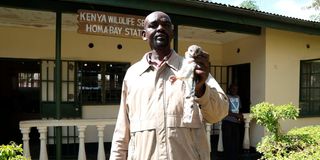
Samuel Oyugi walked into the Kenya Wildlife Service (KWS) office in Homa Bay Town on Wednesday afternoon with cautious hope in his heart. He had not expected an instant reward, but he believed that, in time, his actions would earn recognition from the wildlife agency.
Cradled in a cardboard box was an African Pygmy Falcon he had captured the previous day at his compound in Andiwo Village, Ndhiwa, Homa Bay County. The bird of prey had become entangled in wire mesh while hunting his chicks, losing its ability to fly. For Mr Oyugi, a farmer who has repeatedly watched such birds swoop down and carry off his poultry, it felt like fate had finally handed him an advantage.
“The bird was trapped in a chicken coop when I caught it. It was hunting my poultry and got tangled in the wire mesh,” he said.
Falcon in attack mode.
Photo credit: Pool
In his village, he explained, birds of prey are a persistent menace. They descend with swift precision, snatch young chicks and vanish into the sky before tearing into their catch. Losses mount quietly but steadily, gnawing at the fragile margins of rural livelihoods.
“I have lost many chicks when birds of prey pounce and fly away with them. We also have other wild animals that target the livestock we keep at home,” Mr Oyugi said.
He admitted that he had often wished to rid himself of the falcons permanently. But killing one, he reasoned, would scarcely dent the larger problem. Besides, the birds are notoriously agile - masters of speed and manoeuvre, able to slice through complex spaces with effortless grace.
When this particular falcon became ensnared, villagers urged him to kill it. But Mr Oyugi had other thoughts. He believed that by sparing the bird and delivering it alive to KWS, he might not only earn compensation but also draw attention to the hardships farmers like him endure.
He had tied its legs to prevent escape and carefully transported it to the KWS office, convinced that preserving its life would strengthen his case.
For years, it has been common knowledge that farmers whose livestock are killed by wildlife can seek redress under the National Wildlife Compensation Scheme, managed by the State Department for Wildlife and County Wildlife Conservation and Compensation Committees. Claims are assessed and payments awarded according to the nature of the loss.
However, instead of compensation, Mr Oyugi received a lesson in conservation and a rebuke.
He was informed that he had erred by capturing the bird. His account was recorded, and he was cautioned never to trap birds of prey.
“I was surprised when I was told I could not be compensated, despite the effort I made to keep the bird alive,” he said.
A KWS officer explained that the agency does not compensate for such cases. Birds of prey, he said, are protected wildlife, free to roam and not to be trapped or harmed.
“It is against the law to set traps or pitfalls for wild birds. They must not be poisoned either,” the ranger said.
Kenya’s Wildlife Conservation and Management Act of 2013 prescribes stiff penalties for harming protected species, including fines of up to Sh20 million or life imprisonment in severe cases. Poaching and illegal wildlife trade attract sentences ranging from 30 years to life, while even possession of bush meat carries significant penalties.
Mr Oyugi was instructed to release the falcon alive. He was advised instead to reinforce barriers around his poultry to keep predators at bay.
Jackson Kibor, the KWS Warden in Homa Bay County, said complaints about birds of prey attacking poultry are rare. However, he noted that the agency can assist communities facing persistent wildlife disturbances.
“We can collaborate with other agencies to install repellents that drive birds of prey away,” Mr Kibor said.
In December, a farmer in Sigomre, Siaya County, was filmed cycling with a dead python and a dog strapped to his bicycle. The man, identified as Charles Otieno, had killed the snake after it attacked and killed his guard dog. In protest, he paraded the reptile before authorities, claiming his repeated calls for KWS to tame animals invading his farm had gone unanswered. He was later assured that he would be compensated.
A screengrab from a viral video showing Charles Otieno cycling to the police station with a dead snake that killed his dog.
Photo credit: Pool
A similar incident occurred weeks later in Kisaka, Suba North. Workers at Soklo poultry farm in Lambwe East Location killed a python nearly eight feet long after it strangled a young goat. The reptile, believed to have slithered from the lake or nearby hills, had already suffocated its prey and was preparing to swallow it when a worker raised the alarm.
“We thought the goat might still be alive and that the snake would release it when confronted. But by the time it let go, it was too late,” said Kennedy Otieno, the farm manager.
The python hissed and struck defensively as villagers pelted it with stones and sticks. Farmers in the region say such encounters are common. The snakes prey on goats, sheep and dogs, discouraging farmers from expanding their herds.
“Snakes can be relocated to other habitats and even used for tourism. We do not want them next to our farms,” Mr Otieno said.
Graph Omwanda added that hippos also encroach on farms, devouring crops. Although KWS responds to distress calls, he said animals often retreat before officers arrive, making relocation difficult.
In some instances, frustrated residents take matters into their own hands.
Mr Kibor urged restraint. Besides the python in Soklo, another was recently killed in Kisui. He emphasised that KWS officers are equipped with snake-handling tools and can safely capture such animals.
“Pythons are not venomous and should not be killed. However, they can be dangerous if threatened. We urge residents to report incidents to our offices,” he said.
An officer from Kenya Wildlife Service (KWS) talks to residents of Sikri Village in Lambwe Ward in Homa Bay County on March 10, 2021 when KWS held a sensitisation meeting on human wildlife conflict with the villagers.
Photo credit: George Odiwuor | Nation Media Group
Environmental experts warn that such clashes are likely to intensify. Clifford Omondi, a climatologist and member of the Environment Institute of Kenya, said habitat loss and climate change are driving wildlife closer to human settlements.
“Animals must adapt to survive. Some end up in homes and farms where people encounter them,” he said.
Encroachment into wildlife habitats and prolonged droughts that deplete water and food sources are among the leading causes of human-wildlife conflict.
“In the case of the snake, it was simply hungry and searching for food,” Mr Omondi said.
For farmers like Samuel Oyugi, the line between conservation and survival remains thin and fraught. In sparing a falcon, he hoped for reward. Instead, he found himself standing at the uneasy frontier of life imprisonment.