Nickson Ochieng can no longer hold his arms parallel to each other. His right arm remains awkwardly bent, a permanent reminder of a terrifying night on Lake Victoria in August.
A fisherman at Koginga Beach in Homa Bay, Mr Ochieng was steering a fishing boat as its coxswain, accompanied by three other men, when a vessel with a far more powerful engine emerged from the darkness.
Repeatedly struck with a blunt object, Mr Ochieng survived the assault, but his livelihood was left in tatters.
“I cannot carry heavy loads after the attack. I do not have enough money to go to hospital for a proper check-up,” he says quietly.
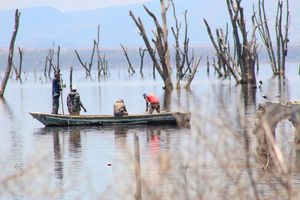
His ordeal is no longer an isolated incident. An increasingly bitter war is unfolding under the cover of darkness on Lake Victoria, where fishermen are locked in violent confrontations over fishing territories and lucrative breeding grounds.
Security agencies have identified Koginga, Ndhuru, Achich, Ngegu and Lela as high-risk beaches, where violent turf wars reportedly erupt almost every fortnight.
The violence has claimed lives. At least three fishermen have died under mysterious circumstances following night-time ambushes on their boats.
On the morning of October 23, the body of James Okanga was found floating near Koginga Beach following a reported confrontation the previous night.
His family said his body bore marks suggesting he had been struck with a blunt object before falling into the water.
His death triggered tension in Homa Bay Town, forcing police to call for reinforcements before the body could be retrieved, more than seven hours after it was discovered.
Just weeks earlier, two other fishermen, Brian Mingo and Joseph Ojwang, had died under similar circumstances. The two, who fished from Ndhuru Beach in Mbita, were reportedly caught up in a violent confrontation on the lake.
According to Patrick Ochogo, chairperson of the Koginga Beach Management Unit (BMU), the conflict is rooted in a breakdown of oversight within the very structures established to protect the lake: the fishermen's patrol units.
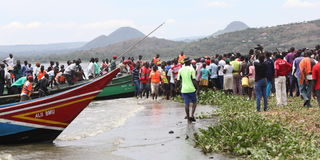
Fishermen mill around the body of one of their colleagues at Ndhuru Beach in Lambwe Ward after it was retrieved from Lake Victoria when two two groups of fishermen fought over fishing ground in Lake Victoria on October 9, 2026.
Photo credit: George Odiwuor | Nation Media Group
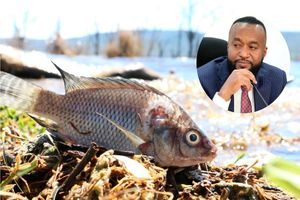
Fish breeding and nursery areas in lakes such as Victoria are not defined by one universal distance from the shoreline. Their size, shape and location depend on natural features, local topography and ecological functions.
They are commonly found in shallow, sheltered waters close to the shore, including river mouths, shallow bays, wetlands and areas with dense aquatic vegetation such as papyrus and water lilies. These habitats provide food and shelter for fish eggs and juvenile fish.
The Kenya Marine and Fisheries Research Institute (KMFRI) has mapped and gazetted specific major fish breeding zones. Rather than following a uniform strip along the shoreline, the designated sites vary in size according to the characteristics of individual bays and river mouths.
According to Mr Ochogo, fishermen operating from Koginga Beach should not cast their nets within 200 yards of the shoreline because the area is considered a breeding ground.
“The rest is common water where anyone can fish. The breeding site should be protected,” he says.
The Government maintains that the lake has no territorial boundaries. Yet, on the water, crossing an invisible line can reportedly trigger a violent confrontation.
Mr Ochogo says each beach has boundaries determined by physical landmarks on land, such as trees and rocks. Individual beaches also have their own by-laws, alongside common laws governing fishing activities.
He says conflicts arise when rogue individuals conducting patrols attempt to arrest fishermen who have not broken any laws, or when patrol units enforce regulations outside their jurisdiction.
That was reportedly the case at Ngegu Beach in August, when a fisherman identified as Evance Okoth died while fishing at night. He is said to have been attacked by a group conducting patrols to eliminate illegal fishing gear.
Illegal fishing activities
Ngegu BMU chairperson Douglas Otieno has denied any involvement in the death. He had been accused of issuing orders that led fishermen to confront the occupants of the boat in which Mr Okoth was fishing.
Mr Otieno, however, said beach officials had been conducting patrols on the lake at 2am on September 13 to eliminate illegal fishing activities.
They encountered a group of fishermen operating in a breeding area and warned them against the practice, he said.
“We later moved to another section when the occupants of the boat where Evance was hit our vessel. I was attacked using a machete,” Mr Otieno said.
He said he lost consciousness after the assault and was rushed to hospital, where he later learnt of Mr Okoth’s death.
In principle, patrol units form the frontline of community-based maritime security and sustainable fisheries management. Supported by the Kenya Fisheries Service (KFS), they train local communities and conduct monitoring, control and surveillance, including operations against illegal fishing gear.
To strengthen this mandate, local MPs have used National Government Constituency Development Fund (NG-CDF) allocations to purchase powerful patrol boats.
However, the investment appears to have produced unintended consequences.
Rogue fishermen are now accused of hijacking the high-powered vessels to conduct unauthorised and undocumented night patrols. The operations have allegedly become avenues for extorting money from vulnerable fishermen and confiscating their catches.
Back at Koginga Beach, where 35 registered fishing boats employ 117 men, fear has become part of the daily routine for those heading out onto the lake.
Mr Ochieng says the dynamics have changed. Instead of fleeing when they encounter patrol boats, fishermen are increasingly launching counter-attacks against groups claiming to protect the lake from illegal activities.
When patrol units from different beaches meet on the water, confrontations can quickly turn violent. The same happens when fishermen resist arrest by Koginga Beach patrol teams.
“It has now become a game of retaliation, where everyone wants to take revenge on the group that previously attacked them,” he says.
The result is a section of Lake Victoria transformed from a source of life into a landscape of fear. The waters that feed families, sustain communities and support thousands of households have become a place where an ordinary fishing expedition can end in bloodshed.
Boats that should carry nets, hooks and other fishing equipment are reportedly venturing onto the lake with machetes, clubs and stones.
Mr Omondi Aloso, a fisherman at Koginga Beach, says the attackers are often people known to their victims. Some interact freely with their targets during the day, engaging in ordinary conversations on land before turning violent under the cover of darkness.
“Sometimes we meet at the market and make ‘jokes’ about planned attacks. It forces fishermen to arm themselves, ready to pounce on whoever provokes them,” he says.
Faced with what they describe as systemic corruption, in which rogue actors and allegedly complicit fisheries officers turn arrests into opportunities for immediate cash payments on the water, many Koginga fishermen want patrol operations removed from the hands of BMUs and placed exclusively under the State Department of Fisheries.
But local authorities and researchers argue that lasting peace will require more than intensified policing. They say the lake needs structural reforms addressing the underlying causes of conflict.
Homa Bay County Fisheries Director Michael Omondi advocates comprehensive spatial planning to divide the lake into clearly designated zones for fish breeding, mining, resorts and public recreation, eliminating uncertainty over how different sections of the water should be used.
“When we have that, then we will have a well-organised and planned lake, which would minimise conflict between the various water users that we have,” he says.
Mr Omondi argues that there is no need for additional legislation, noting that the blue economy cuts across several government departments, each with a clear mandate under existing Acts.
Dansam Ouma, a fisheries researcher, says discussions on the challenges facing the lake should be held more frequently. He warns that some fish species are on the verge of extinction because of the ecological pressures confronting the lake.
He calls for structured engagement and a clear legal framework between the national and county governments. He also advocates a unified legal framework covering all counties sharing the lake, from Busia to Migori, to protect dwindling native fish species from depletion.
“The law should cut across in Nyanza. The lake is facing challenges with depletion of natural species. Overfishing is killing the lake,” he says.
Under this system, juvenile fish are first raised in ponds before being transferred to cages suspended in the lake. They are fed until they mature, after which they are harvested and taken to market.