For 65-year-old Ann Syombua, a resident of Kasoito informal settlement, the stretch of water running through her neighbourhood used to be a lifesaver. Now, it feels like a threat.
"The tributaries are no longer safe," Syombua said. "The water is contaminated from upstream, unlike before. Human settlements upstream without a defined sewer line, especially in riparian lands, have left the rivers dirty."
Syombua is not alone in her fear. Environmental lobby groups and local communities are raising the alarm over the severe contamination of tributaries draining into River Athi within Athi River Township, Machakos County. With expected heavy rains around the corner, many worry that accumulated toxic waste will wash downstream into major water reservoirs, including the near-complete Thwake Dam.
"The mess begins in the factories along the Sabaki River," said John Kakui, founder of Kisaka Foundation Kenya, which actively cleans and conserves the River Athi basin. Kakui noted that recent research by his foundation detected heavy metals, including lead, in water samples taken from the river.
"The tributary rivers drain into the Athi River that in turn drains to water basins southwards and to the ocean, endangering both human and aquatic lives," Kakui added. "If this pollution continues, in 30 years, Kenya might be facing a major catastrophe: polluted water basins that have left a trail of disaster on both humans and animals."
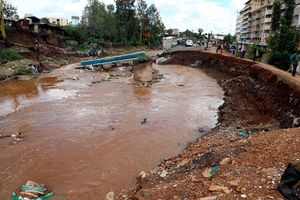
Livestock grazing at the banks of the heavily polluted Sabaki River within Athi River township on October 30, 2026.
Photo credit: Stanley Ngotho | Nation
According to the World Health Organization (WHO), lead is a toxic heavy metal with no safe level of human exposure, building up in organs, bones, and teeth over time.
The threat is compounded by daily life along the banks. In Athi River Township, despite sections of the river drying up during dry spells, the riverbed between the Namanga Highway bridge and Bridge 39 remains choked with waste. Facing pasture shortages, local livestock can be seen grazing on leafy vegetation along the banks.
"River Athi water consumers are courting a health crisis," warned Dr Shedrack Mutei, an environmental lobbyist with the Kisaka Foundation. "We have individuals growing vegetables using the contaminated water and selling to unsuspecting customers. We also have animals feeding at the river banks. No one is safe."
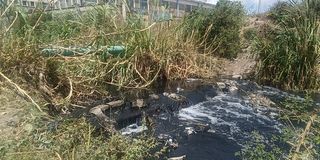
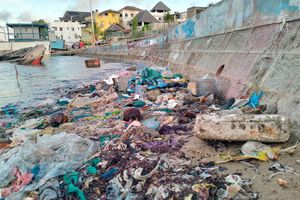
The Sabaki River originates in Syokimau and winds through residential and industrial belts, passing dozens of firms in Mlolongo’s Sabaki Estate before joining River Athi. Without a proper sewer network, raw effluent from rapidly expanding Mlolongo town flows straight into the watercourse. A Nation spot check found the river resembling a thick stream of industrial runoff, heavy metal discharge, and plastic waste.
The Mbagathi River stems from natural springs in the Ngong Hills near Kerarapon and Thogoto Forest. It flows east past Ongata Rongai, Multimedia University, and Magadi Road, tracing the southern boundary of Nairobi National Park before carrying its load of pollutants into River Athi.
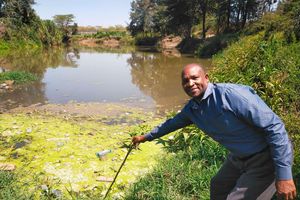
Environmentalist John Kakui display assorted waste in the highly polluted Sabaki River, within Athi River township on October 30, 2026.
Photo credit: Stanley Ngotho | Nation
Data from the National Environment Management Authority (NEMA) indicates that Kenya generates roughly 22,000 tonnes of general waste daily, with toxic, hazardous, and electronic waste ranking among the fastest-growing environmental threats in 2026.
Jurisdictional gaps have hampered local responses. The Machakos County Executive Committee Member in charge of Water noted that catchment and river conservation is not a devolved function, leaving the county government without a direct mandate to address river basin pollution.
However, state agencies are attempting to intervene. Tana and Athi Rivers Development Authority (TARDA) CEO Liban Roba announced an integrated, basin-wide effort focusing on water-quality monitoring, early hotspot identification, and catchment protection. TARDA recently conducted field sampling from Ondiri Swamp and the Nairobi River system through Machakos, Makueni, Tsavo, Galana, and Sabaki, testing physical, chemical, and biological parameters, including E. coli, total coliforms, phosphates, and heavy metals.
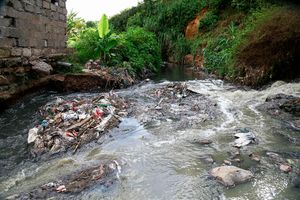
Toxic raw effluent freely flowing in Sabaki River within Athi River township on October 30, 2026.
Photo credit: Stanley Ngotho | Nation
"The results will help establish the actual state of the water, identify areas requiring priority intervention, and provide an evidence-based foundation for subsequent pollution-control measures," Roba stated, emphasising the need for regular seasonal testing around rapidly urbanising industrial zones.
Regulators have also taken enforcement action. A National Assembly Public Participation Committee report approved on April 11, 2024, pointed to industrial and domestic discharge from upstream firms and the Mavoko Industrial Zone as primary pollution drivers.
NEMA reported shutting down 405 illegal discharge points during the 2025/26 financial year, exceeding its target of 400, while increasing environmental audits to 9,798 (up from 6,673 the previous year). Earlier this year, a crackdown spearheaded by Cabinet Secretary for Environment Dr Deborah Barasa targeted hotspots in Mlolongo. Later in May 2026, NEMA shut down a chemical firm in Mlolongo and arrested its owners for discharging untreated chemical waste into the Nairobi River system.
Yet, for hundreds of downstream residents dependent on River Athi, enforcement has not yet eased their anxiety. As the rainy season approaches, the prospect of downpours offers little comfort to communities fearful of what the floodwaters will carry.