For the second time, Kericho governor Erick Mutai political career that was facing premature crumbling was saved by Senators at the 11th hour when all indications had shown that he was headed into political oblivion.
Both local and national politics, questions on the assembly system that was installed in the 11th hour ahead of the impeachment of the governor and the bid to send a message to the executive made the governor have a second bite to the cherry of the governors’ seat again.
The Nation has learnt that a section of Senators felt that powerful forces in the Executive wanted the governor out and he was being sacrificed at the altar of local politics.
Multiple sources in the Senate confided to the Nation that there were questions about the independent report by the ICT Authority, a State agency, presented to the House on the technology system used in the County Assembly.
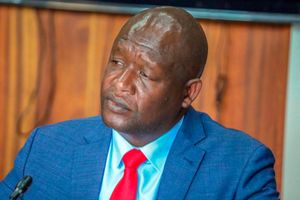
Kericho Governor Eric Mutai addresses the media at Parliament Buildings in Nairobi on August 29, 2025, after the impeachment motion against him at the Senate failed.
Photo credit: Pool
According to sources, just hours before the ICT Authority report was presented, the officer assigned to prepare the report for the Senate disappeared for two hours and could not be traced. This prompted some Senators to suspect there were people out to influence the outcome.
“The ICT man disappeared for two hours and when he came back he wasn’t speaking to anybody, " said Tana River Senator Danson Mungatana.
The crucial technology report was to answer the core question on whether the assembly attained the two-thirds threshold on the impeachment of the governor.
The main purpose of the audit was to establish whether some people voted for others as four MCAs who appeared as witnesses for the governor claimed that they did not even though the system indicated they supported of the impeachment motion.
According to the report, which was ordered by speaker Amason Kingi on the voting system, it was not possible for anyone to vote for another person with the link that was provided to the MCAs.
The document, which was presented by Philip Erode, the deputy director in charge of security at ICT Authority, stated that in addition to the link that was sent to the MCAs, one needed both the username and the password (ID number).
According to the report, the number of MCAs who voted in the motion were 33 as extracted from the voting module logs.
The report also dismissed allegation of tampering with the numbers as alleged by the governors’ witnesses.
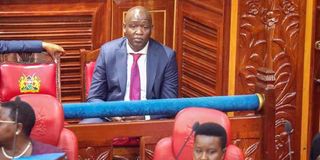
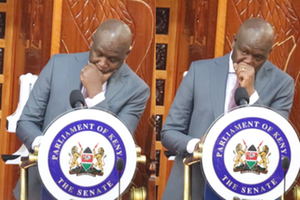
Kericho Governor Eric Kipkoech Mutai appears before the Senate on Thursday, August 28, 2025.
Photo credit: Dennis Onsongo | Nation Media Group
However, Senators poked holes into the report claiming it was just a reproduction of the extracts from the County assembly documents.
Senators also faulted the report because it failed to answer the question of how one Internet Protocol (IP) address was used to vote nine times. According to the lawmakers, it was not clear whether one person was sitting somewhere and voted nine times.
The ICT Authority report was also not signed by the team from the governors’ side hence it did not meet the threshold of concurrence in order to be admitted into the House.
The Nation also learnt a section of Senators were not comfortable with ICT Authority conducting the scrutiny and wanted the Auditor General to do a forensic audit of the assembly IT system.
Vihiga Senator Godfrey Osotsi told the House that a closer check of the system indicated that the devices that were used for voting were in different towns like Kiambu, Kijabe, Eldoret, Ahero Narok, Yala, Baringo, Nyandarua and Kapsabet.
“I have read the report by the expert and it has a lot of inconsistencies. There are IP addresses that have been used for times for voting while others have been used three times,” Mr Osotsi said.
“There is no supporting document in this report, including a report on whether training was done on this system or not,” he added.
Tana River Senator Danson Mungatana said the IT expert created doubt on the exact number of MCAs who voted for the impeachment motions.
“We have been sitting here for the last three days and every person who has spoken to this matter, including the experts, have created doubts on the number of MCAs who participated in this impeachment motion,” Mr Mungatana.
He added: “When we are talking about the threshold, the standards must be very high beyond reasonable doubt.”
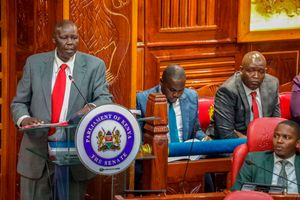
Day 2 - Senate impeachment hearing of Kericho Governor Eric Mutai
Senators also raised doubts on the system that was used during the voting day terming it a special purpose vehicle that was only designed for the impeachment.
“This impeachment was premeditated, you cannot in ICT, develop a system today, launch it a day before and use it before doing a test run,” said Uasin Gishu Senator Jackson Mandago.
It emerged during the debate that the system was installed by a former officer of the county who was sacked by the Executive and it was done at night, hours before the impeachment vote.
“The County Assembly must tell us, how do you hire an officer that was fired by the executive and immediately employ them for only one mission: to make sure that the governor is impeached,” Mr Mandago said.
This hurried nature of installing the system without training the MCAs on its usage raised eyebrows among Senators.
“We cannot sacrifice the governor at the altar of an unverified system,” said Kisumu Senator Tom Ojienda.
According to Mr Osotsi, Article 86 of the Constitution on the voting method demands that any system must be simple, accurate, verifiable, secure, accountable and transparent.
“This does not qualify to meet the basic requirement of the constitution. This House's credibility has been questioned. We have an opportunity to make the right decision or continue being questioned out there. We need to send these MCAs to do the right job,” Mr Osotsi said.
Vihiga senator-elect Godfrey Osotsi.
Photo credit: Jeff Angote | Nation Media Group
Contrary to the ICT Authority report, another audit indicated that the county IT system is hosted by a private company based in Germany and is prone to attacks.
Appearing before the Senate, Mr Job Oguya, who conducted the audit of the system on behalf of the governor’s side, told Senators that the assembly system was highly threatened and vulnerable and susceptible to unauthorised access.
According to Mr Oguya, from their audit of the system, it was possible for someone to vote on behalf of another if they had their ID number.
The report by indicated that the system was compromised because of the sharing of the username and address. It also highlighted that it was possible for the system to be compromised and accessed by a third party.
Mr Oguya. However, failed to answer the core question that Senators wanted on whether some people voted for four MCAs as claimed saying it was not part of their mandate which he insisted was only to ascertain on the security of the system.
“From the print out, 33 MCAs voted but we cannot ascertain that they actually voted because the password could be accessed by the IT administrator, who set up the system,” Mr Oguya said. “I would not recommend the system to be used by anyone until the security features are upgraded.”
The impeachment motion which came when the relationship between legislators and President William Ruto, also provided an opportunity for the Senators to flex their muscles and not yield to the whims of the Executive.
The Nation also learnt that the way Majority Whip Boni Khalwale moved the motion was deemed as arrogant and was meant to sway Senators to vote in a particular way.
Mr Mutai was impeached after being accused of illegal appointments, unlawful dismissals and transfers and usurpation of the constitutional and statutory functions of the County Public Service. Specifically, the governor is accused of engaging in skewed and nepotistic appointments of county employees.
Kericho Governor Eric Mutai: I am not perfect, but God gives second chances
He is also facing charges on illegally appointing a County Attorney while a substantive office holder was still in place and subverting, discrediting and impeding the oversight role of the County Assembly by writing to the speaker purporting to direct them on, inter alia, the timelines within which summoned chief officers should respond to the assembly in the exercise of its oversight mandate.
Further the assembly accused Mr Mutai of misappropriation and misallocation of county finances, contrary to Articles 10, 183 and 201 of the constitution. In particular, he is said to have authorised fictitious payments for goods, services and works that were either never delivered or only partially completed totaling to Sh85, 704,522