Before dawn breaks over the thorny scrublands of Bamba in Kilifi County, motorbikes roar to life. Their headlights slice through the darkness as riders balance yellow jerrycans stacked precariously on metal carriers.
Every few minutes, another bike passes, rattling over the dusty ground, ferrying water that has become a most precious commodity.
Amid the dust left behind are women who cannot afford the cost of water ferried by motorcycles. Instead, they have accepted that sleep has become a luxury as they struggle to fetch water from as far as 10 kilometres away.
Climate Tracker
Kenya Satellite Analysis
Developed by Geoffrey Onyambu • © 2026 Nation Research Desk
“We leave our homes at night to look for water. If you wait for daylight, you may come back with nothing,” says Ms Kavumbi Kaderekaka, a resident of Mitsengerini sub-location.
According to locals, Mitsengerini is a place whose name comes from mitsengere, a thorny shrub that thrives where little else survives.
Today, the name feels like a prophecy.
Motorbike riders charge Sh250 for a three-kilometre trip carrying seven jerrycans. The price goes higher depending on the distance. For families with no steady income, that cost is devastating, yet there is no alternative.
“If it does not rain, where will we go? We are dying of hunger. We are dying without water,” she laments.
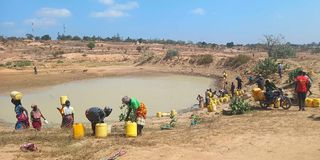
Hundreds of residents have now made it a daily routine to fetch water from what remains of the Mbogo water pan, the last functioning water source in the area.
Women fetch water at Mbogo water pan in Bandari location, Bamba, Kilifi County on February 11, 2026. Of the five water pans dug in Bandari, only Mbogo has water.
Photo credit: Valentine Obara | Nation Media Group
Of the five water pans dug in the Bandari location with support from charity organisations, only Mbogo still holds water.
Even then, the water is unsafe for domestic use as it is shared between humans and animals at the source.
Water-borne diseases such as diarrhoea, cholera and typhoid loom as silent threats.
“If you get sick and go to hospital, you won’t find medicine. That is our fear,” Ms Kaderekaka adds, blaming leaders for neglecting the community.
“They use piped water or bottled water. Ours is dirty. It can bring disease. But people have no choice,” she says.
Residents fear that if it does not rain soon, the remaining water will be finished.
The other water pans Mkwavi, Kazungwi and Chambuko have dried into cracked basins, their beds bleached white by the sun. At Mvueni water pan, nothing remains but dust.
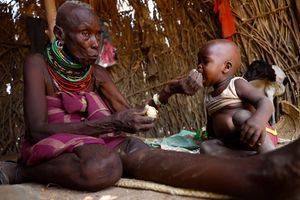
At times, children are forced to go to school on empty stomachs when there is no water to prepare a meal.
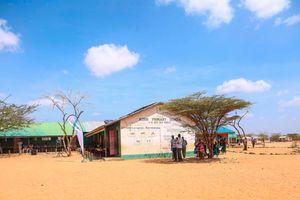
Mr Suleiman Kenga Mangi, the Assistant Chief of Mitsengerini, says two primary schools serve Bandari location and both are struggling. Mitsengerini Primary has 876 pupils, while Chambugo Primary has 300.
Residents have relied on farming for decades, with some keeping livestock as well. When the short rains failed, and the long rains never came in 2025, life became unbearable.
“People planted, but there was no harvest. How do people live without food? That is the reality here,” he states.
His sentiments are evident in maize fields filled with withered crops. Bandari has a population of about 4,700 people. The last government food aid arrived in November 2025.
According to administrators, this is because the area is vast, with 21 sub-locations, and relief food is supplied on a rotational basis.
In one settlement, residents scramble around a water tank constructed by World Vision, which they say has not been in use for four years. The taps remain locked, and a group of men atop the tank is tasked with manually fetching water into jerrycans.
They use a rope to lift empty jerrycans and lower them once filled with water. Residents say they are unable to use the tap because it is automated through an innovation that requires payment using a water card.
“They need tokens. Without tokens, there is no water,” one resident explains.
Cattle drink from an algae-contaminated water pan in Ganze, Kilifi County on February 11, 2026.
Photo credit: Valentine Obara | Nation Media Group
In Ganze, Mr Kahindi Themo, a herder, watches a water pan built 40 years ago recede by the day. The water pan is mostly relied upon by pastoralists, some bringing livestock from as far as 20 kilometres away every day.
“We see the water reducing very fast. Some herders walk more than three hours to bring animals here. If the rains fail again, the water will dry completely,” he says.
With farming no longer viable, some young men have turned to fishing in a stagnant, dirty pond left behind after failed rains. They are oblivious to the green-coloured water, a sign of serious algae contamination commonly caused by a combination of biological growth, heat and stagnation, especially during drought.
The Kenya Red Cross coordinator in Kilifi County, Ms Kauthar Alwy Mohamed, says that although the situation has not reached a level where people are starving to death, more action is needed by all concerned agencies to assist those affected.
“If it rains even in the highlands, things will get better because the water will come downstream. Otherwise, it will get worse,” she said.
Further into the Coast region, the crisis intensifies.
In Kenya, the drought crisis is often described in statistics. But in Tana River County, it has the smell of rotting carcasses and the weight of a 20-litre jerrycan dragged across scorched earth.
Residents mill around a water tank in Bamba, Kilifi County, on February 11, 2026. The group of men atop the tank is tasked with manually fetching water into jerrycans because the tap is automated through an innovation that requires payment using a water card.
Photo credit: Valentine Obara | Nation Media Group
The situation is causing the collapse of an entire way of life. The cry is the same: “Where are our leaders when we need them the most?”
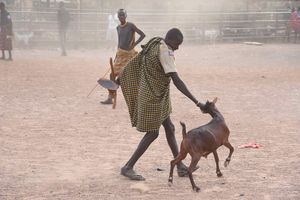
“Livestock started dying in December and the situation has not changed. Our animals are weak. They have no food. They have no water,” says Mr Suleiman Dame, a pastoralist from Matanya in Galole.
In this part of the Coast, livestock is everything. Pastoralists rely on animals for wealth, food, school fees and identity.
Mr Dame gestures toward the empty plains, trying to explain the pain of watching livestock die of hunger and thirst every passing day.
“We depend on livestock. When livestock suffers, humans suffer. I had 35 cattle, now I have 12,” he says.
The ongoing drought has destroyed livestock value. At the Garsen market, cattle prices have fallen drastically as buyers take advantage of desperate sellers.
“When you take livestock to the market, it’s worthless. A cow that used to sell for Sh50,000 or Sh60,000 now sells for Sh10,000 or Sh15,000,” he adds.
Community leader Mohamed Farah questions why no action was taken early by government agencies despite clear warning signs.
“This drought was expected. Early preparation was not done. We see meetings happening in boardrooms after the damage is already done,” says Mr Farah.
Human food aid has begun to trickle in from the government and charity organisations, but there is no support for livestock. Mr Farah insists an offtake programme is needed so the government can buy livestock before they die.
Pastoralists now travel over 20 kilometres in search of water and pasture. Many animals do not survive the journey.
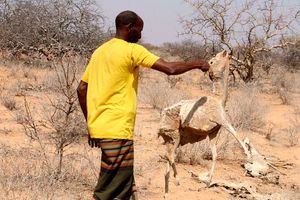
The journey toward the remote areas of Bura tells the story in full. The stench of decay hangs in the air. Bones and skeletons litter the bush, while tens of carcasses lie by the roadside.
One dead cow is covered with a makeshift shade, suggesting its owner stayed with it until the very end. Nearby, a skinned carcass lies exposed, its owner likely salvaging what little value remains.
Locals say tension has grown between pastoralists and farmers who rely on the Bura irrigation scheme as resources shrink. However, violence has been held at bay so far.
Imam Idris Haji Dulu explains that rice fields, which resemble grass, can easily attract livestock brought to the area in search of pasture. He adds that elders and religious leaders have so far prevented conflict through community sensitisation.
“Our fear is conflict between farmers and herders. Many people are coming from upstream areas looking for pasture. But the elders have controlled the situation,” he says.
“We ask herders not to enter farms and farmers to allow herders to collect what remains after harvesting,” states Mr Dulu, adding that peace has always been fragile in the region.
According to the Tana River County steering group on drought mitigation, at least 200,000 people are affected in the county.
At Jirfa in Hirimani location, a seasonal river has dried into memory. A well dug in the riverbed now serves hundreds of residents, drawing water one container at a time.
Women carry or roll 20-litre jerrycans, some for up to 10 kilometres under 40-degree heat. Whirlwinds dance across the barren land, lifting dust like smoke from a battlefield.
“This is heavy work, but what choice do we have?” one woman asks.
Within this area, only a few goats and sheep remain. Thousands of cattle that once filled the fields have been relocated to Bura and other areas in search of water and pasture.
According to Mr Abdulrahman Bonaya, a community leader, residents who once relied on livestock products such as meat and milk are now forced to buy food from shops located over 40 kilometres away.
“The only option is to send motorbikes to buy flour in bulk. Transport alone costs Sh1,500,” he says.
Residents are increasingly concerned about malnutrition among children and expectant women due to a lack of water and food.
They are demanding lasting solutions such as functional water systems and early action, while also appealing for urgent measures including livestock offtake programmes, animal feed support and safe drinking water before the crisis turns into a catastrophe.