On a normal day, Lodwar Livestock Market, located between the Turkwel Bridge and the Lodwar GK Prison roundabout, would be buzzing with activity.
The bleating of more than 1,000 healthy goats and sheep fills the air as traders and buyers haggle and conduct business.
In the mornings, the market offers a glimpse into the local economy and Turkana’s traditional pastoral life. Herders, draped in their usual shukas, sandals, and wrist knives, carry their traditional stools in one hand while managing untied animals with practised ease.
The market has 800 registered members under the Lodwar Livestock Marketing Association, and on any given day, at least half of them are present, selling livestock at fair prices to established buyers from outside the county as well as to local hotels.
During the rainy season, a grade-one goat prized for its tender, naturally reared meat typically weighs between 20 and 23 kilograms and sells for around Sh13,000.
Sheep and goats belonging to Emekwi Sikee, from Loima in Turkana County, are fed Prosobis seeds (Mathenge seeds) at the Turkana County Livestock Marketing Sale Yard in Lodwar town on February 13, 2026, to fatten them for about two to three months before they can fetch higher prices.
Photo credit: Jared Nyataya | Nation Media Group
Today, however, the market is flooded with emaciated livestock, and the familiar bustle of traders and healthy animals has been replaced by a quiet desperation.
The drought has turned Turkana’s livestock markets upside down. Goats that would have sold for Sh13,000 now barely fetch Sh5,000 at the Lodwar Livestock market, thanks to worsening drought that has left herders counting losses and hoping for rain.
Climate Tracker
Kenya Satellite Analysis
Developed by Geoffrey Onyambu • © 2026 Nation Research Desk
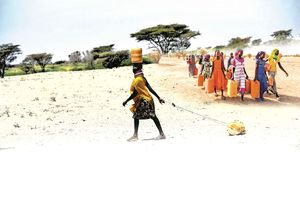
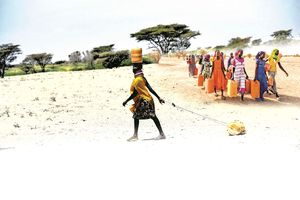
Emaciated livestock line the pens, an evident sign of the severe drought ravaging Turkana and threatening livelihoods across the county.
Market days once offered herders both income and social connection. Now, they come hoping simply to survive the losses caused by drought.
Mr Emekwi Sike, who travelled four days from his Lomwaragete village in Loima Sub-County, now has only 12 goats left out of 30 after many died along the journey to the market, from weakness.
“If all my livestock were healthy, I would have made at least Sh250,000,” he says.
“The remaining goats are not appealing. They are so weak that I am using my savings to buy Prosopis juliflora and acacia seeds, hoping they will regain weight in a few weeks and fetch a buyer,” he explains.
He is not alone. Many herders, unable to afford supplementary feed for their weak animals, watch helplessly as market prices collapse, knowing well that more livestock could die before sale.
Large-scale traders are also facing significant losses. Mr Isaiah Ewoi, a trader and transporter, says that since December last year, many goats have drastically lost substantial weight while being held at the market for more than two days before starting the 24-hour journey to Nairobi.
“The more we hold them, the more we lose. Sometimes, we are forced to sell a grade-one goat at Sh7,000 in Nairobi just because it has lost weight,” he explains.
In remote sale yards, prices are even lower. The drought has forced herders to travel extraordinary distances in search of pasture and water.
Traders like Mr Mohammed Atalej from Kibish report that many herders from Turkana North, Kibish, Kaikor, and Kokuro risk crossing into Ethiopia for pasture and water, rather than risk losing livestock over the 300-kilometre journey to Lodwar.
In Nakoret and Turkwel village sale yards, goats are selling for as little as Sh2,000.
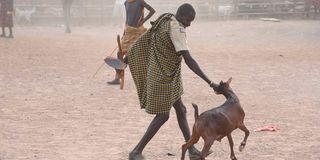
Locals in Turkana County arrive with goats and sheep for sale at the Turkana Livestock Marketing Sale Yard in Lodwar town on February 13, 2026.
Photo credit: Jared Nyataya | Nation Media Group
Mr Ewoi also complains about the Sh100 cess fee on every goat charged by Turkana County, arguing that it is unsustainable during drought.
“West Pokot charges only Sh20 per goat. The county should reduce it to Sh50 to help traders survive these hard times,” he says.
According to Mr James Elim, Secretary of the Lodwar Livestock Marketing Association, the fees were imposed without consultation.
He warns that many traders could abandon the trade or turn to quick cash ventures, including banditry, because of the high fees.
“The government should support livestock traders as actively as it supports maize and coffee farmers during price crises,” he says.
Traders are also appealing to national and county governments, as well as development partners, to establish reliable markets or a slaughterhouse in Turkana. They say the county’s strategic location, bordering Ethiopia, Uganda, and South Sudan, could support meat exports.
“We need immediate support like feed for livestock, functioning markets, and reliable abattoir and tannery facilities, if pastoralists are to survive this drought,” Mr Elim says,
“Instead of transporting livestock to Nairobi and losing weight along the way, we could slaughter them locally and export meat through Lokichogio Airport,” he adds.
As it is, hopes remain pinned on the coming rains. Mr Ibrahim Jama, another trader, urges authorities to create a stockpile of livestock feed at Lodwar market, to be sold at subsidised prices or given free to prevent further weight loss during transit.
“After buying livestock, we hold them for two days before transport. Their prices drop if they are not fed. Authorities should provide feed to maintain their weight,” he says.
Pastoralists in Turkana West are calling for the revival of the Lomidat Abattoir, which was stalled due to cross-border banditry, poor roads, and inadequate transport networks linking Kenya and South Sudan.
Mr John Ekalale from Oropoi village adds that the county also lacks a functioning tannery, leaving hides and skins to go to waste when animals die, missing a potential income source.
“The abattoir and tannery will provide a ready market for livestock, increase pastoralists’ income, and improve welfare in border communities affected by drought and banditry,” he says.
A local in Turkana County arrives with a goat for sale at Turkana County Livestock Marketing Sale Yard in Lodwar town on February 13, 2026.
Photo credit: Jared Nyataya | Nation Media Group
The two projects would also create local employment and support export markets. The abattoir would process camels, cattle, sheep, and goats, adding value to products and boosting county revenue.
“A revived abattoir will transform livelihoods. Our pastoralists will have a stable market, and the local economy will grow. We must ensure a steady supply of quality livestock,” he said.
Loima MP Dr Protus Akuja urged the government to use North and North-Eastern Development Initiative (NEDI) programmes to fund abattoirs, tanneries, and market construction in previously insecure areas.
“Turkana has a large number of livestock, but without a tannery or markets, pastoralists cannot earn from hides or higher prices for meat,” he said.
After the 2011 drought, the county government, the United Nations Development Programme (UNDP), and the National Drought Management Authority (NDMA) established a tannery to build community resilience through alternative livelihoods. However, the project stalled due to poor stakeholder commitment and a lack of public awareness, delaying the county’s aim to become a supplier of leather commodities.
The tannery was intended to operate commercially, collecting hides and skins from across Turkana, grading and processing them into leather goods such as shoes, belts, bags, key holders, and table mats.
With the current drought and livestock crisis, herders and traders are urging authorities to revive these facilities and markets, or risk further economic collapse in one of Kenya’s most livestock-dependent counties.