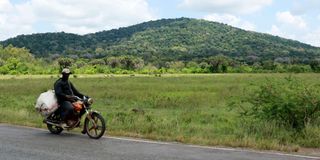
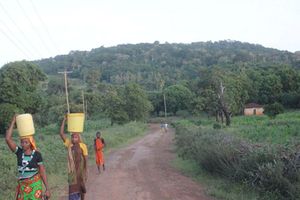
Communities living around Mrima Hill in Kwale County have regarded the forested elevation as more than just a mountain for generations.
Its shrines are places of worship, its trees and medicinal plants are part of a traditional conservation system, and its forests are a repository of cultural identity. But beneath this sacred landscape lies a geological treasure that could change Kenya's economic fortunes.
Now, as the government moves to unlock mineral deposits estimated to be worth Sh8 trillion, the people who have protected the hill for generations confront an uncertain future.
Mrima, a word which means hill or mountain in the local language, is located about 70 kilometres south-west of Mombasa. The forested landmark, which has attracted international mining interest because of its rich mineral deposits, rises prominently off the Mombasa-Lunga Lunga highway.
A signboard within Mrima Hill in Kwale, which is set for mining of minerals after a US-led consortium, Frontier Minerals, won the tender to develop the Mrima Hill critical minerals project.
Photo credit: Kevin Odit | Nation Media Group
Residents and community leaders have accused the national government of sidelining them in plans to develop the rare earth and niobium deposits, warning that mining cannot proceed without meaningful public participation and clear assurances on compensation, environmental protection and benefit-sharing.
Heard it through the media
Local children living besides Mrima Hill play on an open field.
Photo credit: Kevin Odit | Nation Media Group
The community says it learnt about the selection of a US-linked consortium to develop the deposits through media reports, with little information provided to those living around the hill, whose cultural and environmental heritage is at stake.
The announcement by Mining Cabinet Secretary Hassan Joho last Thursday has revived fears among residents that the project could repeat the experience of Base Titanium, which operated in the county for years but, according to local leaders, left the county government without its share of mineral royalties.
Base Titanium ended its mining operations in Kwale in December 2024 after exhausting commercially viable ore reserves, bringing an 11-year mining venture with capital expenditure exceeding $380 million (Sh49.4 billion) to a close.
“We know about our rights. There was no public participation, which is enshrined in the Constitution. We were duped that the Base Titanium deal was done under the old Constitution and before the Mining Act 2016 came in place. We are vigilant,” said Masudi Mwarezo, a Kaya elder and chairman of the Digo community elders.
Section 183(5) of the Mining Act, 2016 provides for mineral royalties to be shared among the three levels of beneficiaries, with 70 per cent going to the national government, 20 per cent to the county government and 10 per cent to the community where mining takes place.
Masoud Suleiman Mwarezo, one of the village elders living besides Mrima Hill in Kwale.
Photo credit: Kevin Odit | Nation Media Group
Mr Mwarezo said communities that have preserved Mrima Hill for generations were being kept in the dark about a project that could fundamentally alter their cultural and environmental heritage.
He identified five villages, Bumbuni, Herani, Mwabovo, Dzuni and Mwachanongo, also known as Lango la Baraka, as among those likely to be affected by the proposed development. He added that the project could also affect seven surrounding shrines and an eighth major shrine at the centre of the hill, which the community considers its most sacred site.
“We are not opposing the project, but our culture will be destroyed since a total of eight shrines will be destroyed. There are indigenous, endangered monkeys (Colobus) and rare trees which we have protected for years but will be gone. We want procedures to be followed,” said Mr Mwarezo, who also chairs the Mrima Hill Community Resource Trust.
Previous mineral exploration around the hill
For some residents, the uncertainty surrounding the proposed project brings back memories of decades of mineral exploration around the hill, often without clear communication about the intentions of the companies involved.
Ms Mwanapili Omar Suleiman, a local living besides Mrima Hill in Kwale.
Photo credit: Kevin Odit | Nation Media Group
Ms Mwanapili Omar Suleiman, recalled seeing several foreign companies undertaking activities around the hill since the 1960s, but said residents were rarely adequately informed about their intentions or the eventual outcomes.
She said residents are now anxious about whether they will be relocated and what would happen to their homes, land and livelihoods.
“I have seen several companies from the US, France and Germany in the forest since the 1960s, but we have never heard people being relocated. We have not been told how we are going to be relocated, and how we will move on is a concern,” said Ms Suleiman.
Her recollections are supported by archival records showing that foreign interest in Mrima Hill's mineral deposits dates back more than five decades.
A 1991 report by the Japan International Cooperation Agency (JICA) on mineral exploration in the Coast region noted that niobium and rare earth deposits at Mrima Hill had attracted exploration interest since the early 1950s.
According to the report, interest in the deposits emerged after the then Mines and Geological Department completed a niobium prospecting programme in the early 1950s, which indicated reserves of 30 million tonnes.
Ms Suleiman also questioned why residents were being warned about the potential dangers of minerals and mining without the government holding meetings to explain the findings and proposed interventions.
Land ownership is another source of concern, with residents saying some parcels around Mrima Hill remain without individual title deeds despite land adjudication exercises conducted between 1992 and 1998.
“Our land is still under community ownership with a joint title, how can individual person be compensated if that will be done?” she asked.
Secretary of the Mrima Community Forest Association Ayubu Suya said public participation and an environmental impact assessment should precede any prospecting or mining activities.
He noted that the proposed project could affect community institutions, including schools, community-based organisations, forest associations and agroforestry initiatives, all of which should be considered during the assessment process.
Secretary of the Mrima Community Forest Association Ayubu Suya.
Photo credit: Kevin Odit | Nation Media Group
He cited the Mining Act 2016 and the Constitution as providing safeguards that must be respected. He added that Kaya elders had identified 32 cultural and natural resources around Mrima Hill, including trees, medicinal plants, shrines and other sites of cultural significance.
A satellite map from the Ministry of Mining outlining the proposed Mrima Mines area shows that it is surrounded by settlements, schools and other facilities, including markets and government offices. The proposed project area covers approximately 31.9 square kilometres (about 7,880 acres).
Some of the schools that could be affected, according to the map, include Mrima Primary School, Mwashetani Secondary School, Mwabovo Primary School and Kiruku Primary and Secondary Schools.
Lunga Lunga MP Chiforomodo Munga said he had limited information about the project despite earlier assurances from the Mining Cabinet Secretary that public participation would be conducted.
“I have little information about it. Last time we held a meeting with CS Mining Hassan Joho, he promised us public participation will be conducted, but since then things are moving without us, leaders, being involved,” said Mr Munga.
Kwale Governor Fatuma Achani has also insisted that the county government and residents must be involved in the process, warning that the county should not be excluded from the economic benefits of mineral extraction.
On Thursday, Mr Joho announced that the Ministry of Mining had issued a Notice of Intention to Award the project to Frontier Minerals Consortium, comprising Frontier Minerals LLC, Bunker Hill Mining Corp, ReElement Technologies and American Resources Corporation.
The Cabinet Secretary said the selected consortium would be required to engage host communities, landowners, county leadership and other stakeholders and obtain the requisite consents before undertaking prospecting activities.
“No prospecting operation can proceed without the social licence and formal consents of the people on the ground,” the ministry stated.
The consortium will also be required to apply for prospecting licences through the Online Mining Cadastre platform, with the Mineral Rights Board reviewing applications before licences are issued.
The United States welcomed the selection of the American consortium, saying the project could introduce innovation, promote local value addition, create jobs and generate economic benefits for both countries.
The announcement followed years of diplomatic efforts by the US to have its companies develop the mining site. Most recently, the issue featured prominently during a meeting between President William Ruto and US Secretary of State Marco Rubio on September 21, on the sidelines of the United Nations General Assembly (UNGA) in New York.
The US is seeking to expand its commercial interests in Kenya and Africa's mineral resources as it moves to reduce dependence on China, particularly for critical minerals used in the manufacture of electric vehicles, electronics, high-strength steel and advanced defence technologies.
However, the proposed development has also faced legal challenges. The Centre for Litigation Trust has petitioned the High Court to halt the proposed agreement, citing concerns over transparency, parliamentary approval and community consultation.
Environmental organisations have previously raised concerns about Mrima Hill's biodiversity and cultural significance. The proposed mining project has therefore revived questions about how the government intends to balance mineral exploitation with the protection of the area's natural and cultural heritage.
Attempts to develop the deposits have stalled in the past following licensing disputes, environmental concerns and legal challenges, including controversies surrounding licences issued to Cortec Mining Kenya Ltd.