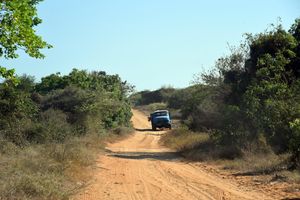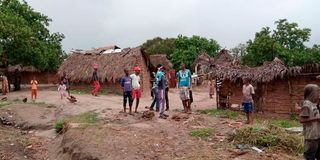
Kiangwe Village, one of the five villages inside Boni Forest in Lamu County.

The Boni minority community in Lamu County is demanding compensation for disrupted livelihoods due to the anti-terrorism operation in the area that has lasted for over a decade.
In September 2015, at the height of Al-Shabaab attacks in Lamu and along the Kenya-Somalia border, the government launched a multi-agency security operation in Boni Forest.
The operation was intended to flush out militants believed to be hiding in the dense forest. The government subsequently banned members of the Boni community from accessing the forest, citing security concerns.
Eleven years later, the operation, which has undergone various rebrandings and is now known as Operation Amani Boni (OAB), is still ongoing in the expansive forest and surrounding areas.
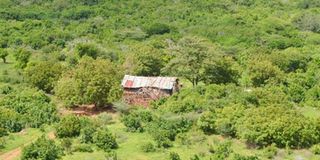
An aerial view of Boni Forest in Lamu County.
Speaking in Basuba on Sunday, Boni elders, leaders and residents said the security crackdown had severely disrupted their ancestral way of life, including traditional hunting, honey harvesting and fruit gathering.
Led by former Basuba Ward MCA Mohamed Delo, they argued that because the government approved and paid Sh1.76 billion in compensation to local fisherfolk whose traditional fishing grounds were affected by dredging for the Lamu Port, the Boni community also deserves compensation.
The government made a payout to more than 4,000 fishermen displaced to pave the way for the construction of the Sh310 billion Lamu Port under the Lamu Port-South Sudan-Ethiopia Transport (Lapsset) Corridor project after legal battles in court.
Mr Delo said the security operations had cut deeper than the effects of port dredging. He argued that their displacement from the forest warranted an equivalent and fair financial package, and called on President William Ruto to treat the matter as urgent.
The Boni, also known as the Aweer, are an indigenous forest community whose traditional livelihood involves hunting game, gathering fruits and plants, and harvesting wild honey.
“It’s exactly 11 years since the government banned the Boni community from accessing the forest. It’s widely known that since time immemorial, the Boni people depend entirely on the forest for livelihood,” said Mr Delo.
Mr Delo reiterated that they were not fighting the government but seeking justice as a community.
“Today, we can’t hunt, gather fruits or harvest wild honey since the forest is out of bounds. We, therefore, demand equal treatment to Lapsset fishermen,” said Mr Delo.
Mr Omar Bwana Barissa, an elder from Basuba Village inside Boni Forest, said the traditional hunters and gatherers had been rendered jobless. He added that the security operation had also affected the community’s cultural identity, religious practices and heritage.
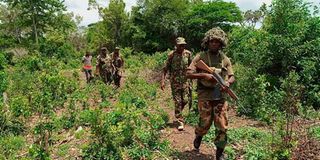
Security officers inside Boni Forest in Lamu.
“We are deeply tied to the ecosystem of the forest. We have our traditional shrines deep inside that forest. Unfortunately, we aren’t allowed to enter any more. This means accessing those shrines for prayers to our gods is now unheard of,” said Mr Barissa.
Ms Halima Musa, a resident of Mararani, said restrictions on access to the forest had forced the Boni community to turn to farming. However, she added that the transition to subsistence farming had not been successful because of the intense human-wildlife conflicts in their villages.
“You plant crops only for them to be destroyed by monkeys and other wildlife here. Compensation is our only saviour,” said Ms Musa.
Lamu County Commissioner Stephen Sangolo said the government had never received any direct complaints or proposals from the Boni community outlining their specific demands.
Mr Sangolo said the government was currently focused on restoring security and subsequently opening up the Boni region for development, including building schools, improving the transport network through road construction and providing other infrastructure.
He added that if the Boni community had specific proposals, it should come forward and present them for consideration at both national and county levels. He, however, dismissed claims that the Boni people had been completely banned from accessing the forest.
“These people already live in villages within Boni Forest. They’re actually residing inside the forest. The government only cautioned them from going deep inside the dense forest since one doesn’t actually know what awaits them inside there in terms of individual security. Caution shouldn’t be treated as denial. Yes, they can access a bit of the forest but not go deep inside it,” said Mr Sangolo.
The community believes that if compensated adequately, they will be able to change their lifestyle and no longer need to depend on the forest for their livelihood.
Follow our WhatsApp channel for breaking news updates and more stories like this.